
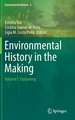
Environmental History in the Making: Volume II: Acting: Environmental History, cartea 7
Editat de Cristina Joanaz de Melo, Estelita Vaz, Lígia M. Costa Pintoen Limba Engleză Paperback – 7 iul 2018
Considering that political ideologies such as socialism and capitalism, as well as religion, fail to offer global paradigms for common ground, an environmentally positive discourse instead of an ecological determinism might serve as an umbrella common language to overcome blocking factors, real or invented, and avoid repeating ecological loss.
Therefore, agency, environmental speech and historical research are urgently neededin order to sustain environmental paradigms and overcome political, cultural an economic interests in the public arena.
This book intertwines reflections on our bonds with landscapes, processes of natural and scientific transfer across the globe, the changing of ecosystems, the way in which scientific knowledge has historically both accelerated destruction and allowed a better distribution of vital resources or as it, in today’s world, can offer alternatives that avoid harming those same vital natural resources: water, soil and air. In addition, it shows the relevance of cultural factors both in the taming of nature in favor of human comfort and in the role of the environment matters in the forging of cultural identities, which cannot be detached from technical intervention in the world.
In short, the book firstly studies the past, approaching it as a data set of how the environment has shaped culture, secondly seeks to understand the present, and thirdly assesses future perspectives: what to keep, what to change, and what to dream anew, considering that conventional solutions have not sufficed to protect life on our planet.
| Toate formatele și edițiile | Preț | Express |
|---|---|---|
| Paperback (2) | 911.34 lei 6-8 săpt. | |
| Springer International Publishing – 27 iun 2018 | 911.34 lei 6-8 săpt. | |
| Springer International Publishing – 7 iul 2018 | 912.25 lei 6-8 săpt. | |
| Hardback (2) | 917.09 lei 6-8 săpt. | |
| Springer International Publishing – 24 oct 2016 | 917.09 lei 6-8 săpt. | |
| Springer International Publishing – noi 2016 | 918.00 lei 6-8 săpt. |
Din seria Environmental History
-
 Preț: 92.19 lei
 - 15%
 Preț: 624.95 lei
 - 8%
 Preț: 401.89 lei
 - 18%
 Preț: 919.98 lei
 -
 Preț: 373.76 lei
 - 18%
 Preț: 1062.23 lei
 - 18%
 Preț: 912.55 lei
 - 18%
 Preț: 965.17 lei
 - 18%
 Preț: 920.45 lei
 - 15%
 Preț: 680.12 lei
 - 18%
 Preț: 922.24 lei
 - 15%
 Preț: 638.15 lei
 - 18%
 Preț: 965.00 lei
 - 18%
 Preț: 941.66 lei
 - 18%
 Preț: 917.09 lei
 - 24%
 Preț: 1025.21 lei
 -
 Preț: 92.45 lei
Preț: 912.25 lei
Preț vechi: 1112.50 lei
-18%
Puncte Express: 1368
Preț estimativ în valută:
161.23€ • 189.68$ • 140.74£
161.23€ • 189.68$ • 140.74£
Carte tipărită la comandă
Livrare economică 06-20 aprilie
Specificații
ISBN-13: 9783319822761
ISBN-10: 3319822764
Pagini: 376
Ilustrații: XIV, 376 p. 44 illus., 21 illus. in color.
Dimensiuni: 155 x 235 mm
Greutate: 0.55 kg
Ediția:Softcover reprint of the original 1st ed. 2017
Editura: Springer International Publishing
Colecția Springer
Seria Environmental History
Locul publicării:Cham, Switzerland
ISBN-10: 3319822764
Pagini: 376
Ilustrații: XIV, 376 p. 44 illus., 21 illus. in color.
Dimensiuni: 155 x 235 mm
Greutate: 0.55 kg
Ediția:Softcover reprint of the original 1st ed. 2017
Editura: Springer International Publishing
Colecția Springer
Seria Environmental History
Locul publicării:Cham, Switzerland
V-ar putea interesa
-
 The Reason WhyJohn GribbinPreț: 109.02 lei
 -
 Mathematical Population Genetics 1Warren J. Ewens-18%Preț: 1078.33 lei1315.04 lei
 -
 Computational Genome AnalysisRichard C Deonier-15%Preț: 578.63 lei680.74 lei
 -
 Moral OriginsChristopher BoehmPreț: 216.87 lei
 -
 Darwin's NotebookJonathan ClementsPreț: 104.74 lei
 -
 Programming of LifeDonald E. JohnsonPreț: 79.13 lei
 -
 Statistical Methods for Microarray Data Analysis: Methods and ProtocolsAndrei Y. Yakovlev-5%Preț: 693.91 lei730.42 lei
 -
 MetamorphosisFrank RyanPreț: 77.21 lei
 -
 Ethics in MedicineShabih H. Zaidi-5%Preț: 354.03 lei372.67 lei
 -
 -15%Preț: 618.03 lei727.08 lei
 -
 Preț: 213.06 lei
 -
 Preț: 415.14 lei
Cuprins
1. Using resources - stories of resources exploitation in time and its evolving in the long run).- 2. Transforming in sito – manipulating, changing, evolving landscapes, waterscapes, airscapes (classical approach of territorial changing, causes, actors and consequences).- 3. Transferring –migrations - resources exploitation and trade; local to global – native sources, new case studies tans-continental approaches.- 4. Conscience of loss, awareness of need, Improving – nowadays awareness of how we arrive here, undoing wrong territorial policies with environmental impact.- 5. Civic and political agency - history as memory of social process, knowing the past planning the future.
Textul de pe ultima copertă
This book is the product of the 2nd World Conference on Environmental History, held in Guimarães, Portugal, in 2014. It gathers works by authors from the five continents, addressing concerns raised by past events so as to provide information to help manage the present and the future. It reveals how our cultural background and examples of past territorial intervention can help to combat political and cultural limitations through the common language of environmental benefits without disguising harmful past human interventions.
Considering that political ideologies such as socialism and capitalism, as well as religion, fail to offer global paradigms for common ground, an environmentally positive discourse instead of an ecological determinism might serve as an umbrella common language to overcome blocking factors, real or invented, and avoid repeating ecological loss.
Therefore, agency, environmental speech and historical research are urgently needed in order tosustain environmental paradigms and overcome political, cultural an economic interests in the public arena.
This book intertwines reflections on our bonds with landscapes, processes of natural and scientific transfer across the globe, the changing of ecosystems, the way in which scientific knowledge has historically both accelerated destruction and allowed a better distribution of vital resources or as it, in today’s world, can offer alternatives that avoid harming those same vital natural resources: water, soil and air. In addition, it shows the relevance of cultural factors both in the taming of nature in favor of human comfort and in the role of the environment matters in the forging of cultural identities, which cannot be detached from technical intervention in the world.
In short, the book firstly studies the past, approaching it as a data set of how the environment has shaped culture, secondly seeks to understand the present, and thirdly assesses future perspectives: what to keep, what to change, and what to dream anew, considering that conventional solutions have not sufficed to protect life on our planet.
Considering that political ideologies such as socialism and capitalism, as well as religion, fail to offer global paradigms for common ground, an environmentally positive discourse instead of an ecological determinism might serve as an umbrella common language to overcome blocking factors, real or invented, and avoid repeating ecological loss.
Therefore, agency, environmental speech and historical research are urgently needed in order tosustain environmental paradigms and overcome political, cultural an economic interests in the public arena.
This book intertwines reflections on our bonds with landscapes, processes of natural and scientific transfer across the globe, the changing of ecosystems, the way in which scientific knowledge has historically both accelerated destruction and allowed a better distribution of vital resources or as it, in today’s world, can offer alternatives that avoid harming those same vital natural resources: water, soil and air. In addition, it shows the relevance of cultural factors both in the taming of nature in favor of human comfort and in the role of the environment matters in the forging of cultural identities, which cannot be detached from technical intervention in the world.
In short, the book firstly studies the past, approaching it as a data set of how the environment has shaped culture, secondly seeks to understand the present, and thirdly assesses future perspectives: what to keep, what to change, and what to dream anew, considering that conventional solutions have not sufficed to protect life on our planet.
Caracteristici
A major reference in scientific research The most updated academic outcome of experts on environmental history Studies the past, seeks to understand the present and assesses future perspectives