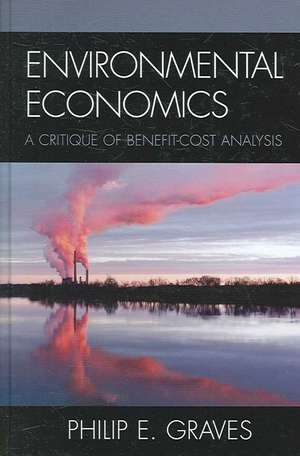
Environmental Economics: A Critique of Benefit-Cost Analysis
Autor Philip E. Gravesen Limba Engleză Hardback – 9 apr 2007
Preț: 594.87 lei
Preț vechi: 869.57 lei
-32%
Puncte Express: 892
Carte tipărită la comandă
Livrare economică 24 noiembrie-08 decembrie
Livrare prin curier în România Termenul estimat este afișat lângă disponibilitate.
Transport gratuit pentru acest produs Plată online sau ramburs, în funcție de opțiunile comenzii.
Retur gratuit în 14 zile Comandă securizată și suport în română.
Specificații
ISBN-13: 9780742546981
ISBN-10: 0742546985
Pagini: 187
Dimensiuni: 161 x 238 x 20 mm
Greutate: 0.42 kg
Editura: Bloomsbury Publishing
Colecția Rowman & Littlefield
Locul publicării:New York, United States
ISBN-10: 0742546985
Pagini: 187
Dimensiuni: 161 x 238 x 20 mm
Greutate: 0.42 kg
Editura: Bloomsbury Publishing
Colecția Rowman & Littlefield
Locul publicării:New York, United States
V-ar putea interesa
-
 The Green Collar EconomyVan JonesPreț: 88.32 lei
 -
 The Plundered PlanetPaul Collier-19%Preț: 62.93 lei77.79 lei
 -
 Preț: 394.21 lei
 -
 Plundered Nations?Paul Collier-15%Preț: 487.18 lei573.15 lei
 -
 A Rough Ride to the FutureJames LovelockPreț: 77.15 lei
 -
 The Green to Gold Business PlaybookDaniel C. EstyPreț: 279.14 lei
 -
 Smart Solutions to Climate ChangeBjørn LomborgPreț: 313.95 lei
 -
 Pricing CarbonA. Denny Ellerman-11%Preț: 446.31 lei501.46 lei
 -
 Sustainable Development in PracticeMohan Munasinghe-25%Preț: 440.73 lei589.10 lei
 -
 The Unified Neutral Theory of Biodiversity and BiogeographyStephen P. Hubbell-19%Preț: 613.53 lei757.44 lei
 -
 Consumption and Its ConsequencesDaniel MillerPreț: 148.04 lei
 -
 Oil and HoneyBill McKibbenPreț: 113.11 lei
 -
 Modeling Dynamic Economic SystemsMatthias Ruth-15%Preț: 613.69 lei721.99 lei
 -
 Energy, Environment and DevelopmentJose GoldembergPreț: 441.89 lei
 -
 Preț: 288.59 lei
 -
 An Introduction to Climate Change Economics and PolicyFelix R. Fitzroy-21%Preț: 198.21 lei250.18 lei
 -
 Green PhilosophyRoger Scruton-18%Preț: 90.13 lei109.55 lei
 -
 -27%Preț: 78.12 lei107.16 lei
 -
 Economics UnmaskedManfred Max-Neef-40%Preț: 76.19 lei127.59 lei
 -
 WastenomicsKenny TangPreț: 356.82 lei
Cuprins
Part 1 Part I: Economics Background-Why Economists Like Benefit-Cost Analysis
Chapter 2 1 Introductory Matters of Logic and Philosophy
Chapter 3 2 Why Economists Like Market Outcomes for Ordinary Goods
Chapter 4 3 Benefit-Cost Analysis when Information Is "Perfect": The Role of Time in Environmental Economic Decisions
Part 5 Part II: "Missing Markets": Externalities, Public Goods, and Property Rights
Chapter 6 4 Externalities as "Missing Markets"
Chapter 7 5 Public Goods as "Missing Markets"
Chapter 8 6 Property Rights as a Potential Solution to Environmental Problems
Part 9 Part III: Important Theoretical Problems with Implementing Benefit-Cost Analysis
Chapter 10 7 The Well-Known "Demand Revelation" Problem Out of a Given Income
Chapter 11 8 A Less-Well-Known "Supply Revelation" Problem
Part 12 Part IV: Practical Problems with the Implementation of Benefit-Cost Analysis
Chapter 13 9 Approaches to Estimating the Costs of Environmental Control Policies
Chapter 14 10 Overview of Approaches to the Valuation of Benefits of Environmental Policies
Chapter 15 11 Voting as a Way to Infer Environmental Benefits
Chapter 16 12 Constructed Markets: Stated Preferences and Experiments to Infer Environmental Benefits
Chapter 17 13 The Sum of Specific Damages Approach
Chapter 18 14 Hedonic Methods of Valuing Environmental Amenities
Chapter 19 15 Travel Cost Method of Valuing Environmental Amenities
Chapter 20 16 Political and Jurisdictional Problems
Part 21 Epilogue
Chapter 2 1 Introductory Matters of Logic and Philosophy
Chapter 3 2 Why Economists Like Market Outcomes for Ordinary Goods
Chapter 4 3 Benefit-Cost Analysis when Information Is "Perfect": The Role of Time in Environmental Economic Decisions
Part 5 Part II: "Missing Markets": Externalities, Public Goods, and Property Rights
Chapter 6 4 Externalities as "Missing Markets"
Chapter 7 5 Public Goods as "Missing Markets"
Chapter 8 6 Property Rights as a Potential Solution to Environmental Problems
Part 9 Part III: Important Theoretical Problems with Implementing Benefit-Cost Analysis
Chapter 10 7 The Well-Known "Demand Revelation" Problem Out of a Given Income
Chapter 11 8 A Less-Well-Known "Supply Revelation" Problem
Part 12 Part IV: Practical Problems with the Implementation of Benefit-Cost Analysis
Chapter 13 9 Approaches to Estimating the Costs of Environmental Control Policies
Chapter 14 10 Overview of Approaches to the Valuation of Benefits of Environmental Policies
Chapter 15 11 Voting as a Way to Infer Environmental Benefits
Chapter 16 12 Constructed Markets: Stated Preferences and Experiments to Infer Environmental Benefits
Chapter 17 13 The Sum of Specific Damages Approach
Chapter 18 14 Hedonic Methods of Valuing Environmental Amenities
Chapter 19 15 Travel Cost Method of Valuing Environmental Amenities
Chapter 20 16 Political and Jurisdictional Problems
Part 21 Epilogue
Recenzii
Graves' economics book takes a critical look at the benefit-cost analysis of environmental issues. This well-written, teaching-style book has excellent coverage of the applicable theory and methodology, and serves as a good primer for advanced undergraduates and practitioners with some economics background.
Philip Graves provides a lucid account of contemporary environmental economics that is not only interesting but also goes beyond the conventional wisdom on the subject. Therefore, both beginning students and seasoned researchers in the field will find this book to be of considerable value.
Philip Graves provides a lucid account of contemporary environmental economics that is not only interesting but also goes beyond the conventional wisdom on the subject. Therefore, both beginning students and seasoned researchers in the field will find this book to be of considerable value.