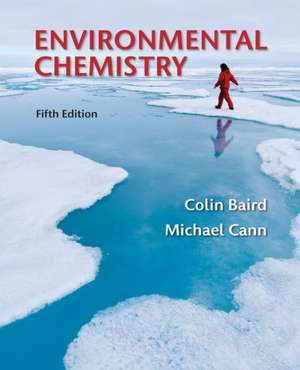
Environmental Chemistry
Autor Colin Baird, Michael Cannen Limba Engleză Hardback – 23 mar 2012
Cea de-a cincea ediție a lucrării Environmental Chemistry aduce o actualizare substanțială a conținutului academic, adaptându-l la provocările climatice și tehnologice ale deceniului curent. Considerăm că elementul de noutate cel mai relevant pentru curriculumul de chimie de mediu este integrarea extinsă a conceptelor de „chimie verde”, susținută de noi studii de caz practice, cum ar fi dezvoltarea tonerelor pe bază biologică sau utilizarea agenților de coalescență reactivi pentru reducerea compușilor organici volatili în vopsele. Structura volumului urmărește o progresie logică, de la chimia atmosferei și problema stratului de ozon (Partea I), către o analiză detaliată a energiei și schimbărilor climatice (Partea II), continuând cu chimia apei și a solului. Această ediție acoperă aceeași arie tematică precum Environmental Chemistry in Society de James M. Beard, dar cu o abordare mult mai axată pe procesele chimice riguroase și pe soluții industriale de atenuare a poluării, spre deosebire de accentul pus de Beard pe politici sociale și toxicologie. De asemenea, față de Introductory Chemistry for the Environmental Sciences, lucrarea lui Colin Baird și Michael Cann oferă o perspectivă mai aplicată, facilitată de noile diagrame schematice menite să clarifice reacțiile complexe. Recomandăm acest manual pentru rigoarea cu care tratează echilibrul dintre producția chimică și impactul asupra mediului. Introducerea activităților de cercetare (mini-proiecte) în fiecare capitol transformă lectura dintr-un proces pasiv într-unul interactiv, oferind studenților instrumentele necesare pentru a analiza critic datele despre calitatea aerului și emisiile de gaze cu efect de seră la nivel global.
Preț: 1685.12 lei
Preț vechi: 2055.03 lei
-18%
Carte disponibilă
Livrare economică 10-24 noiembrie
Specificații
ISBN-10: 1429277041
Pagini: 852
Dimensiuni: 192 x 244 x 38 mm
Greutate: 1.41 kg
Ediția:5th edition
Editura: W. H. Freeman
V-ar putea interesa
-
 QbismHans Christian Von BaeyerPreț: 280.95 lei
 -
 After PhysicsDavid Z AlbertPreț: 224.75 lei
 -
 Solutions Manual for Environmental ChemistryColin Baird-41%Preț: 339.77 lei572.15 lei
 -
 Experience ScotlandMike MaceacheranPreț: 127.77 lei
 -
 Traité de Chimie Élémentaire. Tome 2Louis-Jacques ThénardPreț: 337.52 lei
 -
 Traité de chimie élémentaire. Tome 3Louis-Jacques ThénardPreț: 284.80 lei
 -
 Traité de chimie élémentaire. Tome 4Louis-Jacques ThénardPreț: 223.53 lei
 -
 Traité de chimie élémentaire. Tome 1Louis-Jacques ThénardPreț: 270.12 lei
 -
 Preț: 184.19 lei
 -
 Élémens de chimie. Tome 2Jean-Antoine ChaptalPreț: 215.30 lei
 -
 Preț: 117.06 lei
 -
 Dix années dans l''histoire d''une théorie 2ème éd. de La chimie dans l''espaceJacobus Henricus Van't HoffPreț: 102.59 lei
 -
 Les caoutchoucs africains .DewèvrePreț: 101.17 lei
 -
 Preț: 146.48 lei
 -
 Preț: 124.22 lei
 -
 Expériences sur l'écoulement des gaz en longues conduitesCharles MonardPreț: 80.31 lei
 -
 -15%Preț: 613.00 lei721.18 lei
 -
 Chemoreception in the Carotid BodyH. Acker-15%Preț: 618.64 lei727.80 lei
 -
 -15%Preț: 612.38 lei720.45 lei
 -
 Excluded Volume Effects in Polymer SolutionsLothar Schäfer-18%Preț: 744.41 lei907.81 lei
 -
 -15%Preț: 627.93 lei738.74 lei
 -
 Chemical Structures 2Wendy A. Warr-15%Preț: 655.08 lei770.67 lei
 -
 From CA to CAS onlineHedda Schulz-15%Preț: 645.56 lei759.48 lei
 -
 Industrial Information and Design IssuesJacques-Emile Dubois-15%Preț: 644.73 lei758.51 lei
 -
 Affective Dimensions in Chemistry EducationMurat Kahveci-15%Preț: 645.56 lei759.48 lei
 -
 Introduction to instrumental AnalysisRobert D Braun-13%Preț: 1217.36 lei1399.27 lei
De ce să citești această carte
Recomandăm această ediție studenților și specialiștilor care doresc o înțelegere profundă a mecanismelor chimice din spatele încălzirii globale și poluării. Cititorul câștigă acces la studii de caz moderne despre chimia verde și energie alternativă, beneficiind de o structură pedagogică ce include activități practice și diagrame clare. Este o resursă esențială pentru cei care vor să înțeleagă cum poate chimia să ofere soluții sustenabile pentru viitor.
Despre autor
Colin Baird și Michael Cann sunt cadre didactice și cercetători recunoscuți pentru capacitatea lor de a face chimia de mediu accesibilă fără a sacrifica rigoarea științifică. Colin Baird este cunoscut pentru manualele sale care pun accent pe claritatea explicațiilor în chimie anorganică și de mediu. Michael Cann a fost un pionier în promovarea „chimiei verzi” în curriculumul universitar, efort reflectat în numeroasele studii de caz și secțiuni dedicate sustenabilității din această lucrare. Deși există referințe spre alte titluri sub numele lor, în contextul academic, aceștia rămân voci autoritare în literatura de specialitate dedicată științelor mediului.
Descriere scurtă
Cuprins
Descriere
Colin Baird and Michael Cann's acclaimed Environmental Chemistry helps students explore the chemical processes and properties underlying environmental issues they hear about every day - climate change, pollution, biofuels, sustainability and more. Like no other textbook of its kind, it makes accessible the many ways chemists are tackling fundamental environmental problems – including those for which the chemical industry itself is a source.
With up-to-date, balanced, and authoritative coverage of soil, water, and air chemistry, the new edition again focuses on the environmental impacts of chemical production and experimentation, offering additional "green chemistry" sections and new case studies.
Updates include:
• Expanded coverage of energy production (especially biofuels), the generation and disposal of CO2, and innovative ways to combat climate change.
• Increased international coverage to give all students a better perspective on environmental problems and solutions around the world – for example, there is increased coverage of gaseous and particulate air pollution and CO2 emissions and air quality standards in different countries, both developed and developing ones.
• Updated Green Chemistry cases, including new cases on the development of bio-based toners; recycling carbon dioxide; a non-volatile, reactive coalescent for the reduction of VOCs in latex paints; bio-based liquid fuels and chemicals; and
spinetoram, an improvement on a green pesticide.
• An Activity has been inserted into each chapter – these web- or library-based mini-projects could be assigned to individual students or to a group of them to accomplish and report on.
• More schematic diagrams have been added to promote student comprehension of the more complicated chemistry and appeal to a variety of learning styles.
• Marginal notes – to supplement the main text with additional interesting material, and to indicate which Review Questions are relevant to the material at hand.
Notă biografică
MICHAEL CANN University of Scranton, USA.
Caracteristici noi
Green Chemistry coverage expanded
- With several new and updated Green Chemistry cases, for example:
- Reduction of VOCs (Volatile Organic Compounds) in paints and coatings
- Using waste carbon dioxide as a feedstock for the production of chemicals and liquid fuels
- Spinetoram, an improvement on a green pesticide
- Toners for copy machines produced from bio-based materials
- The production of liquid fuels and chemicals from biomass
Increased international coverage
- More examples and data from countries outside North America are used to show how the chemistry and techniques are being applied to real world problems.
- Chinais now especiallyhighlighted in many places.
- Afew topics of interest mainly in developing countries - such as the new wood stoves - have also been added.
New 'Activities' feature
- An Activity has been inserted into each chapter; these could be assigned to individual students or to a group to accomplish and report on.
MORE USER-FRIENDLY TEXT STRUCTURE
- 'Water Chemistry and Water Pollution' is now covered before 'Toxic Organic Compounds' so that Water Chemistry is being covered earlier and falls in line with preferred teaching sequences. This also means that the Organic material is covered later and can be eliminated depending on the module's depth and students' background.
- Detailed mathematical material repositioned to the end of chapters in many cases, so coverage does not appear to be mandatory or interrupt the flow of the main text.
- More hints and background on the more difficult in-text and Additional Problems
- New Marginal notes add interesting points to the main text material, indicate which Review Questions and Additional Problems are relevant to the material at hand, help recall the reactions being discussed, and show miscellaneous structures, etc.
- Streamlined by moving the Organic Chemistry appendix to the website, and by removing the Scientific American Readings as well as the Additional Reading lists at the end of chapters, as these became out-of-date too quickly
- Other layout improvements for readability
- Text broken into smaller subsections and shorter paragraphs, to help understanding
- Italicized text emphasizes the most important statements, including conclusions, and summaries within subsections
- Greater use of bullets, for points most readily covered in a list or sequence
- Subsection numbering, allows lecturers to assign material to be covered/skipped more easily