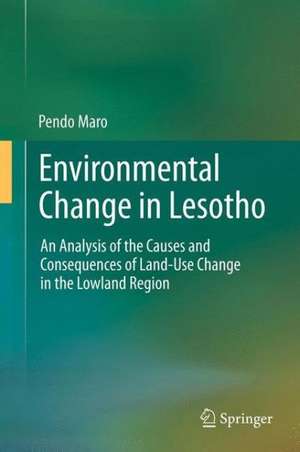
Environmental Change in Lesotho
Autor Pendo Maroen Limba Engleză Hardback – 20 aug 2011
Preț: 664.39 lei
Preț vechi: 781.64 lei
-15%
Puncte Express: 997
Carte tipărită la comandă
Livrare economică 23 noiembrie-07 decembrie
Livrare prin curier în România Termenul estimat este afișat lângă disponibilitate.
Transport gratuit pentru acest produs Plată online sau ramburs, în funcție de opțiunile comenzii.
Retur gratuit în 14 zile Comandă securizată și suport în română.
Specificații
ISBN-13: 9789400718807
ISBN-10: 9400718802
Pagini: 204
Ilustrații: X, 192 p.
Dimensiuni: 160 x 241 x 16 mm
Greutate: 0.43 kg
Ediția:2011
Editura: Springer
Locul publicării:Dordrecht, Netherlands
ISBN-10: 9400718802
Pagini: 204
Ilustrații: X, 192 p.
Dimensiuni: 160 x 241 x 16 mm
Greutate: 0.43 kg
Ediția:2011
Editura: Springer
Locul publicării:Dordrecht, Netherlands
V-ar putea interesa
-
 Governing Knowledge CommonsBrett M. Frischmann-28%Preț: 430.29 lei596.90 lei
 -
 Water Law in India: An Introduction to Legal InstrumentsPhilippe Cullet-18%Preț: 274.56 lei333.24 lei
 -
 Environmental Principles: From Political Slogans to Legal RulesNicolas de Sadeleer-19%Preț: 418.98 lei517.26 lei
 -
 EU Environmental Law and the Internal MarketNicolas de Sadeleer-14%Preț: 911.69 lei1060.11 lei
 -
 European Perspectives on Environmental Law and GovernanceSuzanne Kingston-18%Preț: 1255.87 lei1531.54 lei
 -
 Environmental and Energy LawKE Makuch-27%Preț: 700.15 lei959.12 lei
 -
 Environmental Law and Governance for the AnthropoceneProfessor Louis Kotzé-32%Preț: 661.16 lei976.82 lei
 -
 Better Air: Benefits & Costs of the Clean Air ActJessica Lincoln-Oswalt-27%Preț: 1578.79 lei2151.92 lei
 -
 Emissions Control in Electricity GenerationJackson L Walker-27%Preț: 888.02 lei1210.01 lei
 -
 Wildfire Suppression: Federal Funding & SpendingNeal Jenkins-27%Preț: 1022.57 lei1395.15 lei
 -
 Indigenous Peoples, Consent and Benefit SharingRachel WynbergPreț: 417.50 lei
Public țintă
GraduateCuprins
Introduction.- The Wealth of Knowledge: Drivers and Consequences of Land-Use Change.- Lesotho: Macro to Micro Perspectives of Land-Use Change.- Village Perceptions of Land-Use Change.-Village Patterns of Land-Use Change.- Discussing Causes and Consequences of Land-Use Change in the Lowland Region.- Conclusions: So What?.- Index.
Textul de pe ultima copertă
The aim of this book is to identify and analyze the drivers of land-use change and the consequences of these changes on the livelihoods of rural land-users/managers. To accomplish this, a combination of tools from the social sciences and environmental fields were developed to identify causes and consequences of land-use change at selected levels, using a ‘nested’ approach. These methods were then applied to a case study of villages in Maseru and Mohale’s Hoek districts in the Lowland region of Lesotho.
Based on the research findings, key proximate drivers of land-use change in the Lowland villages were established. These were drought, lack of water, land mismanagement, HIV/AIDS and ‘dependency syndrome’. These were acted on by underlying and other drivers to bring about major changes in land-use. The book offers an understanding of the actions of local land-users and managers, and their responses to biophysical, social-political, environmental, HIV/AIDS and other stresses, giving an insight into a household’s decision-making behaviour, degree of vulnerability and hence their resilience and adaptive capabilities and mechanisms.
This book is directed at the wide scientific and non-scientific audience including environmental and social science experts, researchers, decision-makers, and development/aid workers interested in understanding the intricate human-environment relationship as it relates to land-use change in a changing biophysical, socio-economic, political and institutional context, coupled by HIV/AIDS, changing demographics, local perceptions and what is termed here ‘dependency syndrome’.
Based on the research findings, key proximate drivers of land-use change in the Lowland villages were established. These were drought, lack of water, land mismanagement, HIV/AIDS and ‘dependency syndrome’. These were acted on by underlying and other drivers to bring about major changes in land-use. The book offers an understanding of the actions of local land-users and managers, and their responses to biophysical, social-political, environmental, HIV/AIDS and other stresses, giving an insight into a household’s decision-making behaviour, degree of vulnerability and hence their resilience and adaptive capabilities and mechanisms.
This book is directed at the wide scientific and non-scientific audience including environmental and social science experts, researchers, decision-makers, and development/aid workers interested in understanding the intricate human-environment relationship as it relates to land-use change in a changing biophysical, socio-economic, political and institutional context, coupled by HIV/AIDS, changing demographics, local perceptions and what is termed here ‘dependency syndrome’.
Caracteristici
This Lesotho case study discusses HIV/AIDS and ‘dependency syndrome’ in the context of human geography Contributes policy-relevant knowledge for decision-making on sustainable land use Challenges some commonly-held myths about land-use change