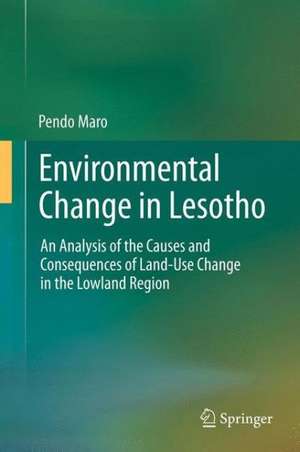
Environmental Change in Lesotho
Autor Pendo Maroen Limba Engleză Hardback – 20 aug 2011
Preț: 620.13 lei
Preț vechi: 729.57 lei
-15%
Puncte Express: 930
Carte tipărită la comandă
Livrare economică 01-15 iunie
Specificații
ISBN-13: 9789400718807
ISBN-10: 9400718802
Pagini: 204
Ilustrații: X, 192 p.
Dimensiuni: 160 x 241 x 16 mm
Greutate: 0.48 kg
Ediția:2011
Editura: Springer
Locul publicării:Dordrecht, Netherlands
ISBN-10: 9400718802
Pagini: 204
Ilustrații: X, 192 p.
Dimensiuni: 160 x 241 x 16 mm
Greutate: 0.48 kg
Ediția:2011
Editura: Springer
Locul publicării:Dordrecht, Netherlands
V-ar putea interesa
-
 Governing Knowledge CommonsBrett M. Frischmann-30%Preț: 393.43 lei563.88 lei
 -
 Water Law in India: An Introduction to Legal InstrumentsPhilippe Cullet-18%Preț: 274.56 lei333.24 lei
 -
 Environmental Principles: From Political Slogans to Legal RulesNicolas de Sadeleer-19%Preț: 418.98 lei517.26 lei
 -
 EU Environmental Law and the Internal MarketNicolas de Sadeleer-33%Preț: 822.90 lei1234.00 lei
 -
 European Perspectives on Environmental Law and GovernanceSuzanne Kingston-18%Preț: 1199.89 lei1463.28 lei
 -
 Environmental and Energy LawKE Makuch-27%Preț: 700.15 lei959.12 lei
 -
 Environmental Law and Governance for the AnthropoceneProfessor Louis Kotzé-33%Preț: 619.98 lei931.63 lei
 -
 Better Air: Benefits & Costs of the Clean Air ActJessica Lincoln-Oswalt-30%Preț: 1448.36 lei2078.45 lei
 -
 Emissions Control in Electricity GenerationJackson L Walker-30%Preț: 814.92 lei1168.79 lei
 -
 Wildfire Suppression: Federal Funding & SpendingNeal Jenkins-26%Preț: 1001.79 lei1347.58 lei
 -
 Indigenous Peoples, Consent and Benefit SharingRachel WynbergPreț: 417.50 lei
Public țintă
GraduateCuprins
Introduction.- The Wealth of Knowledge: Drivers and Consequences of Land-Use Change.- Lesotho: Macro to Micro Perspectives of Land-Use Change.- Village Perceptions of Land-Use Change.-Village Patterns of Land-Use Change.- Discussing Causes and Consequences of Land-Use Change in the Lowland Region.- Conclusions: So What?.- Index.
Textul de pe ultima copertă
The aim of this book is to identify and analyze the drivers of land-use change and the consequences of these changes on the livelihoods of rural land-users/managers. To accomplish this, a combination of tools from the social sciences and environmental fields were developed to identify causes and consequences of land-use change at selected levels, using a ‘nested’ approach. These methods were then applied to a case study of villages in Maseru and Mohale’s Hoek districts in the Lowland region of Lesotho.
Based on the research findings, key proximate drivers of land-use change in the Lowland villages were established. These were drought, lack of water, land mismanagement, HIV/AIDS and ‘dependency syndrome’. These were acted on by underlying and other drivers to bring about major changes in land-use. The book offers an understanding of the actions of local land-users and managers, and their responses to biophysical, social-political, environmental, HIV/AIDS and other stresses, giving an insight into a household’s decision-making behaviour, degree of vulnerability and hence their resilience and adaptive capabilities and mechanisms.
This book is directed at the wide scientific and non-scientific audience including environmental and social science experts, researchers, decision-makers, and development/aid workers interested in understanding the intricate human-environment relationship as it relates to land-use change in a changing biophysical, socio-economic, political and institutional context, coupled by HIV/AIDS, changing demographics, local perceptions and what is termed here ‘dependency syndrome’.
Based on the research findings, key proximate drivers of land-use change in the Lowland villages were established. These were drought, lack of water, land mismanagement, HIV/AIDS and ‘dependency syndrome’. These were acted on by underlying and other drivers to bring about major changes in land-use. The book offers an understanding of the actions of local land-users and managers, and their responses to biophysical, social-political, environmental, HIV/AIDS and other stresses, giving an insight into a household’s decision-making behaviour, degree of vulnerability and hence their resilience and adaptive capabilities and mechanisms.
This book is directed at the wide scientific and non-scientific audience including environmental and social science experts, researchers, decision-makers, and development/aid workers interested in understanding the intricate human-environment relationship as it relates to land-use change in a changing biophysical, socio-economic, political and institutional context, coupled by HIV/AIDS, changing demographics, local perceptions and what is termed here ‘dependency syndrome’.
Caracteristici
This Lesotho case study discusses HIV/AIDS and ‘dependency syndrome’ in the context of human geography Contributes policy-relevant knowledge for decision-making on sustainable land use Challenges some commonly-held myths about land-use change