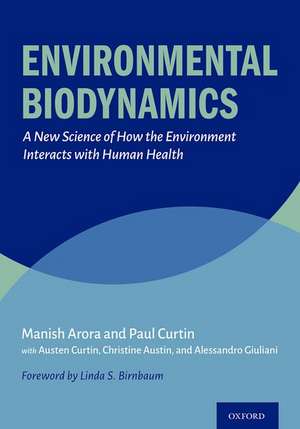
Environmental Biodynamics: A New Science of How the Environment Interacts with Human Health
Autor Manish Arora, Paul Curtin Cu Austen Curtin, Christine Austin, Alessandro Giuliani Cuvânt înainte de Linda S. Birnbaumen Limba Engleză Hardback – 24 mar 2022
successfully predicted the dynamic behavior between these complex systems in real time. Environmental Biodynamics offers a daring new inquiry into our environment and its impact on human health. Moving beyond a reductionist view of human physiology and the environment, this volume proposes a fundamental shift in environmental health science from quantifying structural relationships,
such as static measures of environmental factors or momentary health indicators, to studying functional interdependencies in time. Across six chapters, the authors weave together the latest research from biology, environmental science, theoretical physics, mathematics, and philosophy to explore
their Biodynamic Interface Theory, which states that complex systems connect primarily through a dynamic, operationally independent interface that regulates the bidirectional interactions between systems over time. Later chapters compare the proposed theory against current practice and provide
suggestions for further methods of data collection and computational analysis. Supported by vivid full-color diagrams and a wealth of original data, Environmental Biodynamics is an accessible theoretical guide to this promising new field of environmental health
Preț: 435.13 lei
Preț vechi: 580.25 lei
-25%
Carte disponibilă
Livrare economică 12-18 noiembrie
Specificații
ISBN-10: 019758294X
Pagini: 160
Ilustrații: 32 full color illustrations
Dimensiuni: 267 x 188 x 20 mm
Greutate: 0.52 kg
Editura: Oxford University Press
Colecția OUP USA
Locul publicării:New York, United States
V-ar putea interesa
-
 Introduction to Environmental ScienceMalcolm Cresser-15%Preț: 648.03 lei762.39 lei
 -
 Systems Biology: A Very Short IntroductionEberhard O. Voit-20%Preț: 56.65 lei70.82 lei
 -
 Ecology: A Very Short IntroductionJaboury Ghazoul-20%Preț: 57.15 lei71.12 lei
 -
 -29%Preț: 299.36 lei420.66 lei
 -
 -13%Preț: 131.16 lei151.45 lei
 -
 Preț: 348.44 lei
 -
 The Web of LifeFritjof CapraPreț: 98.49 lei
 -
 AdaptableHerman PontzerPreț: 193.37 lei
 -
 Life in SyncPhilippa GanderPreț: 128.57 lei
 -
 Air-BorneCarl Zimmer-34%Preț: 82.42 lei125.70 lei
 -
 Immune to Age: The game-changing science of lifetime healthDr Jenna Macciochi-26%Preț: 99.82 lei135.33 lei
 -
 Preț: 155.31 lei
 -
 Environmentor Rolf Halden-32%Preț: 52.49 lei76.72 lei
 -
 Advances in Environmental Research: Volume 18Justin A Daniels-26%Preț: 730.58 lei992.26 lei
 -
 Nature and the MindMarc BermanPreț: 122.36 lei
 -
 Documents in International Environmental LawMaria Gavouneli-17%Preț: 380.54 lei457.66 lei
 -
 The Other Side of ChangeMaya ShankarPreț: 122.07 lei
 -
 Human NatureKate MarvelPreț: 136.91 lei
 -
 -19%Preț: 128.78 lei158.33 leiRecomandat
 -
 -22%Preț: 311.22 lei399.49 leiRecomandat
Descriere
Is there a central scientific theory governing how human physiology interacts with the environment?
Our environment exerts a profound effect on our health and well-being. Yet, the rules guiding such interaction between individual human physiology and the environment remain elusive. While various disciplines have emerged studying components and base interactions of each system, no method has
successfully predicted the dynamic behavior between these complex systems in real time.
Environmental Biodynamics offers a daring new inquiry into our environment and its impact on human health. Moving beyond a reductionist view of human physiology and the environment, this volume proposes a fundamental shift in environmental health science from quantifying structural relationships,
such as static measures of environmental factors or momentary health indicators, to studying functional interdependencies in time. Across six chapters, the authors weave together the latest research from biology, environmental science, theoretical physics, mathematics, and philosophy to explore
their Biodynamic Interface Theory, which states that complex systems connect primarily through a dynamic, operationally independent interface that regulates the bidirectional interactions between systems over time. Later chapters compare the proposed theory against current practice and provide
suggestions for further methods of data collection and computational analysis. Supported by vivid full-color diagrams and a wealth of original data, Environmental Biodynamics is an accessible theoretical guide to this promising new field of environmental health
Recenzii
Drawing upon concepts from diverse fields such as physics and systems theory, Environmental Biodynamics offers an ambitious proposal to shift the paradigm of environmental health research, arguing that incorporating a biodynamic approach will allow researchers to develop better, and more useful, explanations of the complex relationships that hold between environmental chemical exposures and human health. This approach has the potential to rescue researchers from the 'ocean of correlations' that such studies usually generate and the constraints that current reductionistic methods place on scientific inference.
This is a book full of fearless ideas that hopes to bring about an advance in the way we understand our relationship with our environment and how it impacts human health.
Notă biografică
Manish Arora is the Edith J Baerwald Professor and Vice Chair of Environmental Medicine and Public Health at the Mount Sinai School of Medicine in New York where he directs a program at the intersection of exposure sciences, environmental epidemiology, and public health to study the environmental determinants of health and disease. Along with Drs. Alessandro Giuliani and Paul Curtin, he is credited with postulating the Biodynamic InterfaceConjecture, a theoretical framework to study complex system interactions through the lens of temporal dynamics. In 2015, he was recognized with the Presidential Early Career Award for Scientists and Engineers by President Barack Obama, the highest award that the United States confers on early career scientists. Paul Curtin, is Assistant Professor of Environmental Medicine and Public Health at the Mount Sinai School of Medicine in New York. Dr. Curtin's work focuses on the interface of Systems Biology, Computational Neuroscience, and Exposure Biology.He is an author of several dozen papers in these and related fields, and leads nationally-funded projects focusing on the role of environmental factors in neurodevelopment. With co-authors and collaborators on Environmental Biodynamics, he has contributed to the development of the Biodynamic Interface Conjecture and related theoretical perspectives dealing with the interactions of complex systems. Austen Curtin is a computational biologist and data scientist in the department of Environmental Medicine and Public Health at the Mount Sinai School of Medicine in New York. Her work focuses on the integration of dynamical computational methods in contexts relating to exposure biology and neurodevelopment. She has contributed to many peer-reviewed papers in these fields and continues to work on methodological advances in these domains. Christine Austin is Assistant Professor in the Department of Environmental Medicine and Public Health at Mount Sinai School of Medicine in New York.She received her PhD from the University of Technology, Sydney, Australia in 2011, specializing in elemental bioimaging of tissues using laser ablation-inductively coupled plasma-mass spectrometry. She completed postdoctoral training at the University of Sydney, Australia and the Icahn School of Medicine at Mount Sinai, USA. Dr. Austin's research focus is developing novel analytical techniques to reconstruct histories of environmental exposures throughout life, including the prenatal and earlychildhood periods. Alessandro Giuliani is Senior Scientist at the Istituto Superiore di Sanità (Italian NIH). He is involved mainly in the generation and testing of soft physical and statistical models for life sciences, with a special emphasis on the elucidation of mesoscopic complex systems like network approach to protein structure/function, quantitative structure/activity relations in medicinal chemistry, analysis of physiological time series, and biophysical approaches to geneexpressionregulation. He is the author of many publications on a wide spectrum of research fields and has a solid teaching experience in applied statistics and research methodology. Linda S. Birnbaum is Scientist Emeritus and Former Director of the National Institute of Environmental Health Sciences and National Toxicology Program. She is also Scholar in Residence at the Nicholas School of the Environment at Duke University.
Cuprins
- Foreword by Linda S. Birnbaum
- Preface
- Chapter 1: Introduction to Environmental Biodynamics
- Chapter 2: The Lens of "Thingness": Structuralism, Reductionism and Simplicity
- Chapter 3: The Shape of Change: Complexity, Organization, and Chaos
- Chapter 4: The Process of Interdependence: Temporal Dynamics of Biodynamic Interfaces
- Chapter 5: The Geometry of Health: Patterns, Structures, Forms, and Constraints
- Chapter 6: The Layers of Life: Emergent Complexity and Self-Organization
- Appendix: Operationalizing Environmental Biodynamics