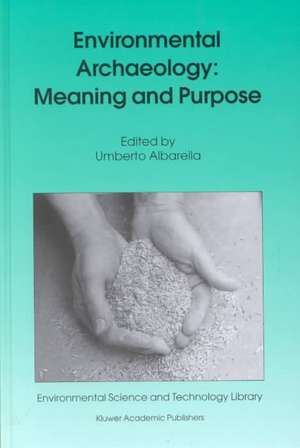
Environmental Archaeology
Autor Umberto Albarellaen Limba Engleză Hardback – 31 ian 2001
Preț: 955.63 lei
Preț vechi: 1165.40 lei
-18%
Puncte Express: 1433
Carte tipărită la comandă
Livrare economică 19 octombrie-02 noiembrie
Livrare prin curier în România Termenul estimat este afișat lângă disponibilitate.
Transport gratuit pentru acest produs Plată online sau ramburs, în funcție de opțiunile comenzii.
Retur gratuit în 14 zile Comandă securizată și suport în română.
Specificații
ISBN-13: 9780792367635
ISBN-10: 0792367634
Pagini: 340
Ilustrații: X, 326 p.
Dimensiuni: 156 x 234 x 21 mm
Greutate: 0.65 kg
Ediția:2001 edition
Editura: Springer Nature B.V.
Locul publicării:Dordrecht, Netherlands
ISBN-10: 0792367634
Pagini: 340
Ilustrații: X, 326 p.
Dimensiuni: 156 x 234 x 21 mm
Greutate: 0.65 kg
Ediția:2001 edition
Editura: Springer Nature B.V.
Locul publicării:Dordrecht, Netherlands
V-ar putea interesa
-
 Pigs and Humans: 10,000 Years of InteractionUmberto Albarella-33%Preț: 1491.58 lei2218.72 lei
 -
 The History of British BirdsDerek Yalden-28%Preț: 400.80 lei557.91 lei
 -
 The Oxford Handbook of ZooarchaeologyUmberto Albarella-32%Preț: 1083.12 lei1590.13 lei
 -
 Between Artifacts and TextsAnders Andrén-15%Preț: 636.03 lei748.27 lei
 -
 Archaeological Obsidian StudiesM. Steven Shackley-15%Preț: 638.74 lei751.46 lei
 -
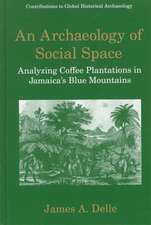 An Archaeology of Social SpaceJames A. Delle-15%Preț: 638.03 lei750.62 lei
 -
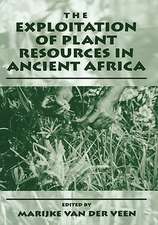 The Exploitation of Plant Resources in Ancient AfricaMarijke van der Veen-15%Preț: 645.64 lei759.58 lei
 -
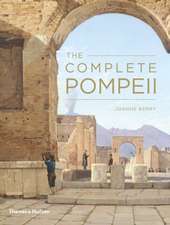 The Complete PompeiiJoanne Berry-15%Preț: 125.36 lei147.97 lei
 -
 The Archaeology of the Holy LandJodi MagnessPreț: 414.05 lei
 -
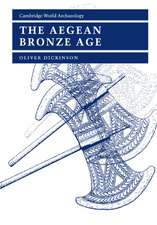 The Aegean Bronze AgeOliver DickinsonPreț: 278.27 lei
 -
 The Cambridge Manual of Latin EpigraphyAlison E. CooleyPreț: 337.16 lei
 -
 Artefacts in Roman BritainLindsay Allason-JonesPreț: 356.45 lei
 -
 Indo-Roman Trade: From Pots to PepperRoberta Tomber-17%Preț: 184.38 lei221.84 lei
 -
 Preț: 347.97 lei
 -
 Travels of LearningAna Simões-18%Preț: 913.61 lei1114.15 lei
 -
 Classical ArchaeologyRobin OsbornePreț: 323.61 lei
 -
 BonesAndrea Piccioli-5%Preț: 756.65 lei796.48 lei
 -
 Troia and the TroadGünther A. Wagner-18%Preț: 2112.87 lei2576.68 lei
 -
 Red-Figure Pottery in its Ancient SettingStine SchierupPreț: 209.24 lei
 -
 -19%Preț: 509.82 lei629.41 lei
Public țintă
ResearchCuprins
Exploring the real Nature of environmental archaeology. An introduction.- Meaning and Purpose.- Economic prehistory or environmental archaeology? On gaining a sense of identity.- Re-inventing environmental archaeology. A comment on “Economic prehistory or environmental archaeology? On gaining a sense of identity”.- Whose dichotomy is it anyway? A reply to Hamilakis.- Environmental archaeology is not human palaeoecology.- Environmental archaeology is dead: long live bioarchaeology, geoarchaeology and human palaeoecology. A comment on “Environmental archaeology is not human palaeoecology”.- A reply to Thomas.- The poverty of empiricism and the tyranny of theory.- Commercialising the palaeoenvironment. Developer funding and environmental archaeology.- The responsibilities of archaeologists to nature conservation.- Sustainability and the rate of change. A comment on “The responsibilities of archaeologists to nature conservation”.- A reply to Graves-Brown.- What is geoarchaeology? Re-examining the relationship between archaeology and earth sciences.- Is human osteoarchaeology environmental archaeology?.- Case Studies.- The rhetoric of people and grains.- A match made in heaven or a marriage of convenience? The problems and rewards of integrating palaeoecological and archaeological data.- Historical archaeology and new directions in environmental archaeology. Examples from Neolithic Scandinavia and Venezuela (400–1400 AD).- Can’t see the wood for the trees. Interpreting woodland fire history from microscopic charcoal.- The potential for using religious belief to derive environmental information on past societies, with a case study on the environment of Attica.- Reconstructing house activity areas.- Environmental archaeology and the interpretation of socialspace. A comment on “Reconstructing house activity areas”.- When method meets theory. The use and misuse of cereal producer/consumer models in archaeobotany.- Producers and consumers in archaeobotany. A comment on “When method meets theory: the use and misuse of cereal producer/consumer models in archaeobotany”.- Conclusions.- Agendas for environmental archaeology.