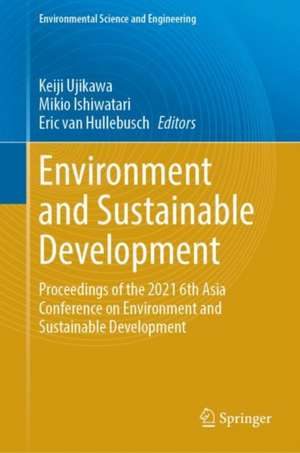
Environment and Sustainable Development
Editat de Keiji Ujikawa, Mikio Ishiwatari, Eric van Hullebuschen Limba Engleză Hardback – 7 apr 2022
În domeniul ingineriei edilitare și al științei mediului, integrarea soluțiilor tehnologice avansate a devenit imperativă pentru a răspunde provocărilor climatice actuale. Volumul de față, publicat de Springer, sistematizează cercetări de ultimă oră prezentate la ediția din 2023 a conferinței ACESD din Sapporo, Japonia. Putem afirma că lucrarea reprezintă o resursă tehnică densă, structurată pe piloni esențiali: de la dinamica ecosistemelor și ingineria ecologică, până la controlul riguros al poluării aerului și managementul sustenabil al deșeurilor solide. Pe linia practică a volumului Advances in Environmental Sustainability, dar cu focus pe implementarea tehnologiilor de nișă, cum ar fi biosinteza nanoparticulelor de argint pentru tratarea apelor, această apariție editorială se distinge prin rigoarea datelor experimentale. Structura este una de tip antologie academică, unde progresia este dictată de complexitatea intervențiilor: se începe cu analize chimice și microbiologice (precum formarea trihalometanilor în bazinele hidrografice) și se avansează către modelări matematice complexe. Merită menționat capitolul dedicat aplicării algoritmului Whale Optimization (WOA) pentru operarea rezervoarelor, un exemplu clar de fuziune între inteligența artificială și hidrologie. Spre deosebire de Sustainability in Environmental Engineering and Science, care oferă o perspectivă mai generală asupra tehnologiilor eco-friendly, volumul editat de Keiji Ujikawa și colegii săi pune accent pe date empirice din regiunea Asia-Pacific, oferind soluții concrete pentru probleme specifice de turbiditate a apei marine sau contaminarea apelor subterane cu elemente toxice. Documentul servește drept ghid tehnic pentru specialiștii care caută nu doar teorie, ci protocoale de testare și rezultate validate în teren.
Preț: 1160.67 lei
Preț vechi: 1415.45 lei
-18%
Carte tipărită la comandă
Livrare economică 01-15 decembrie
Specificații
ISBN-10: 9811917035
Pagini: 416
Ilustrații: XII, 404 p. 187 illus., 150 illus. in color.
Dimensiuni: 160 x 241 x 28 mm
Greutate: 0.74 kg
Ediția:1st ed. 2022
Editura: Springer
Locul publicării:Singapore, Singapore
V-ar putea interesa
-
 Into the Clear Blue SkyRob JacksonPreț: 79.10 lei
 -
 -27%Preț: 1076.98 lei1482.84 lei
 -
 Environmental Engineering and Sustainable DesignBradley Striebig-25%Preț: 645.64 lei863.99 lei
 -
 Introduction to Environmental Engineering ISEMackenzie Davis-26%Preț: 410.16 lei551.64 lei
 -
 -5%Preț: 735.24 lei773.94 lei
 -
 Introduction to Environmental Engineering and ScienceGilbert Masters-15%Preț: 694.07 lei816.56 lei
 -
 SnoSverker SörlinPreț: 124.75 lei
 -
 Wastewater Treatment Fundamentals I, Liquid TreatmentWater Environment Federation-14%Preț: 885.44 lei1029.58 lei
 -
 Advances in Environmental Research: Volume 18Justin A Daniels-26%Preț: 730.58 lei992.26 lei
 -
 SunbirthAn YuPreț: 108.24 lei
 -
 Going NuclearTim GregoryPreț: 124.00 lei
 -
 Environmental and Natural Resources EngineeringLawrence K. Wang-24%Preț: 906.97 lei1193.38 lei
 -
 -24%Preț: 1133.60 lei1491.57 lei
 -
 Advances in Energy Resources and Environmental EngineeringAbdelfatah Abomohra-18%Preț: 1536.13 lei1873.32 lei
 -
 Wastewater Sludge NexusAshootosh Mandpe-18%Preț: 1159.69 lei1414.26 lei
 -
 Advanced Studies on Environmental SustainabilityAhmed J. Obaid-18%Preț: 1450.29 lei1768.65 lei
 -
 Environmental Engineering and Waste ManagementVineet Kumar-18%Preț: 1014.85 lei1237.63 lei
 -
 -18%Preț: 1040.89 lei1269.37 lei
 -
 Lean & Green: Best PracticeDaniel ReichertPreț: 451.09 lei
De ce să citești această carte
Această carte se adresează inginerilor de mediu, cercetătorilor și profesioniștilor din administrația publică care au nevoie de soluții tehnice validate pentru gestionarea resurselor de apă și controlul poluării. Cititorul câștigă acces la studii de caz internaționale și metodologii noi, precum fotocataliza sustenabilă și optimizarea algoritmică a infrastructurii critice, esențiale pentru proiectarea unor sisteme urbane reziliente.
Despre autor
Volumul este coordonat de un colectiv de experți internaționali condus de Keiji Ujikawa, specialist recunoscut în politici de mediu și dezvoltare durabilă. Alături de el, Mikio Ishiwatari aduce o vastă experiență în managementul riscurilor de dezastre și ingineria resurselor de apă, având un istoric profesional legat de instituții de prestigiu precum Agenția de Cooperare Internațională a Japoniei (JICA). Eric van Hullebusch completează echipa editorială cu expertiza sa în biogeochimia metalelor și tehnologii de tratare a deșeurilor, asigurând rigoarea științifică a lucrărilor selectate pentru publicare în această serie prestigioasă a editurii Springer.
Descriere scurtă
Cuprins
Notă biografică
Caracteristici
Descriere
The book focuses on environmental restoration and ecological engineering, global environmental change and ecosystems management, environmental dynamics, wastewater and sludge treatment, air pollution and control, and environmental sustainability.