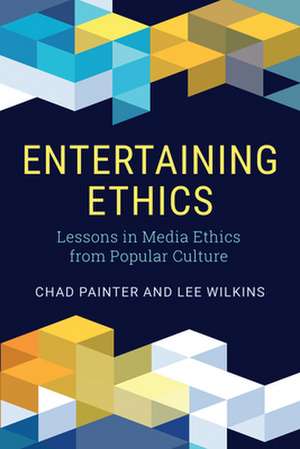
Entertaining Ethics: Lessons in Media Ethics from Popular Culture
Autor Chad Painter, Lee Wilkinsen Limba Engleză Paperback – 11 mar 2021
Chad Painter and Lee Wilkins explore how popular culture explains media ethics and the philosophy that is key to solid ethical thinking. Each chapter focuses on a key ethical concept, anchors the discussion of that concept in a contemporary or classic accessible film, analyzes decisions made in that film with other popular culture artifacts, and grounds the analysis in appropriate philosophical thought.
The book focuses on core philosophical concepts of media ethics-truth telling, loyalty, privacy, public service, media economics, social justice, advocacy, and accountability-as they are examined through the lens of narrative film, television, and music. Discussion questions and online instructor materials further course applicability while the popular culture examples make ethical theory accessible and exciting for students and professors from a variety of academic backgrounds.
Preț: 177.86 lei
Preț vechi: 238.10 lei
-25%
Puncte Express: 267
Carte tipărită la comandă
Livrare economică 21 noiembrie-05 decembrie
Livrare prin curier în România Termenul estimat este afișat lângă disponibilitate.
Transport gratuit de la 400.00 lei Plată online sau ramburs, în funcție de opțiunile comenzii.
Retur gratuit în 14 zile Comandă securizată și suport în română.
Specificații
ISBN-13: 9781538138205
ISBN-10: 1538138204
Pagini: 192
Ilustrații: 1 b/w illustration; 17 b/w photos
Dimensiuni: 148 x 226 x 10 mm
Greutate: 0.27 kg
Editura: Bloomsbury Publishing
Colecția Rowman & Littlefield
Locul publicării:New York, United States
ISBN-10: 1538138204
Pagini: 192
Ilustrații: 1 b/w illustration; 17 b/w photos
Dimensiuni: 148 x 226 x 10 mm
Greutate: 0.27 kg
Editura: Bloomsbury Publishing
Colecția Rowman & Littlefield
Locul publicării:New York, United States
V-ar putea interesa
-
 Wayne Morse: A Bio-BibliographyLee Wilkins-54%Preț: 256.05 lei560.23 lei
 -
 -40%Preț: 470.16 lei788.69 lei
 -
 Risky Business: Communicating Issues of Science, Risk, and Public PolicyLillian C. Black Wilkins-30%Preț: 473.25 lei674.85 lei
 -
 Preț: 441.29 lei
 -
 Law and Ethics for Today's Journalist: A Concise GuideJoe Mathewson-18%Preț: 1472.55 lei1795.79 lei
 -
 Preț: 392.44 lei
 -
 The Silent RevolutionM. BunzPreț: 385.14 lei
 -
 The Routledge Handbook of Mass Media EthicsLee Wilkins-18%Preț: 1808.25 lei2205.18 lei
 -
 The Undeclared War between Journalism and FictionD. UnderwoodPreț: 371.35 lei
 -
 Moscow DownLee WilkinsPreț: 124.83 lei
 -
 Covering ConflictsAli Rafeeq-8%Preț: 463.56 lei503.86 lei
 -
 Alltag im FernsehenBarbara PoschPreț: 375.08 lei
 -
 PR und JournalismusDaniela DohmenPreț: 311.58 lei
 -
 Preț: 82.40 lei
 -
 Preț: 87.96 lei
 -
 Preț: 306.49 lei
 -
 Corporate Identity und Coporate Image von StarbucksAnna HolterhusPreț: 88.33 lei
Recenzii
Painter and Wilkins seamlessly blend engaging analyses of popular cultural artifacts with accessible summaries of philosophical principles to depict the competing interests-including truth-telling, loyalty, privacy, public service, and the profit motive-that confront media professionals in making ethical decisions.. The authors memorably trace the phrase public service from an early use in 1576 to the normative roles of journalism displayed in the TV shows Adventures of Superman (1952-58) and House of Cards (2013-18) and the films All the President's Men (1976) and Contagion (2011) to document the profession's evolving values in the 20th and 21st centuries. This timely book samples popular culture and theoretical scholarship without short shrifting either. It includes discussion questions throughout and a conclusion full of fruitful questions for further research. Highly recommended. Undergraduates through faculty.
An exciting read from Star Trek to Madame Secretary. The beauty of this book is that it addresses overarching themes and topics that are relevant to journalism and mass communication and then views it through the lens of popular culture, supporting the analysis through philosophy.
An intelligent, well-written text that can capture students' attention through the use of popular culture while balancing readability with an appropriate depth of analysis.
This book offers a fresh take on entertainment ethics, especially the depiction of journalists in popular culture. It integrates ethics theory with excerpted dialogue from several movies and TV shows. Students can learn much about the history of how journalists are viewed and how it supports or refutes journalists' real experiences.
Painter and Wilkins offer an engaging analysis of entertainment media for insights into competing interests that confront media practitioners today. Abundant discussion questions make good use of contemporary debate about social justice and privacy rights, among many others, to show how pop culture entertainments free us to imagine valid decision-making in the real world. Graduate and upper-division students planning careers in public relations, strategic communications, or reporting will benefit from this consistently accessible blend of normative ethics theory and pop culture commentary.
An exciting read from Star Trek to Madame Secretary. The beauty of this book is that it addresses overarching themes and topics that are relevant to journalism and mass communication and then views it through the lens of popular culture, supporting the analysis through philosophy.
An intelligent, well-written text that can capture students' attention through the use of popular culture while balancing readability with an appropriate depth of analysis.
This book offers a fresh take on entertainment ethics, especially the depiction of journalists in popular culture. It integrates ethics theory with excerpted dialogue from several movies and TV shows. Students can learn much about the history of how journalists are viewed and how it supports or refutes journalists' real experiences.
Painter and Wilkins offer an engaging analysis of entertainment media for insights into competing interests that confront media practitioners today. Abundant discussion questions make good use of contemporary debate about social justice and privacy rights, among many others, to show how pop culture entertainments free us to imagine valid decision-making in the real world. Graduate and upper-division students planning careers in public relations, strategic communications, or reporting will benefit from this consistently accessible blend of normative ethics theory and pop culture commentary.