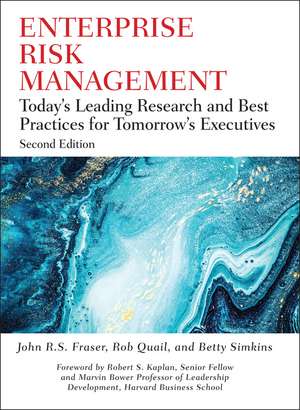
Enterprise Risk Management
Editat de Betty Simkins, John R. S. Fraser, Rob Quailen Limba Engleză Hardback – 20 aug 2021
În contextul unei volatilități economice globale fără precedent, marcată de crize climatice și amenințări cibernetice sofisticate, capacitatea unei organizații de a anticipa și gestiona incertitudinea a devenit principalul diferențiator competitiv. Observăm în Enterprise Risk Management, coordonată de Betty Simkins, John R. S. Fraser și Rob Quail, o trecere de la gestionarea reactivă a riscurilor la o strategie proactivă, integrată în procesul de luare a deciziilor la cel mai înalt nivel. Remarcăm cum această a doua ediție nu este doar o actualizare, ci o reconstrucție aproape totală a fundamentelor disciplinei, adaptată cerințelor actuale ale executivilor. Abordarea de față diferă de cea din Fundamentals of Risk Management – Understanding, Evaluating and Implementing Effective Enterprise Risk Management de Clive Thompson prin pragmatismul său accentuat — în timp ce lucrarea lui Thompson este un ghid introductiv aliniat standardelor ISO, volumul de față este mai puțin abstract și considerabil mai aplicabil, oferind instrumente specifice pentru „toolmaking” și activități centrate pe cursant. Structura cărții, organizată în secțiuni ce pornesc de la cadrul teoretic (ERM Frameworks) și evoluează spre cultura riscului și indicatori de performanță (KRI), facilitează o progresie logică de la strategie la execuție. Descoperim aici o continuitate a rigoarei analitice pe care Betty Simkins a demonstrat-o și în Energy Finance and Economics, însă aplicată acum la scara întregii întreprinderi. Spre deosebire de The Risk Management Handbook, care oferă o privire de ansamblu asupra peisajului riscului, Enterprise Risk Management se concentrează pe mecanismele interne care conduc succesul afacerii, de la rolul Chief Risk Officer-ului până la alocarea resurselor bazată pe risc, oferind cititorului nu doar o hartă a pericolelor, ci un manual de navigație.
Preț: 633.13 lei
Preț vechi: 822.24 lei
-23%
Carte disponibilă
Livrare economică 31 octombrie-14 noiembrie
Livrare express 17-23 octombrie pentru 78.95 lei
Specificații
ISBN-10: 1119741483
Pagini: 944
Dimensiuni: 184 x 258 x 43 mm
Greutate: 1.71 kg
Ediția:2. Auflage
Editura: John Wiley & Sons, Inc.
Locul publicării:Hoboken, United States
V-ar putea interesa
-
 Introduction to Risk Management and InsuranceMark S Dorfman-15%Preț: 1168.56 lei1374.78 lei
 -
 Corporate Governance MattersDavid Larcker-13%Preț: 468.05 lei537.99 lei
 -
 Mastering Operational RiskTony Blunden-19%Preț: 451.38 lei557.26 lei
 -
 -8%Preț: 544.23 lei591.55 lei
 -
 Preț: 421.98 lei
 -
 Preț: 448.54 lei
 -
 Preț: 367.99 lei
 -
 Preț: 302.54 lei
 -
 Empowered Enterprise Risk ManagementHakan JankensgardPreț: 270.86 lei
 -
 Strategic Risk Management - Designing Portfolios and Managing RiskCampbell R. HarveyPreț: 204.33 lei
 -
 Ten Laws of Operational RiskMichael GrimwadePreț: 375.65 lei
 -
 The Essentials of Risk Management, Third EditionMichel Crouhy-16%Preț: 346.73 lei410.41 lei
 -
 -19%Preț: 562.33 lei694.23 lei
 -
 Preț: 438.65 lei
 -
 -35%Preț: 133.14 lei206.26 lei
 -
 -27%Preț: 1219.99 lei1661.16 lei
 -
 Project Risk Management: A Practical Implementation ApproachMichael A. BissonettePreț: 311.71 lei
 -
 Preț: 128.70 lei
 -
 Enterprise Risk Management ModelsDavid L. Olson-23%Preț: 710.20 lei922.34 lei
De ce să citești această carte
Această carte este esențială pentru directorii de risc, membrii consiliilor de administrație și managerii care doresc să transforme managementul riscului dintr-o funcție de conformitate într-un avantaj strategic. Veți câștiga o metodologie clară pentru prioritizarea răspunsurilor la risc și veți învăța cum să implementați cele mai bune practici în securitate cibernetică și planificare strategică, asigurând reziliența organizației pe termen lung.
Despre autor
Betty Simkins este profesor de finanțe și deține o catedră de excelență în cadrul Oklahoma State University, fiind recunoscută la nivel mondial pentru expertiza sa în managementul riscului și finanțe energetice. John R. S. Fraser a activat ca Senior Vice President și Chief Risk Officer la Hydro One Networks Inc., având o vastă experiență practică în implementarea sistemelor ERM complexe. Rob Quail este un consultant și educator renumit, specializat în dezvoltarea culturii riscului. Împreună, acești editori combină rigoarea academică cu pragmatismul corporativ, oferind o resursă autoritară publicată de John Wiley & Sons, Inc..
Descriere
Unlock the incredible potential of enterprise risk management
There has been much evolution in terms of ERM best practices, experience, and standards and regulation over the past decade. Enterprise Risk Management: Today’s Leading Research and Best Practices for Tomorrow’s Executives, Second Edition is the revised and updated essential guide to the now immensely popular topic of enterprise risk management (ERM). With contributions from leading academics and practitioners, this book offers insights into what practitioners are doing and what the future holds. You’ll discover how you can implement best practices, improve ERM tools and techniques, and even learn to teach ERM. Retaining the holistic approach to ERM that made the first edition such a success, this new edition adds coverage of new topics including cybersecurity risk, ERM in government, foreign exchange risk, risk appetite, innovation risk, outsourcing risk, scenario planning, climate change risk, and much more. In addition, the new edition includes important updates and enhancements to topics covered in the first edition; so much of it has been revised and enhanced that it is essentially an entirely new book.
Enterprise Risk Management introduces you to the concepts and techniques that allow you to identify risks and prioritize the appropriate responses. This invaluable guide offers a broad overview, covering key issues while focusing on the principles that drive effective decision making and determine business success. This comprehensive resource also provides a thorough introduction to ERM as it relates to credit, market, and operational risk, as well as the evolving requirements of the board of directors’ role in overseeing ERM.
Through the comprehensive chapters and leading research and best practices covered, this book:
- Provides a holistic overview of key topics in ERM, including the role of the chief risk officer, development and use of key risk indicators and the risk-based allocation of resources
- Contains second-edition updates covering additional material related to teaching ERM, risk frameworks, risk culture, credit and market risk, risk workshops and risk profiles and much more. Over 90% of the content from the first edition has been revised or enhanced
- Reveals how you can prudently apply ERM best practices within the context of your underlying business activities
Filled with helpful examples, tables, and illustrations, Enterprise Risk Management, Second Edition offers a wealth of knowledge on the drivers, the techniques, the benefits, as well as the pitfalls to avoid, in successfully implementing ERM.