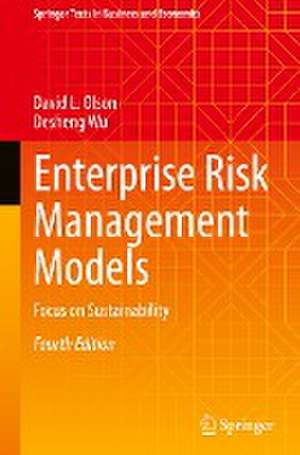
Enterprise Risk Management Models: Springer Texts in Business and Economics
Autor David L. Olson, Desheng Wuen Limba Engleză Hardback – 29 oct 2023
The publication of this book comes at a crucial time when the world is facing increasing challenges from various forms of risk. Events such as Covid-19, the energy crisis, wars, and terrorism in the 21st century have all disrupted supply chains, thus highlighting the critical importance of enterprise risk management. Additional risks, such as financial and technological bubbles, along with concerns surrounding rampant artificial intelligence, contribute to a climate that demands enhanced risk management within organizations.
Din seria Springer Texts in Business and Economics
- 17%
 Preț: 407.04 lei
 -
 Preț: 200.06 lei
 - 17%
 Preț: 497.05 lei
 - 14%
 Preț: 683.83 lei
 - 18%
 Preț: 757.65 lei
 - 13%
 Preț: 350.58 lei
 - 18%
 Preț: 810.94 lei
 - 18%
 Preț: 612.19 lei
 - 15%
 Preț: 520.21 lei
 -
 Preț: 629.08 lei
 - 20%
 Preț: 776.15 lei
 - 15%
 Preț: 496.73 lei
 - 15%
 Preț: 671.37 lei
 - 19%
 Preț: 400.35 lei
 -
 Preț: 457.34 lei
 -
 Preț: 364.47 lei
 -
 Preț: 402.76 lei
 - 15%
 Preț: 735.15 lei
 - 18%
 Preț: 779.87 lei
 -
 Preț: 411.78 lei
 -
 Preț: 493.13 lei
 - 15%
 Preț: 724.55 lei
 - 24%
 Preț: 680.62 lei
 - 23%
 Preț: 694.84 lei
 -
 Preț: 510.27 lei
 -
 Preț: 390.01 lei
 -
 Preț: 390.72 lei
 - 15%
 Preț: 617.10 lei
 - 19%
 Preț: 413.92 lei
 - 15%
 Preț: 554.70 lei
 - 18%
 Preț: 1107.69 lei
 - 15%
 Preț: 688.24 lei
 - 15%
 Preț: 566.33 lei
 - 15%
 Preț: 392.71 lei
 - 47%
 Preț: 350.62 lei
 - 45%
 Preț: 332.56 lei
 -
 Preț: 408.17 lei
 - 15%
 Preț: 699.43 lei
 - 15%
 Preț: 549.25 lei
 -
 Preț: 346.49 lei
 - 15%
 Preț: 524.56 lei
 - 15%
 Preț: 519.07 lei
 - 19%
 Preț: 538.82 lei
 - 18%
 Preț: 777.74 lei
 -
 Preț: 412.31 lei
 - 15%
 Preț: 617.43 lei
Preț: 706.04 lei
Preț vechi: 861.03 lei
-18%
Puncte Express: 1059
Carte tipărită la comandă
Livrare economică 27 noiembrie-11 decembrie
Livrare prin curier în România Termenul estimat este afișat lângă disponibilitate.
Transport gratuit pentru acest produs Plată online sau ramburs, în funcție de opțiunile comenzii.
Retur gratuit în 14 zile Comandă securizată și suport în română.
Specificații
ISBN-13: 9783662680377
ISBN-10: 3662680378
Pagini: 260
Ilustrații: XI, 248 p. 62 illus.
Dimensiuni: 160 x 241 x 20 mm
Greutate: 0.56 kg
Ediția:Fourth Edition 2023
Editura: Springer
Colecția Springer Texts in Business and Economics
Seria Springer Texts in Business and Economics
Locul publicării:Berlin, Heidelberg, Germany
ISBN-10: 3662680378
Pagini: 260
Ilustrații: XI, 248 p. 62 illus.
Dimensiuni: 160 x 241 x 20 mm
Greutate: 0.56 kg
Ediția:Fourth Edition 2023
Editura: Springer
Colecția Springer Texts in Business and Economics
Seria Springer Texts in Business and Economics
Locul publicării:Berlin, Heidelberg, Germany
Cuprins
1. Enterprise Risk Management in Supply Chains.- 2. Risk Matrices.- 3. Value-Focused Supply Chain Risk Analysis.- 4. Examples of Supply Chain Decisions Trading-off Criteria.- 5. Simulation of Supply Chain Risk.- 6. Value at Risk Models.- 7. Chance-Constrained Models.- 8. Data Envelopment Analysis in Enterprise Risk Management.- 9. Data Mining Models and Enterprise Risk Management.- 10. Balanced Scorecards to Measure Enterprise Risk Performance.- 11. Machine Learning and Artificial Intelligence Risk.- 12. Enterprise Risk Management in Projects.- 13. Natural Disaster Risk Management.- 14. Sustainability and Enterprise Risk Management.- 15. Environmental Damage and Risk Assessment.
Notă biografică
David L. Olson ist der James & H.K. Stuart Chancellor's Distinguished Chair und ordentlicher Professor an der University of Nebraska. Er hat in über 150 begutachteten Zeitschriftenartikeln Forschungsergebnisse veröffentlicht, vor allem zu den Themen Entscheidungsfindung mit mehreren Zielen, Informationstechnologie, Risikomanagement in der Lieferkette und Data Mining. Er lehrt in den Bereichen Management-Informationssysteme, Management-Wissenschaft und Operations Management. Er hat über 20 Bücher verfasst. Er ist Mitglied des Decision Sciences Institute, des Institute for Operations Research and Management Sciences und der Multiple Criteria Decision Making Society. Von 1999 bis 2001 war er Lowry-Mays-Stiftungsprofessor an der Texas A&M University. Im Jahr 2002 wurde er mit dem Raymond E. Miles Distinguished Scholar Award ausgezeichnet, und von 2005 bis 2006 war er James C. and Rhonda Seacrest Fellow. Im Jahr 2006 wurde er von der IFIP zum "Best Enterprise Information Systems Educator" ernannt. Er ist ein Fellow des Decision Sciences Institute.
Dr. Georg Lauhoff führt bei IBM Forschungs- und Entwicklungsarbeiten auf dem Gebiet der Materialwissenschaft und ihrer Anwendung in Datenspeichern durch und verwendet auch die in diesem Buch beschriebenen Techniken für seine Arbeit. Er ist Mitverfasser von 38 begutachteten Zeitschriftenartikeln und über 30 Konferenzvorträgen, hauptsächlich zu den Themen Materialwissenschaft, Datenspeichermaterialien und magnetische Dünnschichten. Er erhielt Stipendien und Forschungszuschüsse in Großbritannien und Japan. Von 1995 bis 1998 war er der Clerk-Maxwell Scholar und ist Fellow der Cambridge Philosophical Society. Er studierte Physik in Aachen (Diplom) und an der Universität Cambridge (Master und Ph.D.) und spezialisierte sich dabei auf die Bereiche Materialwissenschaften und magnetische Dünnschichten und Sensoren. Nach seinem Abschluss ging er nach Japan und arbeitete als Assistentprofessor für Materialwissenschaft und Werkstoffkunde am Toyota Technological Institute in Nagoya. Anschließend forschte er an der Universität Cambridge auf dem Gebiet der DNA-Sequenzierung mit Hilfe magnetischer Sensoren, bevor er 2005 in die Datenspeicherindustrie im Silicon Valley wechselte und bei Maxtor, Samsung, Western Digital und nun IBM Almaden für die Entwicklung von Festplattenlaufwerke und magnetisch Bandlaufwerke verantwortlich ist. Georg studierte neben seiner Arbeit von 2015-2020 an der University of Nebraska-Lincoln Betriebswirtschaftslehre (MBA).
Textul de pe ultima copertă
This textbook, now in its fourth edition, serves as a comprehensive guide to learning various aspects of risk, encompassing supply chain management, artificial intelligence, and sustainability. It demonstrates a wide range of operations research models that have been successfully applied to enterprise supply chain risk management. Each chapter of the book can function as a standalone module focusing on a specific topic, offering dedicated examples, definitions, and discussion notes.
The publication of this book comes at a crucial time when the world is facing increasing challenges from various forms of risk. Events such as Covid-19, the energy crisis, wars, and terrorism in the 21st century have all disrupted supply chains, thus highlighting the critical importance of enterprise risk management. Additional risks, such as financial and technological bubbles, along with concerns surrounding rampant artificial intelligence, contribute to a climate that demands enhanced risk management within organizations.
The publication of this book comes at a crucial time when the world is facing increasing challenges from various forms of risk. Events such as Covid-19, the energy crisis, wars, and terrorism in the 21st century have all disrupted supply chains, thus highlighting the critical importance of enterprise risk management. Additional risks, such as financial and technological bubbles, along with concerns surrounding rampant artificial intelligence, contribute to a climate that demands enhanced risk management within organizations.
Caracteristici
Helps comprehend the potential of models within risk management Gives simple examples to demonstrate the methods Demonstrates simulation and other operational research models