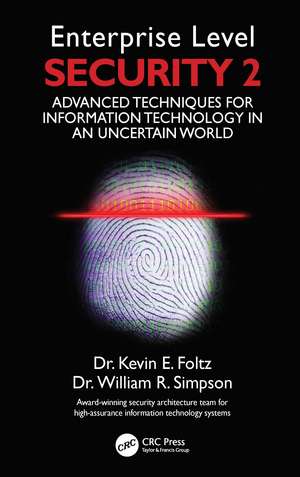
Enterprise Level Security 2: Advanced Techniques for Information Technology in an Uncertain World
Autor Kevin E. Foltz, William R. Simpson, Institute for Defense Analysesen Limba Engleză Paperback – 9 ian 2023
- The ELS model of enterprise security is endorsed by the Secretary of the Air Force for Air Force computing systems and is a candidate for DoD systems under the Joint Information Environment Program.
- The book is intended for enterprise IT architecture developers, application developers, and IT security professionals.
- This is a unique approach to end-to-end security and fills a niche in the market.
Preț: 415.72 lei
Puncte Express: 624
Carte disponibilă
Livrare economică 12-26 noiembrie
Livrare express 29 octombrie-04 noiembrie pentru 43.07 lei
Livrare prin curier în România Termenul estimat este afișat lângă disponibilitate.
Transport gratuit pentru acest produs Plată online sau ramburs, în funcție de opțiunile comenzii.
Retur gratuit în 14 zile Comandă securizată și suport în română.
Specificații
ISBN-13: 9780367532963
ISBN-10: 0367532964
Pagini: 338
Ilustrații: 93
Dimensiuni: 156 x 234 x 23 mm
Greutate: 0.63 kg
Ediția:1
Editura: CRC Press
Colecția CRC Press
ISBN-10: 0367532964
Pagini: 338
Ilustrații: 93
Dimensiuni: 156 x 234 x 23 mm
Greutate: 0.63 kg
Ediția:1
Editura: CRC Press
Colecția CRC Press
V-ar putea interesa
-
 Digital Forensics: Threatscape and Best PracticesJohn Sammons-31%Preț: 226.00 lei329.37 lei
 -
 Security, Privacy, and Applied Cryptography EngineeringRajat Subhra Chakraborty-20%Preț: 339.95 lei424.94 lei
 -
 Radio Frequency IdentificationStefan Mangard-20%Preț: 261.58 lei326.98 lei
 -
 Security and Trust ManagementSara Foresti-20%Preț: 322.37 lei402.96 lei
 -
 -20%Preț: 307.11 lei383.89 lei
 -
 Network and System SecurityMeikang Qiu-20%Preț: 335.26 lei419.08 lei
 -
 Advanced Concepts for Intelligent Vision SystemsSebastiano Battiato-20%Preț: 368.05 lei460.07 lei
 -
 Information Systems SecuritySushil Jajoda-20%Preț: 360.68 lei450.86 lei
 -
 -20%Preț: 322.59 lei403.23 lei
 -
 Internet of Vehicles - Safe and Intelligent MobilityChing-Hsien Hsu-20%Preț: 345.45 lei431.82 lei
 -
 Gesichtserkennungssystem als Methode der AuthentifizierungBenard Ogere Ekemu-20%Preț: 212.25 lei265.31 lei
 -
 Sistema di riconoscimento del volto come metodo di autenticazioneBenard Ogere Ekemu-20%Preț: 212.25 lei265.31 lei
 -
 Sistema de Reconhecimento Facial como Método de AutenticaçãoBenard Ogere Ekemu-20%Preț: 212.55 lei265.69 lei
 -
 Sistema raspoznawaniq lic kak metod autentifikaciiBenard Ogere Jekemu-20%Preț: 105.73 lei132.16 lei
Public țintă
Postgraduate and ProfessionalCuprins
Chapter 1. The First 16 Years.
1.1 The Beginning of Enterprise Level Security (ELS).
1.2 Design Principles.
1.3 Key Concepts.
1.4 Implementation.
Chapter 2. A Brief Review of the Initial Book.
2.1 Security Principles.
2.2 ELS Framework.
Chapter 3. Minimal Requirements for the Advanced Topics.
3.1 Needed Capabilities.
3.2 Creating an Attribute Store.
3.3 Registering a Service.
3.4 Computing Claims.
3.5 User Convenience Services.
3.6 The Enterprise Attribute Ecosystem.
3.7 Summary.
Identity and Access Advanced Topics.
Chapter 4. Identity Claims in High Assurance.
4.1 Who Are You?.
4.2 Entity Vetting.
4.3 Naming.
4.4 Key and Credential Generation.
4.5 Key and Credential Access Control.
4.6 Key and Credential Management.
4.7 Key and Credential Uses.
4.8 Some Other Considerations.
Chapter 5. Cloud Key Management.
5.1 Clouds.
5.2 ELS in a Private Cloud.
5.3 The Public Cloud Challenge.
5.4 Potential Hybrid Cloud Solutions.
5.5 Proposed Secure Solutions.
5.6 Implementation.
5.7 Cloud Key Management Summary.
Chapter 6. Enhanced Assurance Needs.
6.1 Enhanced Identity Issues.
6.2 Scale of Identity Assurance.
6.3 Implementing the Identity Assurance Requirement.
6.4 Additional Requirements.
6.5 Enhanced Assurance Summary.
Chapter 7. Temporary Certificates.
7.1 Users That Do Not Have a PIV..
7.2 Non-PIV STS/CA-Issued Certificate.
7.3 Required Additional Elements.
7.4 Precluding the Use of Temporary Certificates.
7.5 Temporary Certificate Summary.
Chapter 8. Derived Certificates on Mobile Devices.
8.1 Derived Credentials.
8.2 Authentication with the Derived Credential.
8.3 Encryption with the Derived Credential.
8.4 Security Considerations.
8.5 Certificate Management.
Chapter 9. Veracity and Counter Claims.
9.1 The Insider Threat.
9.2 Integrity, Reputation, and Veracity.
9.3 Measuring Veracity.
9.4 Creating a Model & Counter-Claims.
9.5 Veracity and Counter-Claims Summary.
Chapter 10. Delegation of Access and Privilege.
10.1 Access and Privilege.
10.2 Delegation Principles.
10.3 ELS Delegation.
10.4 Delegation Summary.
Chapter 11. Escalation of Privilege.
11.1 Context for Escalation.
11.2 Access and Privilege Escalation.
11.3 Planning for Escalation.
11.4 Invoking Escalation.
11.5 Escalation Implementation within ELS.
11.6 Accountability.
11.7 Escalation Summary.
Chapter 12. Federation.
12.1 Federation Technical Considerations.
12.2 Federation Trust Considerations.
12.3 Federation Conclusions.
ELS Extensions – Content Management.
Chapter 13. Content Object Uniqueness for Forensics.
13.1 Exfiltration in Complex Systems.
13.2 Product Identifiers.
13.3 Hidden Messages.
13.4 Content Management.
13.5 Content Object Summary.
Chapter 14. Homomorphic Encryption.
14.1 Full Homomorphic Encryption (FHE)
14.2 Partial Homomorphic Encryption (PHE)
14.3 PHE Performance Evaluation.
14.4 Homomorphic Encryption Conclusions.
ELS Extensions – Data Aggregation.
Chapter 15. Access and Privilege in Big Data Analysis.
15.1 Big Data Access.
15.2 Big Data Related Work.
15.3 Big Data with ELS.
15.4 Big Data Summary.
Chapter 16. Data Mediation
16.1 Maintaining Security with Data Mediation.
16.2 The Mediation Issue.
16.3 Approaches.
16.4 Choosing a Solution.
16.5 Mediation Summary.
ELS Extensions – Mobile Devices.
Chapter 17. Mobile Ad Hoc
17.1 Mobile Ad Hoc Implementations.
17.2 Network Service Descriptions.
17.3 Other Considerations.
17.4 Mobile Ad Hoc Summary.
Chapter 18. Endpoint Device Management
18.1 Endpoint Device Choices.
18.2 Endpoint Device Management
ELS Extensions – Other Topics.
Chapter 19. Endpoint Agent Architecture
19.1 Agent Architecture.
19.2 Related Work.
19.3 ELS Agent Methods.
19.4 Endpoint Agent Results.
19.5 Endpoint Agent Conclusions.
19.6 Endpoint Agent Extensions.
Chapter 20. Ports and Protocols
20.1 Introduction.
20.2 Communication Models.
20.3 Ports in Transport Protocols.
20.4 Threats Considered.
20.5 Assigning Ports and Protocols.
20.6 Server Configurations.
20.7 Firewalls and Port Blocking.
20.8 Application Firewalls.
20.9 Network Firewalls in ELS.
20.10 Endpoint Protection in ELS.
20.11 Handling and Inspection of Traffic.
20.12 Additional Security Hardening.
Chapter 21. Asynchronous Messaging
21.1 Why Asynchronous Messaging?.
21.2 Prior Work.
21.3 Asynchronous Messaging Security.
21.4 PSS Rock and Jewel
21.5 Summary.
Chapter 22. Virtual Application Data Center
22.1 Introduction.
22.2 Enterprise Level Security and VADC Concepts.
22.3 VADC Implementation.
22.4 Resource Utilization.
22.5 Distributed Benefits and Challenges.
22.6 Virtual Application Conclusions.
Chapter 23. Managing System Changes
23.1 System Change.
23.2 Current Approaches.
23.3 The Vision.
23.4 Realizing the Vision.
23.5 Moving into the Future.
23.6 Managing Information Technology Changes.
Chapter 24. Concluding Remarks
24.1 Staying Secure in an Uncertain World.
24.2 The Model is Important
24.3 Zero Trust Architecture.
24.4 Computing Efficiencies.
24.5 Current Full ELS System..
24.6 Future Directions.
References and Bibliography.
Acronyms.
Index.
1.1 The Beginning of Enterprise Level Security (ELS).
1.2 Design Principles.
1.3 Key Concepts.
1.4 Implementation.
Chapter 2. A Brief Review of the Initial Book.
2.1 Security Principles.
2.2 ELS Framework.
Chapter 3. Minimal Requirements for the Advanced Topics.
3.1 Needed Capabilities.
3.2 Creating an Attribute Store.
3.3 Registering a Service.
3.4 Computing Claims.
3.5 User Convenience Services.
3.6 The Enterprise Attribute Ecosystem.
3.7 Summary.
Identity and Access Advanced Topics.
Chapter 4. Identity Claims in High Assurance.
4.1 Who Are You?.
4.2 Entity Vetting.
4.3 Naming.
4.4 Key and Credential Generation.
4.5 Key and Credential Access Control.
4.6 Key and Credential Management.
4.7 Key and Credential Uses.
4.8 Some Other Considerations.
Chapter 5. Cloud Key Management.
5.1 Clouds.
5.2 ELS in a Private Cloud.
5.3 The Public Cloud Challenge.
5.4 Potential Hybrid Cloud Solutions.
5.5 Proposed Secure Solutions.
5.6 Implementation.
5.7 Cloud Key Management Summary.
Chapter 6. Enhanced Assurance Needs.
6.1 Enhanced Identity Issues.
6.2 Scale of Identity Assurance.
6.3 Implementing the Identity Assurance Requirement.
6.4 Additional Requirements.
6.5 Enhanced Assurance Summary.
Chapter 7. Temporary Certificates.
7.1 Users That Do Not Have a PIV..
7.2 Non-PIV STS/CA-Issued Certificate.
7.3 Required Additional Elements.
7.4 Precluding the Use of Temporary Certificates.
7.5 Temporary Certificate Summary.
Chapter 8. Derived Certificates on Mobile Devices.
8.1 Derived Credentials.
8.2 Authentication with the Derived Credential.
8.3 Encryption with the Derived Credential.
8.4 Security Considerations.
8.5 Certificate Management.
Chapter 9. Veracity and Counter Claims.
9.1 The Insider Threat.
9.2 Integrity, Reputation, and Veracity.
9.3 Measuring Veracity.
9.4 Creating a Model & Counter-Claims.
9.5 Veracity and Counter-Claims Summary.
Chapter 10. Delegation of Access and Privilege.
10.1 Access and Privilege.
10.2 Delegation Principles.
10.3 ELS Delegation.
10.4 Delegation Summary.
Chapter 11. Escalation of Privilege.
11.1 Context for Escalation.
11.2 Access and Privilege Escalation.
11.3 Planning for Escalation.
11.4 Invoking Escalation.
11.5 Escalation Implementation within ELS.
11.6 Accountability.
11.7 Escalation Summary.
Chapter 12. Federation.
12.1 Federation Technical Considerations.
12.2 Federation Trust Considerations.
12.3 Federation Conclusions.
ELS Extensions – Content Management.
Chapter 13. Content Object Uniqueness for Forensics.
13.1 Exfiltration in Complex Systems.
13.2 Product Identifiers.
13.3 Hidden Messages.
13.4 Content Management.
13.5 Content Object Summary.
Chapter 14. Homomorphic Encryption.
14.1 Full Homomorphic Encryption (FHE)
14.2 Partial Homomorphic Encryption (PHE)
14.3 PHE Performance Evaluation.
14.4 Homomorphic Encryption Conclusions.
ELS Extensions – Data Aggregation.
Chapter 15. Access and Privilege in Big Data Analysis.
15.1 Big Data Access.
15.2 Big Data Related Work.
15.3 Big Data with ELS.
15.4 Big Data Summary.
Chapter 16. Data Mediation
16.1 Maintaining Security with Data Mediation.
16.2 The Mediation Issue.
16.3 Approaches.
16.4 Choosing a Solution.
16.5 Mediation Summary.
ELS Extensions – Mobile Devices.
Chapter 17. Mobile Ad Hoc
17.1 Mobile Ad Hoc Implementations.
17.2 Network Service Descriptions.
17.3 Other Considerations.
17.4 Mobile Ad Hoc Summary.
Chapter 18. Endpoint Device Management
18.1 Endpoint Device Choices.
18.2 Endpoint Device Management
ELS Extensions – Other Topics.
Chapter 19. Endpoint Agent Architecture
19.1 Agent Architecture.
19.2 Related Work.
19.3 ELS Agent Methods.
19.4 Endpoint Agent Results.
19.5 Endpoint Agent Conclusions.
19.6 Endpoint Agent Extensions.
Chapter 20. Ports and Protocols
20.1 Introduction.
20.2 Communication Models.
20.3 Ports in Transport Protocols.
20.4 Threats Considered.
20.5 Assigning Ports and Protocols.
20.6 Server Configurations.
20.7 Firewalls and Port Blocking.
20.8 Application Firewalls.
20.9 Network Firewalls in ELS.
20.10 Endpoint Protection in ELS.
20.11 Handling and Inspection of Traffic.
20.12 Additional Security Hardening.
Chapter 21. Asynchronous Messaging
21.1 Why Asynchronous Messaging?.
21.2 Prior Work.
21.3 Asynchronous Messaging Security.
21.4 PSS Rock and Jewel
21.5 Summary.
Chapter 22. Virtual Application Data Center
22.1 Introduction.
22.2 Enterprise Level Security and VADC Concepts.
22.3 VADC Implementation.
22.4 Resource Utilization.
22.5 Distributed Benefits and Challenges.
22.6 Virtual Application Conclusions.
Chapter 23. Managing System Changes
23.1 System Change.
23.2 Current Approaches.
23.3 The Vision.
23.4 Realizing the Vision.
23.5 Moving into the Future.
23.6 Managing Information Technology Changes.
Chapter 24. Concluding Remarks
24.1 Staying Secure in an Uncertain World.
24.2 The Model is Important
24.3 Zero Trust Architecture.
24.4 Computing Efficiencies.
24.5 Current Full ELS System..
24.6 Future Directions.
References and Bibliography.
Acronyms.
Index.
Notă biografică
Dr. Kevin E. Foltz, Institute for Defense Analyses, has over a decade of experience working to improve security in information systems. He has presented and published research on different aspects of enterprise security, security modeling, and high assurance systems. He also has degrees in Mathematics, Computer Science, Electrical Engineering, and Strategic Security Studies.
Dr. William R. Simpson, Institute for Defense Analyses, has over two decades of experience working to improve systems security. He has degrees in Aeronautical Engineering and Business Administration, as well as undergoing military and government training. He spent many years as an expert in aeronautics before delving into the field of electronic and system testing, and he has spent the last 20 years on IT-related themes (mostly security, including processes, damage assessments of cyber intrusions, IT security standards, IT security evaluation, and IT architecture).
Dr. William R. Simpson, Institute for Defense Analyses, has over two decades of experience working to improve systems security. He has degrees in Aeronautical Engineering and Business Administration, as well as undergoing military and government training. He spent many years as an expert in aeronautics before delving into the field of electronic and system testing, and he has spent the last 20 years on IT-related themes (mostly security, including processes, damage assessments of cyber intrusions, IT security standards, IT security evaluation, and IT architecture).
Descriere
Enterprise Level Security 2: Advanced Topics in an Uncertain World follows on from the authors’ first book on Enterprise Level Security (ELS), which covered the basic concepts of ELS and the discoveries made during the first eight years of its development. This book follows on from this to give a discussion of advanced topics and solutions.