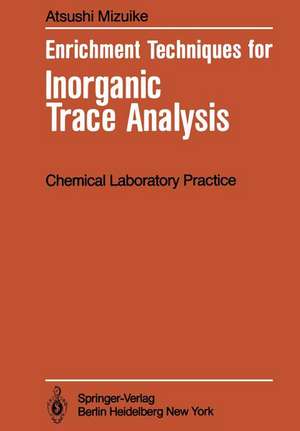
Enrichment Techniques for Inorganic Trace Analysis: Anleitungen für die chemische Laboratoriumspraxis, cartea 19
Autor Atsushi Mizuikeen Limba Engleză Paperback – 10 dec 2011
Din seria Anleitungen für die chemische Laboratoriumspraxis
- 15%
 Preț: 421.30 lei
 -
 Preț: 406.82 lei
 -
 Preț: 397.55 lei
 -
 Preț: 471.88 lei
 -
 Preț: 409.52 lei
 - 15%
 Preț: 422.24 lei
 - 15%
 Preț: 438.45 lei
 - 15%
 Preț: 440.84 lei
 - 15%
 Preț: 434.33 lei
 -
 Preț: 464.79 lei
 - 15%
 Preț: 471.55 lei
 - 15%
 Preț: 475.87 lei
 - 15%
 Preț: 476.59 lei
 -
 Preț: 394.21 lei
 -
 Preț: 430.28 lei
 -
 Preț: 413.42 lei
 -
 Preț: 394.21 lei
 - 15%
 Preț: 492.20 lei
 -
 Preț: 423.99 lei
 -
 Preț: 431.97 lei
 -
 Preț: 427.43 lei
Preț: 369.32 lei
Puncte Express: 554
Carte tipărită la comandă
Livrare economică 02-16 decembrie
Livrare prin curier în România Termenul estimat este afișat lângă disponibilitate.
Transport gratuit de la 400.00 lei Plată online sau ramburs, în funcție de opțiunile comenzii.
Retur gratuit în 14 zile Comandă securizată și suport în română.
Specificații
ISBN-13: 9783642688560
ISBN-10: 364268856X
Pagini: 156
Ilustrații: VIII, 144 p.
Dimensiuni: 170 x 244 x 9 mm
Greutate: 0.28 kg
Ediția:Softcover reprint of the original 1st edition 1983
Editura: Springer
Colecția Anleitungen für die chemische Laboratoriumspraxis
Seria Anleitungen für die chemische Laboratoriumspraxis
Locul publicării:Berlin, Heidelberg, Germany
ISBN-10: 364268856X
Pagini: 156
Ilustrații: VIII, 144 p.
Dimensiuni: 170 x 244 x 9 mm
Greutate: 0.28 kg
Ediția:Softcover reprint of the original 1st edition 1983
Editura: Springer
Colecția Anleitungen für die chemische Laboratoriumspraxis
Seria Anleitungen für die chemische Laboratoriumspraxis
Locul publicării:Berlin, Heidelberg, Germany
V-ar putea interesa
-
 -33%Preț: 356.00 lei533.61 lei
 -
 Inorganic ChemistryJames E. House-25%Preț: 515.02 lei688.14 lei
 -
 Distillation: Fundamentals and PrinciplesAndrzej Gorak-28%Preț: 944.99 lei1309.72 lei
 -
 A Tale of Seven ElementsEric Scerri-24%Preț: 215.57 lei283.85 lei
 -
 Green Analytical Chemistry: Theory and PracticeMiguel de la Guardia-26%Preț: 1280.63 lei1726.66 lei
 -
 -25%Preț: 896.70 lei1200.95 lei
 -
 Introduction to Pharmaceutical Chemical AnalysisSteen Honoré HansenPreț: 561.95 lei
 -
 -39%Preț: 509.81 lei828.97 lei
 -
 NOTES ON STATIST & DATA QUALITY FOR ..Thompson MichaelPreț: 368.21 lei
 -
 Using Commercial Amateur Astronomical SpectrographsJeffrey L. HopkinsPreț: 328.37 lei
 -
 Basic One- and Two-Dimensional NMR SpectroscopyHorst Friebolin-11%Preț: 425.30 lei477.87 lei
 -
 -15%Preț: 693.29 lei815.64 lei
Public țintă
ResearchCuprins
1 Introduction.- 1.1 Inorganic Trace Analysis in Science and Technology.- 1.2 The Role of Enrichment Techniques in Inorganic Trace Analysis.- 2 General Aspects of Enrichment Techniques.- 2.1 Trace Recovery.- 2.2 Enrichment Factor.- 2.3 Contamination.- 2.4 Simplicity and Rapidity.- 2.5 Sample Size.- 3 Control of Contamination and Loss.- 3.1 Airborne Contamination.- 3.2 Contamination and Loss Due to Apparatus.- 3.3 Contamination Due to Reagents.- 3.4 Other Sources of Contamination and Loss.- 4 Volatilization.- 4.1 Volatilization from Solutions.- 4.2 Volatilization from Solid and Molten States.- 5 Liquid-Liquid Extraction.- 5.1 General Procedures.- 5.2 Extraction of Metal Chelates.- 5.3 Extraction of Ion Pairs.- 5.4 Special Extractions.- 6 Selective Dissolution.- 6.1 Selective Dissolution of the Matrix.- 6.2 Selective Dissolution of Trace Elements.- 7 Precipitation.- 7.1 Precipitation of Matrix Elements.- 7.2 Precipitation of Trace Elements.- 8 Electrochemical Deposition and Dissolution.- 8.1 Electrodeposition on Solid Electrodes.- 8.2 Electrodeposition on Mercury Cathodes.- 8.3 Spontaneous Electrochemical Deposition.- 8.4 Anodic Dissolution.- 9 Sorption, Ion Exchange and Liquid Chromatography.- 9.1 General Procedures.- 9.2 Separation with Ion Exchange Resins.- 9.3 Separation with Cellulosic Exchangers.- 9.4 Separation with Polyurethane Foams.- 9.5 Separation with Miscellaneous Organic Sorbents.- 9.6 Separation with Activated Carbon.- 9.7 Inorganic Ion Exchangers.- 10 Flotation.- 10.1 General Procedures.- 10.2 Carrier Precipitation Followed by Flotation.- 10.3 Ion Flotation.- 11 Freezing and Zone Melting.- 11.1 Freeze Concentration of Dilute Aqueous Solutions.- 11.2 Enrichment of Impurities in Solids by Zone Melting.- 12 Enrichment Techniques in Water Analysis.- 12.1 Separation Based on the Particle Size and Density.- 12.2 Separation Based on Chemical Reactivity.- 13 Enrichment Techniques in Gas Analysis.- 13.1 Separation of Particles.- 13.2 Separation of Gaseous Trace Constituents.- Literature.- A.1 Solvents.- A.2 Masking Agents.- A.3 Ion Exchange Data.- Index of Abbreviations and Symbols.