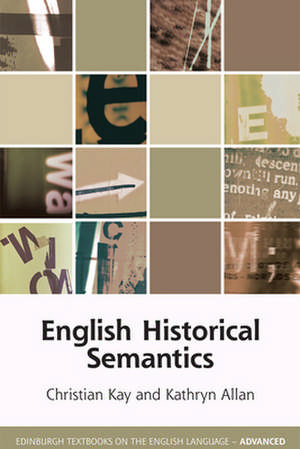
English Historical Semantics
Autor Christian Kay, Kathryn L Allanen Limba Engleză Paperback – 8 oct 2015
Preț: 178.03 lei
Preț vechi: 199.92 lei
-11%
Puncte Express: 267
Carte disponibilă
Livrare economică 05-19 noiembrie
Livrare express 22-28 octombrie pentru 45.88 lei
Livrare prin curier în România Termenul estimat este afișat lângă disponibilitate.
Transport gratuit de la 400.00 lei Plată online sau ramburs, în funcție de opțiunile comenzii.
Retur gratuit în 14 zile Comandă securizată și suport în română.
Specificații
ISBN-13: 9780748644773
ISBN-10: 0748644776
Pagini: 224
Ilustrații: 224 Illustrations
Dimensiuni: 139 x 216 x 17 mm
Greutate: 0.28 kg
Editura: EDINBURGH UNIVERSITY PRESS
ISBN-10: 0748644776
Pagini: 224
Ilustrații: 224 Illustrations
Dimensiuni: 139 x 216 x 17 mm
Greutate: 0.28 kg
Editura: EDINBURGH UNIVERSITY PRESS
V-ar putea interesa
-
 Verbal Judo, Second EditionGeorge J ThompsonPreț: 78.35 lei
 -
 Preț: 102.97 lei
 -
 The Utility of Meaning: What Words Mean and WhyN. J. Enfield-31%Preț: 724.54 lei1053.00 lei
 -
 Weak Island SemanticsMárta Abrusán-22%Preț: 349.79 lei449.68 lei
 -
 -31%Preț: 1028.58 lei1495.28 lei
 -
 Rhetoric: A Very Short IntroductionRichard Toye-20%Preț: 56.62 lei70.82 lei
 -
 English LexicogenesisD. Gary Miller-31%Preț: 934.08 lei1361.06 lei
 -
 Semantics of Statebuilding: Language, meanings and sovereigntyNicolas Lemay-Hébert-18%Preț: 1339.71 lei1633.80 lei
 -
 On DialogueDavid BohmPreț: 230.67 lei
 -
 Stylish Academic WritingHelen SwordPreț: 191.35 lei
 -
 Organizational DiscourseFrancois CoorenPreț: 187.30 lei
 -
 A Glossary of Semantics and PragmaticsAlan Cruse-10%Preț: 128.12 lei142.26 lei
 -
 -24%Preț: 693.81 lei912.23 lei
 -
 Elements of Formal SemanticsYoad Winter-24%Preț: 185.38 lei244.43 lei
 -
 -21%Preț: 691.29 lei869.66 lei
 -
 Edinburgh Handbook of Evaluative MorphologyNicola Grandi-24%Preț: 1194.30 lei1576.99 lei
 -
 The Semantics of Word Formation and LexicalizationPius Ten Hacken-25%Preț: 601.15 lei799.64 lei
 -
 The Stylistics of Professional DiscourseMartin Solly-24%Preț: 496.94 lei654.73 lei
 -
 Understanding PolitenessDániel Z. KádárPreț: 391.44 lei
 -
 Metaphor and MetonymyAllanPreț: 281.24 lei
 -
 Understanding SemanticsSebastian LöbnerPreț: 450.03 lei
 -
 Historical Cognitive LinguisticsMargaret E. Winters-23%Preț: 1140.34 lei1480.95 lei
 -
 Current Methods in Historical SemanticsJustyna A. Robinson-23%Preț: 1139.76 lei1480.21 lei
Cuprins
Chapter 1: Introduction; Chapter 2: A brief history of the English lexicon; 2.1 Introduction; 2.2 Old English (OE: 700-1150); 2.3 Middle English (ME: 1150-1500); 2.4 Early Modern English (EModE: 1500-1750); 2.5 Late Modern English (LModE: 1750 to present day); 2.6 Conclusion: The Present Day; Chapter 3: Categories of meaning; 3.1. Introduction; 3.2 Traditional approaches to Semantics; 3.2.1 Reference; 3.2.2 Sense; 3.2.2.1 Sense relationships; 3.2.3 Components, sets and fields; 3.2.4 A note on homonymy; 3.2.5 A memory aid; 3.3 Categories and prototypes; 3.3.1 Prototypes in action; 3.3.2 Lexical prototypes; 3.3.3 Homonymy revisited; 3.4 Domains and frames; 3.5. Conclusion; Chapter 4: Tracing the development of individual words; 4.1 Introduction; 4.2 Introducing the OED; 4.2.1 OED1; 4.2.2 OED2; 4.2.3 OED3; 4.3 What the OED tells us; 4.3.1 manga2; 4.3.2 monster; 4.3.2.1 Formal history and etymology of monster; 4.3.2.2 Semantic history; 4.3.3 Overview; 4.4 Some other historical dictionaries; 4.4.1 Middle English Dictionary (MED); 4.4.2 Anglo-Norman Dictionary (AND); 4.4.3 Dictionary of the Scots Language (DSL); 4.4.4 Dictionary of Old English (DOE); 4.4.5 Other dictionaries; 4.5 Historical corpora; Chapter 5: How and why words change meaning; 5.1 Introduction; 5.2 The significance of meaning change; 5.3 Studying semantic change; 5.4 The process of semantic change; 5.5 Categories of meaning change; 5.5.1 Widening (or broadening or generalisation) and narrowing (or specialisation); 5.5.2 Amelioration (or elevation) and pejoration (or deterioration or degeneration); 5.5.3 Metaphor and metonymy; 5.6 Grammaticalisation; 5.7 Why do words change meaning?; 5.7.1 External factors; 5.7.2 Internal factors: polysemy, homonymy, synonymy; 5.7.3 Stylistic factors; 5.8 Conclusion; Chapter 6: Larger categories; 6.1 Introduction; 6.2 A brief history of thesauruses; 6.3 The structure of thesauruses; 6.3.1 Basic level and other categories; 6.3.2 Folk and expert categories; 6.4 Using HTOED; 6.4.1 The structure of HTOED; 6.4.2 Inside HTOED categories; 6.5 Conclusion; Chapter 7: English Colour Terms: A case study, C. P. Biggam; 7.1 Introduction; 7.2 How to describe colour; 7.3 What are Basic Colour Terms?; 7.4 The evolution of basic colour categories; 7.5 The development of colour terms in English; 7.5.1 Old English (OE: 700-1150); 7.5.2 Middle English (ME: 1150-1500); 7.5.3 Modern English (ModE 1500-); 7.6 The changing nature of a basic category: BLUE; 7.7 Summary; 7.8 Conclusion; Chapter 8: Language and culture; 8.1 Introduction; 8.2 Linguistics and anthropology; 8.3 Pronouns of address; 8.4 Kinship; 8.4.1 Recent changes; 8.5 Time; 8.6 Conclusion; Chapter 9: Metaphor and metonymy; 9.1 Introduction; 9.2 Metaphor in language and thought; 9.3 Another kind of mapping: metonymy; 9.4 Metaphor and motivation; 9.5 Metonymy and motivation; 9.6 Conclusion; Chapter 10: The big picture and a look ahead; 10.1 Introduction; 10.2 The big picture; 10.3 Green as an example; 10. 4 Looking ahead; References; Glossary of key terms; Index