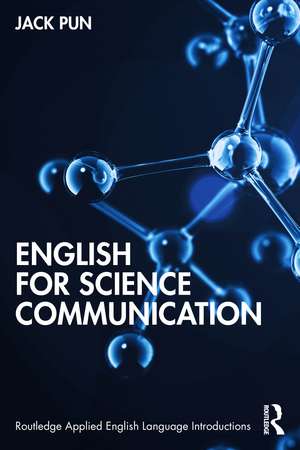
English for Science Communication: Routledge Applied English Language Introductions
Autor Jack Punen Limba Engleză Paperback – 10 noi 2025
The book introduces students to common rhetorical structures used in authentic scientific communication, as well as the typical vocabulary and grammar needed to express these structures. Students will learn to evaluate and report the findings of a scientific study using a range of genres, modes, and media formats, including written scientific reports and multimodal scientific documentaries.
Introducing how to understand, present, write, and communicate scientific information in English, this practical guide is essential for all students using English in their science degrees, including as a second language.

Preț: 382.48 lei
Puncte Express: 574
Carte disponibilă
Livrare economică 31 octombrie-14 noiembrie
Livrare express 17-23 octombrie pentru 39.58 lei
Livrare prin curier în România Termenul estimat este afișat lângă disponibilitate.
Transport gratuit de la 400.00 lei Plată online sau ramburs, în funcție de opțiunile comenzii.
Retur gratuit în 14 zile Comandă securizată și suport în română.
Specificații
ISBN-13: 9781032582771
ISBN-10: 1032582774
Pagini: 368
Ilustrații: 32
Dimensiuni: 156 x 234 x 20 mm
Greutate: 0.56 kg
Ediția:1
Editura: Taylor & Francis
Colecția Routledge
Seria Routledge Applied English Language Introductions
Locul publicării:Oxford, United Kingdom
ISBN-10: 1032582774
Pagini: 368
Ilustrații: 32
Dimensiuni: 156 x 234 x 20 mm
Greutate: 0.56 kg
Ediția:1
Editura: Taylor & Francis
Colecția Routledge
Seria Routledge Applied English Language Introductions
Locul publicării:Oxford, United Kingdom
Public țintă
Undergraduate CoreCuprins
1. Introduction 2. Understanding the Nature of Science Communication 3. Getting Started: Choosing, Evaluating, and Planning Scientific Research 4. Presenting Scientific Information: Structure, Purpose, and Audience 5. Oral Scientific Communication: Documentaries, Scripts, and Presentation Skills 6. Writing in the Scientific Community: Overview and Generic Structure, Citation Styles, and Academic Referencing 7. Introducing Your Research Topic, Conducting a Scientific Investigation, and Writing a Literature Review 8. Describing Methods and Results 9. Discussing Findings and Drawing Conclusions in Science Writing 10. Analysing Science Communication Through Technology (e.g. Using Corpus Tools)
Notă biografică
Jack Pun is Associate Professor in the Department of English at the Chinese University of Hong Kong, Hong Kong SAR, China. He is author of English Medium Instruction in Secondary Education: Policy, Challenges and Practices in Science Classrooms, The Role of Language in Eastern and Western Health Communication, and (with Jack C. Richards) Teaching and Learning in English Medium Instruction: An Introduction.
Descriere
English for Science Communication introduces English-language knowledge and skills for scientific communication in local and international contexts. It develops students’ ability to locate and critically read a variety of scientific texts and communicate the findings of scientific projects to specialist and non-specialist audiences.