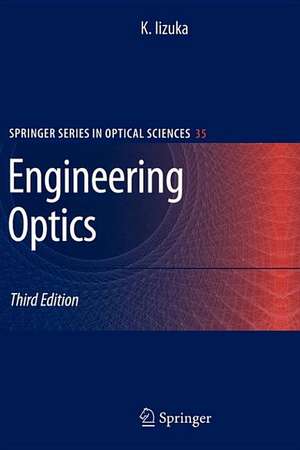
Engineering Optics: Springer Series in Optical Sciences, cartea 35
Autor Keigo Iizukaen Limba Engleză Paperback – 18 noi 2010
Din seria Springer Series in Optical Sciences
- 18%
 Preț: 2204.06 lei
 - 18%
 Preț: 1174.91 lei
 - 18%
 Preț: 958.26 lei
 - 20%
 Preț: 830.84 lei
 - 18%
 Preț: 994.17 lei
 - 18%
 Preț: 923.20 lei
 - 15%
 Preț: 670.11 lei
 - 18%
 Preț: 1846.34 lei
 -
 Preț: 364.80 lei
 - 18%
 Preț: 1392.57 lei
 - 18%
 Preț: 1610.77 lei
 - 18%
 Preț: 2172.45 lei
 - 18%
 Preț: 1233.64 lei
 - 15%
 Preț: 667.47 lei
 - 18%
 Preț: 992.04 lei
 - 18%
 Preț: 983.39 lei
 - 18%
 Preț: 1199.62 lei
 - 18%
 Preț: 910.28 lei
 -
 Preț: 395.45 lei
 - 18%
 Preț: 1035.00 lei
 - 18%
 Preț: 1497.80 lei
 - 18%
 Preț: 1151.98 lei
 - 15%
 Preț: 677.51 lei
 -
 Preț: 413.61 lei
 - 18%
 Preț: 915.58 lei
 - 15%
 Preț: 616.28 lei
 - 15%
 Preț: 609.78 lei
 - 18%
 Preț: 1846.51 lei
 - 18%
 Preț: 1276.23 lei
 -
 Preț: 368.82 lei
 - 15%
 Preț: 640.28 lei
 - 18%
 Preț: 988.65 lei
 - 18%
 Preț: 994.79 lei
 - 18%
 Preț: 1387.68 lei
 - 18%
 Preț: 983.39 lei
 - 18%
 Preț: 1114.16 lei
Preț: 514.00 lei
Preț vechi: 634.56 lei
-19%
Puncte Express: 771
Carte tipărită la comandă
Livrare economică 30 noiembrie-05 decembrie
Livrare prin curier în România Termenul estimat este afișat lângă disponibilitate.
Transport gratuit pentru acest produs Plată online sau ramburs, în funcție de opțiunile comenzii.
Retur gratuit în 14 zile Comandă securizată și suport în română.
Specificații
ISBN-13: 9781441926036
ISBN-10: 1441926038
Pagini: 552
Dimensiuni: 155 x 235 x 29 mm
Greutate: 0.84 kg
Ediția:Softcover reprint of hardcover 3rd ed. 2008
Editura: Springer
Colecția Springer
Seria Springer Series in Optical Sciences
Locul publicării:New York, NY, United States
ISBN-10: 1441926038
Pagini: 552
Dimensiuni: 155 x 235 x 29 mm
Greutate: 0.84 kg
Ediția:Softcover reprint of hardcover 3rd ed. 2008
Editura: Springer
Colecția Springer
Seria Springer Series in Optical Sciences
Locul publicării:New York, NY, United States
V-ar putea interesa
-
 The Quantum Theory of LightRodney Loudon-21%Preț: 514.64 lei647.84 lei
 -
 Atomic Physics: Precise Measurements and Ultracold MatterMassimo Inguscio-20%Preț: 684.58 lei857.51 lei
 -
 Non-Linear Pulses in Integrated and Waveguide OpticsA. B. Shvartsburg-32%Preț: 558.27 lei826.31 lei
 -
 Phase Space Methods for Degenerate Quantum GasesBryan J. Dalton-31%Preț: 874.13 lei1270.55 lei
 -
 Mathematical Foundations of Imaging, Tomography and Wavefield InversionAnthony J. Devaney-11%Preț: 444.03 lei498.91 lei
 -
 Optical PhysicsAriel Lipson-19%Preț: 744.48 lei919.10 lei
 -
 Introduction to Quantum OpticsGilbert Grynberg-11%Preț: 757.32 lei850.93 lei
 -
 Classical Optics and its ApplicationsMasud Mansuripur-11%Preț: 650.92 lei731.37 lei
 -
 Geometrical and Trigonometric OpticsEustace L. Dereniak-11%Preț: 702.08 lei788.84 lei
 -
 -14%Preț: 1177.45 lei1369.13 lei
 -
 Quantum OpticsGirish S. Agarwal-8%Preț: 585.61 lei636.54 lei
 -
 Quantum DotsAlexander Tartakovskii-14%Preț: 1068.22 lei1242.11 lei
 -
 Spectrograph Design FundamentalsJohn JamesPreț: 335.42 lei
 -
 Photonics, Volume 1David L. Andrews-23%Preț: 896.38 lei1164.12 lei
 -
 The Physics of InvisibilityMartin BeechPreț: 186.25 lei
 -
 Schrodinger's Kittens: And The Search For RealityDr John Gribbin-26%Preț: 68.58 lei93.26 lei
Public țintă
GraduateDescriere
Engineering
Optics
is
a
book
for
students
who
want
to
apply
their
knowledge
of
optics
to
engineering
problems,
as
well
as
for
engineering
students
who
want
to
acquire
the
basic
principles
of
optics.
It
covers
such
important
topics
as
optical
signal
processing,
holography,
tomography,
holographic
radars,
fiber
optical
communication,
electro-
and
acousto-optic
devices,
and
integrated
optics
(including
optical
bistability).
As
a
basis
for
understanding
these
topics,
the
first
few
chapters
give
easy-to-follow
explanations
of
diffraction
theory,
Fourier
transforms,
and
geometrical
optics.
Practical
examples,
such
as
the
video
disk,
the
Fresnel
zone
plate,
and
many
more,
appear
throughout
the
text,
together
with
numerous
solved
exercises.
There
is
an
entirely
new
section
in
this
updated
edition
on
3-D
imaging.
Cuprins
History
of
Optics.-
Mathematics
Used
for
Expressing
Waves.-
Basic
Theory
of
Diffractions.-
Practical
Examples
of
Diffraction
Theory.-
Geometrical
Optics.-
Lenses.-
The
Fast
Fourier
Transform
(FFT).-
Holography.-
Laboratory
Procedures
for
Fabricating
Holograms.-
Analysis
of
the
Optical
System
in
the
Spatial
Frequency
Domain.-
Optical
Signal
Processing.-
Applications
of
Microwave
Holography.-Fiber
Optical
Communication.-
Electro
and
Acousto
Optics.-
Integrated
Optics.-
3D
Imaging.-
References.
Recenzii
From
the
reviews
of
the
third
edition:
"...contains 15 richly illustrated chapters and very well selected exercises and problems. It is intended not only for the physics and engineering students who want to acquire the basic principles of optics, but also for researchers and engineers who use optics in their research and/or professional activity. For all these people, this book will be a valuable source of scientific information. ..." Optica Applicata
"Iizuka managed to intermingle lively and exciting ideas, humorous and enthusiastic presentations, eye-catching and tasteful cartoons, significant backbone optics materials and even some frontier state-of-the-art optics information. I did not have a dull moment reading this book. It has a very attractive style: educational, yet entertaining…."
IEEE Circuits and Devices Magazine
"I found this book most helpful in demonstrating an effective teaching approach that was especially suited for engineering students. … The examples and problem sets at the each chapter are also helpful to students and instructors … . Overall, it is a delightful book, and I would definitely recommend it to students starting out on the path of exploring optical technologies and educators who want to enlighten young engineers fascinated by optics." (Li Qian, Optics and Photonics News, November, 2008)
"...contains 15 richly illustrated chapters and very well selected exercises and problems. It is intended not only for the physics and engineering students who want to acquire the basic principles of optics, but also for researchers and engineers who use optics in their research and/or professional activity. For all these people, this book will be a valuable source of scientific information. ..." Optica Applicata
"Iizuka managed to intermingle lively and exciting ideas, humorous and enthusiastic presentations, eye-catching and tasteful cartoons, significant backbone optics materials and even some frontier state-of-the-art optics information. I did not have a dull moment reading this book. It has a very attractive style: educational, yet entertaining…."
IEEE Circuits and Devices Magazine
"I found this book most helpful in demonstrating an effective teaching approach that was especially suited for engineering students. … The examples and problem sets at the each chapter are also helpful to students and instructors … . Overall, it is a delightful book, and I would definitely recommend it to students starting out on the path of exploring optical technologies and educators who want to enlighten young engineers fascinated by optics." (Li Qian, Optics and Photonics News, November, 2008)
Caracteristici
Provides
easy-to-follow
explanations
of
diffraction
theory,
Fourier
transforms,
and
geometrical
optics
Practical examples, such as the video disk, the Fresnel zone plate, and many more, appear throughout the text, together with numerous solved exercises, plus new chapter on 3-D imaging
Brings back to life a classic in the field of optics
Practical examples, such as the video disk, the Fresnel zone plate, and many more, appear throughout the text, together with numerous solved exercises, plus new chapter on 3-D imaging
Brings back to life a classic in the field of optics
Notă biografică
Dr Keigo Iizuka is Professor Emeritus at the University of Toronto and a Fellow of the Optical Society of America. He was born in Kobe, Japan, and he began his university studies at Kyoto University. He completed his Ph. D at Harvard University, where he also worked for a short while as a research fellow and a lecturer. For the past thiry-five years, he has been a professor in the Department of Electrical and Computer Engineering at the University of Toronto.
His research interests have evolved over the years. He began with studies of the properties of antennas, microwave measurements, and microwave holography. These studies served as the foundation for subsequent projects such as the development of an ice surveying radar and a step frequency radar. With the advent of the laser, his studies shifted to the optical frequency range, where once again, his previous work on microwave phenomena served as an excellent foundation for the transition to optical phenomena. In the field of optics, his research includes optical measurement and sensor technology, fiber and integrated optics, the analysis of nonlinear guides, the invention of laser microvision and the Axi-Vision Camera, and 3D displays.