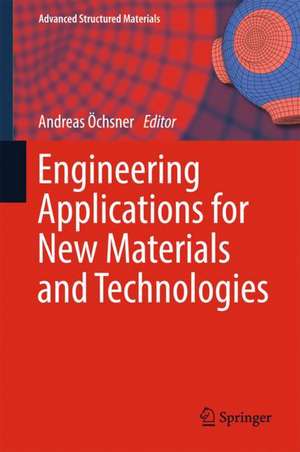
Engineering Applications for New Materials and Technologies: Advanced Structured Materials, cartea 85
Editat de Andreas Öchsneren Limba Engleză Hardback – feb 2018
For example, modern joining technologies can be used to fabricate new compound or composite materials, even those formed from dissimilar component materials. These composite materials are often exposed to harsh environments, must deliver specific characteristics, and are primarily used in automotive and marine technologies, i.e., ships, amphibious vehicles, docks, offshore structures, and even robots. To achieve the desired material performance, computer-based engineering tools are widely used for simulation, data evaluation, and design processes.
Din seria Advanced Structured Materials
- 18%
 Preț: 1109.29 lei
 - 18%
 Preț: 1112.94 lei
 - 18%
 Preț: 993.98 lei
 - 15%
 Preț: 689.81 lei
 - 18%
 Preț: 1120.77 lei
 - 18%
 Preț: 1077.69 lei
 - 18%
 Preț: 1125.80 lei
 - 18%
 Preț: 788.52 lei
 - 18%
 Preț: 862.77 lei
 - 18%
 Preț: 1227.22 lei
 - 18%
 Preț: 1059.18 lei
 - 18%
 Preț: 761.96 lei
 - 18%
 Preț: 808.98 lei
 - 18%
 Preț: 1118.46 lei
 - 18%
 Preț: 1123.28 lei
 - 24%
 Preț: 1186.26 lei
 - 18%
 Preț: 749.54 lei
 - 18%
 Preț: 1093.91 lei
 - 18%
 Preț: 724.04 lei
 - 18%
 Preț: 783.22 lei
 - 18%
 Preț: 806.42 lei
 - 18%
 Preț: 802.31 lei
 - 18%
 Preț: 1127.87 lei
 - 18%
 Preț: 1084.29 lei
 - 18%
 Preț: 864.31 lei
 - 18%
 Preț: 1122.11 lei
 - 18%
 Preț: 972.02 lei
 - 18%
 Preț: 909.56 lei
 - 18%
 Preț: 859.41 lei
 - 18%
 Preț: 916.96 lei
 - 15%
 Preț: 620.26 lei
 - 15%
 Preț: 641.85 lei
 - 15%
 Preț: 716.99 lei
 - 18%
 Preț: 957.40 lei
 - 15%
 Preț: 653.73 lei
 - 18%
 Preț: 917.87 lei
 - 18%
 Preț: 1235.06 lei
 - 15%
 Preț: 640.28 lei
 - 15%
 Preț: 656.12 lei
 - 15%
 Preț: 619.71 lei
 - 15%
 Preț: 652.18 lei
 - 15%
 Preț: 662.34 lei
 - 15%
 Preț: 646.25 lei
 - 15%
 Preț: 624.00 lei
 - 15%
 Preț: 649.22 lei
 - 18%
 Preț: 905.56 lei
Preț: 989.10 lei
Preț vechi: 1206.21 lei
-18%
Puncte Express: 1484
Carte tipărită la comandă
Livrare economică 21 noiembrie-05 decembrie
Livrare prin curier în România Termenul estimat este afișat lângă disponibilitate.
Transport gratuit pentru acest produs Plată online sau ramburs, în funcție de opțiunile comenzii.
Retur gratuit în 14 zile Comandă securizată și suport în română.
Specificații
ISBN-13: 9783319726960
ISBN-10: 331972696X
Pagini: 676
Ilustrații: XII, 661 p. 438 illus., 390 illus. in color.
Dimensiuni: 160 x 241 x 42 mm
Greutate: 1.17 kg
Ediția:1st edition 2018
Editura: Springer
Colecția Advanced Structured Materials
Seria Advanced Structured Materials
Locul publicării:Cham, Switzerland
ISBN-10: 331972696X
Pagini: 676
Ilustrații: XII, 661 p. 438 illus., 390 illus. in color.
Dimensiuni: 160 x 241 x 42 mm
Greutate: 1.17 kg
Ediția:1st edition 2018
Editura: Springer
Colecția Advanced Structured Materials
Seria Advanced Structured Materials
Locul publicării:Cham, Switzerland
Cuprins
1 A Study on the Effect of Parameters on the Tensile Strength of Friction Stir Welded AA6061 1.5 mm Thin Plate Butt-Joints.- 2 Physical and Chemical Properties of Perak River Sand for Greensand Casting Molds.- 3 Potential Use of Cellulose Fibre Composites in Marine Environment – A Review.- 4 Development of a Batik Fiberglass Composite for Marine Applications Based on Water Absorption Testing.
Textul de pe ultima copertă
This book discusses the expertise, skills, and techniques needed for the development of new materials and technologies. It focuses on finite element and finite volume methods that are used for engineering simulations, and present many state-of-the-art applications and advances to highlight these methods’ importance.
For example, modern joining technologies can be used to fabricate new compound or composite materials, even those formed from dissimilar component materials. These composite materials are often exposed to harsh environments, must deliver specific characteristics, and are primarily used in automotive and marine technologies, i.e., ships, amphibious vehicles, docks, offshore structures, and even robots. To achieve the desired material performance, computer-based engineering tools are widely used for simulation, data evaluation, and design processes.
For example, modern joining technologies can be used to fabricate new compound or composite materials, even those formed from dissimilar component materials. These composite materials are often exposed to harsh environments, must deliver specific characteristics, and are primarily used in automotive and marine technologies, i.e., ships, amphibious vehicles, docks, offshore structures, and even robots. To achieve the desired material performance, computer-based engineering tools are widely used for simulation, data evaluation, and design processes.