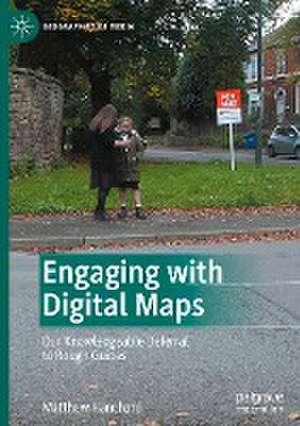
Engaging with Digital Maps: Geographies of Media
Autor Matthew Hancharden Limba Engleză Hardback – 14 feb 2024





Preț: 862.07 lei
Preț vechi: 1051.30 lei
-18%
Puncte Express: 1293
Carte tipărită la comandă
Livrare economică 19 noiembrie-03 decembrie
Livrare prin curier în România Termenul estimat este afișat lângă disponibilitate.
Transport gratuit pentru acest produs Plată online sau ramburs, în funcție de opțiunile comenzii.
Retur gratuit în 14 zile Comandă securizată și suport în română.
Specificații
ISBN-13: 9789819989713
ISBN-10: 981998971X
Pagini: 308
Ilustrații: XXI, 283 p.
Dimensiuni: 153 x 216 x 22 mm
Greutate: 0.51 kg
Ediția:1st ed. 2024
Editura: Palgrave MacMillan
Colecția Geographies of Media
Seria Geographies of Media
Locul publicării:Singapore, Singapore
ISBN-10: 981998971X
Pagini: 308
Ilustrații: XXI, 283 p.
Dimensiuni: 153 x 216 x 22 mm
Greutate: 0.51 kg
Ediția:1st ed. 2024
Editura: Palgrave MacMillan
Colecția Geographies of Media
Seria Geographies of Media
Locul publicării:Singapore, Singapore
Cuprins
Chapter 1: Introduction.- Chapter 2: The socio-technical development of digital maps.- Chapter 3: The missing user in cartographic thought.- Chapter 4: Towards a practice-orientated digital sociology.- Chapter 5: Applying practice-orientated digital sociology.- Chapter 6: Knowledgeable deferral and digital maps as anchors.- Chapter 7: Centring anchors and the affordances of digital maps.- Chapter 8: Rough guides that anchor and the affordances of digital maps.- Chapter 9: Conclusion.
Textul de pe ultima copertă
This book fills a gap in sociological theory surrounding how we engage with digital maps like Google Maps, Bing Maps, and OpenStreetMap (OSM). It explains how they feature in everyday life and with what social consequences. To do so, the book walks through examples of how digital maps shape social practices, from choosing which home to buy (landed capital acquisition), through to selecting routes between places. The book first provides a socio-technical background to digital maps and their development as progeny of the Internet and web rather than direct successors to paper-based ones. It then charts the evolution of theory about map use from its origin in academic cartography to contemporary thought, introducing concepts from systems-based communication models, semiotics, cognitive-behaviorism, critical cartography, and critical data and platform studies. With background concepts in place, the book moves on to develop a particular framework for analysing digital media use. Combining digital sociology and practice theory, the book works through empirical examples to cumulatively develop a new sociological theory on the social consequences of digital maps. The book argues that we defer to digital maps knowledgeably as rough guides, adopting a Bayesian logic - albeit with an awareness of their potential for error. As a result, decisions over choice of place and route - the mobility of people and things in space - become anchored within people’s deferral to digital maps. By extension, so do senses of place, sense of security, and the performance of social positions.
Dr Matthew Hanchard is a Research Associate at the University of Sheffield (UK) with research interests spanning digital sociology, medical sociology, and science and technology studies. His research to date has involved activity on projects funded by the AHRC, ARC, European Commission (COST), UKRI, and Wellcome Trust.
Dr Matthew Hanchard is a Research Associate at the University of Sheffield (UK) with research interests spanning digital sociology, medical sociology, and science and technology studies. His research to date has involved activity on projects funded by the AHRC, ARC, European Commission (COST), UKRI, and Wellcome Trust.