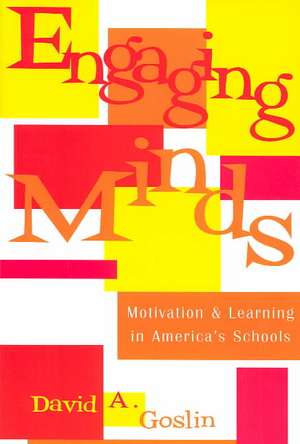
Engaging Minds: Motivation and Learning in America's Schools
Autor David A. Goslinen Limba Engleză Paperback – 11 iun 2003
Preț: 346.82 lei
Preț vechi: 461.16 lei
-25%
Puncte Express: 520
Carte tipărită la comandă
Livrare economică 03-17 decembrie
Livrare prin curier în România Termenul estimat este afișat lângă disponibilitate.
Transport gratuit de la 400.00 lei Plată online sau ramburs, în funcție de opțiunile comenzii.
Retur gratuit în 14 zile Comandă securizată și suport în română.
Specificații
ISBN-13: 9780810847132
ISBN-10: 0810847132
Pagini: 216
Dimensiuni: 146 x 230 x 12 mm
Greutate: 0.29 kg
Ediția:0216
Editura: Bloomsbury Publishing
Colecția R&L Education
Locul publicării:New York, United States
ISBN-10: 0810847132
Pagini: 216
Dimensiuni: 146 x 230 x 12 mm
Greutate: 0.29 kg
Ediția:0216
Editura: Bloomsbury Publishing
Colecția R&L Education
Locul publicării:New York, United States
V-ar putea interesa
-
 Teaching as a Subversive ActivityNeil PostmanPreț: 93.26 lei
 -
 Ethics and Politics in Early Childhood EducationGunilla Dahlberg-15%Preț: 450.78 lei530.34 lei
 -
 Preț: 448.17 lei
 -
 Preț: 451.24 lei
 -
 Schools Our Children Deserve, TheAlfie KohnPreț: 122.02 lei
 -
 Cultivating HumanityMartha Craven NussbaumPreț: 213.64 lei
 -
 Fight For Your Long DayAlex KuderaPreț: 123.28 lei
 -
 Preț: 194.69 lei
 -
 Beyond MeasureVicki AbelesPreț: 88.15 lei
 -
 Visible Learning for Literacy, Grades K-12Douglas FisherPreț: 206.90 lei
Cuprins
Chapter 1 Preface
Chapter 2 Chapter 1 Introduction
Chapter 3 Chapter 2 Engagement: A Necessary Condition for Learning
Chapter 4 Chapter 3 Effort versus Ability: A Matter of Expectations
Chapter 5 Chapter 4 Rewards for Effort
Chapter 6 Chapter 5 Organizing Effort: Increasing the Efficiency of Learning
Chapter 7 Chapter 6 Valuing Effort: Social and Cultural Influences on Academic Motivation
Chapter 8 Chapter 7 Competition for Effort: Academic versus Other Goals
Chapter 9 Chapter 8 Engaging More Minds: Increasing Motivation and Learning in Schools
Chapter 10 References
Chapter 11 Index
Chapter 12 About the Author
Chapter 2 Chapter 1 Introduction
Chapter 3 Chapter 2 Engagement: A Necessary Condition for Learning
Chapter 4 Chapter 3 Effort versus Ability: A Matter of Expectations
Chapter 5 Chapter 4 Rewards for Effort
Chapter 6 Chapter 5 Organizing Effort: Increasing the Efficiency of Learning
Chapter 7 Chapter 6 Valuing Effort: Social and Cultural Influences on Academic Motivation
Chapter 8 Chapter 7 Competition for Effort: Academic versus Other Goals
Chapter 9 Chapter 8 Engaging More Minds: Increasing Motivation and Learning in Schools
Chapter 10 References
Chapter 11 Index
Chapter 12 About the Author
Recenzii
After all the debates about improving curriculum, teaching, testing, and the organization of schooling, Goslin cuts through this thicket to address a central impediment to real learning: student motivation and engagement. Drawing on current research in this complex field, Goslin provides a concrete guide to understanding the forces shaping motivation. Readers can use this resource to craft improved approaches to stimulating students' love of learning and their motivation to learn more.
The questionnaire item 'Good luck is more important than hard work for success in school' was the most powerful single predictor for achievement in the famous study by James Coleman in 1966. A "no" response predicted high achievement. Hard work is the product of motivation, the topic of this important book. David Goslin examines in a thoughtful and readable style the nature and determinants of this common sense notion of what propels some people successfully through life. For parents and teachers, as well as scholars, this is a compelling read.
The central message of David Goslin's important new book is that engagement in the learning process is the key to academic achievement. Students at JEB Stuart High School in Northern Virginia speak more than 40 languages and 60 percent of them are eligible for free or reduced price lunches. Yet we are sending 90 percent of our students on to college. Our success can be attributed in large part to the creation of a mutually supportive community of students, parents, and teachers committed to the importance of academic achievement. Stuart's story provides clear evidence in support of much of what Goslin has to say about the things that positively affect engagement in learning and what can be done to increase it.
A concrete and readable guide to understanding the forces shaping students' motivation...Thoughtful, timely, and compelling, this study will serve as a great reference for further research in the field and is recommended not only for educators but for parents and teachers as well.
Educational researcher Goslin examines the forces that keep students from taking an interest in their studies, and, thus, from achieving academic success, in this in-depth analysis.
This is a timely book on a topic of central importance. Student engagement has been largely ignored by contemporary educational theorists and researchers. Yet it may be the key to understanding when learning occurs and when it does not. Anyone interested in understanding why should be certain to read this book.
The questionnaire item 'Good luck is more important than hard work for success in school' was the most powerful single predictor for achievement in the famous study by James Coleman in 1966. A "no" response predicted high achievement. Hard work is the product of motivation, the topic of this important book. David Goslin examines in a thoughtful and readable style the nature and determinants of this common sense notion of what propels some people successfully through life. For parents and teachers, as well as scholars, this is a compelling read.
The central message of David Goslin's important new book is that engagement in the learning process is the key to academic achievement. Students at JEB Stuart High School in Northern Virginia speak more than 40 languages and 60 percent of them are eligible for free or reduced price lunches. Yet we are sending 90 percent of our students on to college. Our success can be attributed in large part to the creation of a mutually supportive community of students, parents, and teachers committed to the importance of academic achievement. Stuart's story provides clear evidence in support of much of what Goslin has to say about the things that positively affect engagement in learning and what can be done to increase it.
A concrete and readable guide to understanding the forces shaping students' motivation...Thoughtful, timely, and compelling, this study will serve as a great reference for further research in the field and is recommended not only for educators but for parents and teachers as well.
Educational researcher Goslin examines the forces that keep students from taking an interest in their studies, and, thus, from achieving academic success, in this in-depth analysis.
This is a timely book on a topic of central importance. Student engagement has been largely ignored by contemporary educational theorists and researchers. Yet it may be the key to understanding when learning occurs and when it does not. Anyone interested in understanding why should be certain to read this book.