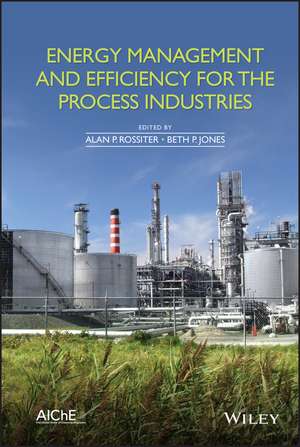
Energy Management and Efficiency for the Process Industries
Editat de Alan P Rossiter, Beth P Jonesen Limba Engleză Hardback – 20 apr 2015
Începem analiza acestui volum prin prisma autorului său, AP Rossiter, a cărui experiență depășește sfera pur tehnică. Așa cum a demonstrat în lucrarea sa anterioară, Professional Excellence – Beyond Technical Competence, Rossiter crede cu tărie că succesul în inginerie necesită o sinergie între rigoarea științifică și eficiența organizațională. Această filozofie fundamentează Energy Management and Efficiency for the Process Industries, un ghid practic publicat de Wiley care transformă eficiența energetică dintr-un concept abstract într-un program operațional sustenabil. Remarcăm structura binară a volumului, care deservește atât nivelul decizional, cât și cel executiv. Prima secțiune ne oferă un cadru metodologic pentru proiectarea programelor de management energetic, de la stabilirea obiectivelor și benchmarking până la designul organizațional și interacțiunea umană. Descoperim aici studii de caz concrete care ilustrează modul în care companiile pot captura economii semnificative prin politici corect implementate. A doua parte a cărții revine la ingineria tradițională, analizând echipamentele de proces și sistemele de uzine prin lentila eficienței, fără a compromite cerințele de producție. Complementar volumului Industrial Energy Management Strategies de Kaushik Bhattacharjee, care pune accent pe analizele de regresie multivariate și CUSUM, lucrarea lui Rossiter acoperă zona critică a structurii de personal și a managementului de echipe energetice, oferind o perspectivă mai integrată asupra ecosistemului industrial. Față de abordările strict academice, acest manual de 400 de pagini funcționează ca o resursă „go-to” pentru inginerii chimiști sau mecanici care preiau responsabilități de coordonare energetică, oferindu-le instrumentele necesare pentru a naviga între specificațiile tehnice ale utilajelor și prioritățile strategice ale corporației.
Preț: 666.42 lei
Preț vechi: 724.37 lei
-8%
Carte tipărită la comandă
Livrare economică 04-18 decembrie
Specificații
ISBN-10: 1118838254
Pagini: 400
Ilustrații: illustrations
Dimensiuni: 161 x 240 x 26 mm
Greutate: 0.76 kg
Editura: Wiley
Locul publicării:Hoboken, United States
V-ar putea interesa
-
 Essentials of ManagementDavid Boddy-13%Preț: 571.93 lei657.39 lei
 -
 The Improvement GuideGerald J Langley-19%Preț: 445.95 lei550.56 lei
 -
 The Principles of Scientific ManagementFrederick Winslow TaylorPreț: 43.15 lei
 -
 Preț: 374.97 lei
 -
 Preț: 374.38 lei
 -
 Manufacturing Process Validation: Concepts, Tools, and Industrial ApplicationsArturo Realyvásquez-Vargas-8%Preț: 442.51 lei481.00 lei
 -
 -19%Preț: 464.69 lei573.69 lei
 -
 Operations and Process ManagementNigel Slack-9%Preț: 578.43 lei635.64 lei
 -
 -19%Preț: 439.33 lei542.38 lei
 -
 Reimagining Operational ExcellencePhilip KotlerPreț: 156.63 lei
 -
 Preț: 225.41 lei
 -
 The Consultant¿s HandbookSamir ParikhPreț: 190.93 lei
 -
 Handbook of Energy Audits, Ninth EditionAlbert Thumann-14%Preț: 902.45 lei1049.36 lei
 -
 Guide to Energy Management, Eighth EditionBarney L. Capehart, Ph.D., CEM-14%Preț: 1175.28 lei1366.61 lei
 -
 Guide to Energy Management, Eighth Edition - International VersionBarney L. Capehart-23%Preț: 1127.40 lei1464.16 lei
 -
 TPM in Process IndustriesTokutaro Suzuki-9%Preț: 828.73 lei910.69 lei
 -
 Shadows At WorkSteven D'SouzaPreț: 112.53 lei
 -
 The Phoenix ProjectMike CollinsPreț: 138.20 lei
 -
 The Origins of EfficiencyBrian PotterPreț: 248.00 lei
 -
 Energy Efficiency in IndustryMarkus Blesl-18%Preț: 744.69 lei908.16 lei
Public țintă
Engineers and managers engaged in various aspects of energy management including corporate energy managers, site energy managers, energy coordinators, and energy team members as well as many engineers (e.g., design engineers, contact engineers, production engineers) who have some components of energy management within their job responsibilities. Typically they hold degrees in chemical, mechanical or industrial engineering. Some may be Certified Energy Managers (CEM).De ce să citești această carte
Recomandăm această carte inginerilor și managerilor de sit care doresc să implementeze programe de eficiență energetică bazate pe date, nu doar pe intuiție. Cititorul câștigă acces la metodologii verificate pentru reducerea costurilor operaționale și optimizarea echipamentelor de proces. Este o resursă esențială pentru obținerea sau menținerea certificării Certified Energy Manager (CEM), oferind echilibrul perfect între expertiza tehnică și strategia de management industrial.
Descriere
This book provides a unique overview of energy management for the process industries. It provides an overall approach to energy management and places the technical issues that drive energy efficiency in context. It combines the perspectives of freewheeling consultants and corporate insiders.
In two sections, the book provides the organizational framework (Section 1) within which the technical aspects of energy management, described in Section 2, can be most effectively executed. It includes success stories from three very different companies that have achieved excellence in their energy management efforts. It covers energy management, including the role of the energy manager, designing and implementing energy management programs, energy benchmarking, reporting, and energy management systems.
Technical topics cover efficiency improvement opportunities in a wide range of utility systems and process equipment types, as well as techniques to improve process design and operation.
Descriere scurtă
With a Foreword by The Honorable Charles D. McConnell, former Assistant Secretary of Energy
Energy efficiency is highly visible in industry in the US and around the world. Many engineers and managers are assigned energy management roles at some point in their careers, but few have a clear understanding of either the scope of the opportunity or the available methodologies to capture savings.
Energy Management and Efficiency for the Process Industries is a "go-to" source for engineers and managers who are designing and implementing policies and programs for energy management and energy efficiency. It introduces a framework for an industrial energy management program, provides illustrations, and discusses the basic principles that lead to robust and sustainable improvements in energy performance.
Through contributions from leading experts in diverse fields, Energy Management and Efficiency for the Process Industries provides a unique overview of industrial energy management informed by the technologies and issues that drive energy efficiency in the process industries.
Divided into two sections, the book provides both management and technical recommendations. The management section offers guidance on how to design and implement energy management programs, with advice on the organizational design, human interaction, and technical aspects of energy management. Management topics include program goal setting, benchmarking, strategies, priorities, tools, the roles of energy management personnel, and case studies from three successful energy programs.
The second section deals with more traditional engineering--the technical aspects of significant process equipment and systems, seen through the lens of energy efficiency as well as process requirements. Technical experts provide advice on proven options for understanding and enhancing the energy efficiency of the plant systems and equipment items with the highest impact on process energy efficiency success.