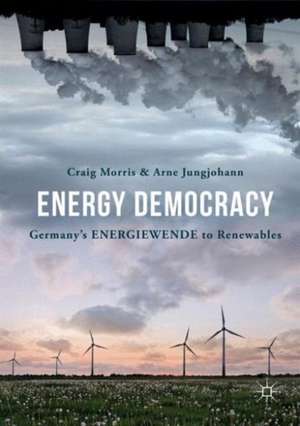
Energy Democracy
Autor Craig Morris, Arne Jungjohannen Limba Engleză Hardback – 26 sep 2016
This book outlines how Germans convinced their politicians to pass laws allowing citizens to make their own energy, even when it hurt utility companies to do so. It traces the origins of the Energiewende movement in Germany from the Power Rebels of Schönau to German Chancellor Angela Merkel’s shutdown of eight nuclear power plants following the 2011 Fukushima nuclear accident. The authors explore how, by taking ownership of energy efficiency at a local level, community groups are key actors in the bottom-up fight against climate change. Individually, citizens might install solar panels on their roofs, but citizen groups can do much more: community wind farms, local heat supply, walkable cities and more. This book offers evidence that the transition to renewables is a one-time opportunity to strengthen communities and democratize the energy sector – in Germany and around the world.
Preț: 379.31 lei
Puncte Express: 569
Carte tipărită la comandă
Livrare economică 24 noiembrie-08 decembrie
Livrare prin curier în România Termenul estimat este afișat lângă disponibilitate.
Transport gratuit de la 400.00 lei Plată online sau ramburs, în funcție de opțiunile comenzii.
Retur gratuit în 14 zile Comandă securizată și suport în română.
Specificații
ISBN-13: 9783319318905
ISBN-10: 331931890X
Pagini: 464
Ilustrații: XXIII, 437 p. 1 illus. in color.
Dimensiuni: 153 x 216 x 30 mm
Greutate: 0.67 kg
Ediția:1st edition 2016
Editura: Palgrave MacMillan
Locul publicării:Cham, Switzerland
ISBN-10: 331931890X
Pagini: 464
Ilustrații: XXIII, 437 p. 1 illus. in color.
Dimensiuni: 153 x 216 x 30 mm
Greutate: 0.67 kg
Ediția:1st edition 2016
Editura: Palgrave MacMillan
Locul publicării:Cham, Switzerland
V-ar putea interesa
-
 Energy Poverty: Global Challenges and Local SolutionsAntoine Halff-31%Preț: 937.17 lei1363.42 lei
 -
 Global Energy DilemmasMichael J. Bradshaw-15%Preț: 434.37 lei511.02 lei
 -
 Global Energy DilemmasMike BradshawPreț: 181.67 lei
 -
 -9%Preț: 866.99 lei952.74 lei
 -
 Energy Security in Japan: Challenges After FukushimaVlado Vivoda-18%Preț: 1253.73 lei1528.95 lei
 -
 United States Energy SecurityBrandon E Mcdonald-27%Preț: 1000.24 lei1362.90 lei
 -
 Clean Energy Standard Act: Policy Proposal & ImpactsAaron C K Kim-26%Preț: 500.87 lei675.07 lei
 -
 Spent Nuclear Fuel: Storage Options & EffortsPhillip T Crawford-27%Preț: 999.79 lei1362.60 lei
 -
 -27%Preț: 999.20 lei1362.23 lei
 -
 -27%Preț: 889.05 lei1210.69 lei
Cuprins
Chapter 1: Energiewende – the solution to more problems than climate change.- Chapter 2: The birth of a movement: 1970s protests for democracy in Wyhl.- Chapter 3: Fledgling wind power – the folly of innovation without deployment.- Chapter 4: German wind pioneers fighting power monopolies in the 1980s.- Chapter 5: The Power Rebels of Schönau.- Chapter 6: Renewable energy in conservative communities.- Chapter 7: The 1990s: laying the foundations for the Energiewende.- Chapter 8: Green capitalism made in Germany.- Chapter 9: The Red-Green revolution (1998-2005).- Chapter 10: Healthy democracy: key to the Energiewende’s success.- Chapter 11: Utilities bet on gas and coal and renewables boom (2005-2011).- Chapter 12: From Meitner to Merkel: a history of German nuclear power.- Chapter 13: Merkel takes ownership of the Energiewende (2011-today).- Chapter 14: Will the Energiewende succeed?.- Chapter 15: Act now or be left out.
Textul de pe ultima copertă
This book offers an accessible overview of how Germans convinced their politicians to pass laws allowing citizens to make their own energy, even when it hurt utility companies to do so. It traces the origins of the Energiewende movement in Germany from the Power Rebels of Schönau to German Chancellor Angela Merkel’s shutdown of eight nuclear power plants following the 2011 Fukushima nuclear accident. The authors explore how, by taking ownership of energy efficiency at a local level, community groups are key actors in the bottom-up fight against climate change. Individually, citizens might install solar panels on their roofs, but citizen groups can do much more: community wind farms, local heat supply, walkable cities and more. This book offers evidence that the transition to renewables is a one-time opportunity to strengthen communities and democratize the energy sector – in Germany and around the world.
Craig Morris is Contributing Editor of Renewables Internationaland lead author at EnergyTransition.de. He has served as editor of IRENA’s REmap report and Greenpeace’s Energy (R)evolution in addition to translating several major German books on renewables into English. In 2014, he won the IAEE prize for journalism in energy economics.
Arne Jungjohann is an author, consultant and political scientist. He served as a strategic advisor for the Minister President of Baden-Württemberg and in the Deutscher Bundestag. Based in Washington DC for several years, he fostered transatlantic dialogue on climate and energy matters. He lives with his family in Stuttgart.
Caracteristici
Focuses on Germany as a role-model for other countries to follow Feeds into the broader discussion surrounding energy transition and the move from coal and nuclear to renewables Tackles the debate in an accessible and engaging style