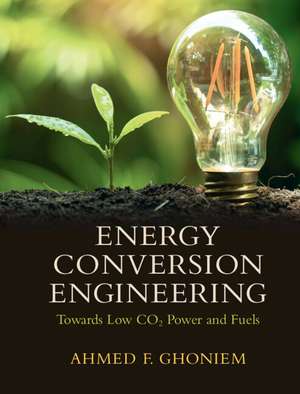
Energy Conversion Engineering
Autor Ahmed F Ghoniemen Limba Engleză Hardback – 13 ian 2022
Subliniem de la început că Energy Conversion Engineering este un volum dens, de 1000 de pagini, conceput pentru studenții de la nivel licență avansată și masterat, precum și pentru cercetătorii care stăpânesc deja bazele fizicii și matematicii inginerești. Autorul Ahmed F Ghoniem propune o abordare riguroasă a sistemelor energetice moderne, punând un accent deosebit pe tranziția către soluții cu emisii reduse de carbon. Notăm cu interes structura cursului: primele capitole consolidează fundamentele termodinamicii chimice și electrochimice, elemente esențiale pentru a înțelege funcționarea pilelor de combustie și a proceselor de ardere. Progresia conținutului este logică și tehnică, migrând de la ciclurile clasice de turbine cu gaz și Rankine către sisteme hibride, energie solară termică și geotermală. Ceea ce diferențiază acest tratat de Energy Systems de Renaud Gicquel este rigoarea acordată fundamentelor termodinamice; în timp ce volumul lui Gicquel prioritizează modelarea sistemelor în detrimentul teoriei de bază, Ahmed F Ghoniem insistă pe conexiunea indisolubilă dintre principiile fizice și designul final al instalației. De asemenea, spre deosebire de Applied Thermodynamics de Andriy Redko, care se concentrează pe aplicații la temperaturi joase și HVAC, volumul de față oferă o analiză mult mai detaliată a ciclurilor de captare a carbonului pentru gaze naturale și cărbune (capitolele 11-13). Lucrarea include resurse practice valoroase, precum proiecte de semestru și probleme complexe de calcul, transformând teoria abstractă în instrumente de proiectare pentru ingineria viitorului.
Preț: 648.54 lei
Preț vechi: 712.69 lei
-9%
Carte disponibilă
Livrare economică 29 mai-12 iunie
Livrare express 14-20 mai pentru 88.89 lei
Specificații
ISBN-10: 1108478379
Pagini: 1000
Dimensiuni: 203 x 249 x 41 mm
Greutate: 1.91 kg
Ediția:Nouă
Editura: Cambridge University Press
Locul publicării:Cambridge, United Kingdom
V-ar putea interesa
-
 Fundamentals of Renewable Energy ProcessesAldo Vieira da Rosa-32%Preț: 505.23 lei742.68 lei
 -
 Bioprocess Engineering PrinciplesRoss Carlson-33%Preț: 577.49 lei867.31 lei
 -
 Energy Systems: A Very Short IntroductionNick Jenkins-22%Preț: 53.62 lei68.32 lei
 -
 Thermodynamics of Chemical ProcessesGareth PricePreț: 231.78 lei
 -
 -21%Preț: 368.09 lei466.43 lei
 -
 Chemical, Biochemical, and Engineering ThermodynamicsStanley I. Sandler-19%Preț: 566.47 lei699.34 lei
 -
 Applied Thermodynamics for Engineering TechnologistsT. D. Eastop-15%Preț: 644.42 lei758.14 lei
 -
 Renewable Energy EngineeringNick JenkinsPreț: 440.50 lei
 -
 -14%Preț: 744.62 lei865.83 lei
 -
 -23%Preț: 567.20 lei736.62 lei
 -
 Thermodynamics: An Engineering Approach ISEYunus Cengel-26%Preț: 376.13 lei505.69 lei
 -
 Reeds Vol 12: Motor Engineering Knowledge for Marine EngineersAnthony S Prince-27%Preț: 362.47 lei498.70 lei
 -
 Power Plant EngineeringFarshid Zabihian-23%Preț: 1114.16 lei1446.96 lei
 -
 Thermal Sciences for MachinesGiorgio Cornetti-15%Preț: 583.14 lei686.05 lei
 -
 Thermal EngineeringVladimir Ermolaev-15%Preț: 565.58 lei665.39 lei
 -
 Sustainability of Thermochemical Waste Conversion TechnologiesCynthia Ofori-Boateng-18%Preț: 966.48 lei1178.63 lei
 -
 -18%Preț: 885.70 lei1080.12 lei
 -
 Electrochemical Energy Conversion and StorageRudolf Holze-19%Preț: 515.44 lei636.35 lei
 -
 Thermodynamics for Chemical EngineersKenneth R. Hall-11%Preț: 535.05 lei601.19 lei
De ce să citești această carte
Această resursă este esențială pentru inginerii care doresc să proiecteze sisteme energetice durabile. Prin parcurgerea celor 14 capitole, cititorul câștigă capacitatea de a modela matematic procese complexe, de la gazeificarea biomasei la pile de combustie. Este un instrument de lucru care face trecerea de la termodinamica teoretică la soluții industriale concrete pentru reducerea amprentei de carbon.
Descriere scurtă
Cuprins
Recenzii
'A comprehensive toolkit for understanding, evaluating, and comparing conventional and evolving new energy systems in terms of their engineering performance and environmental impacts and benefits. It is a must-read for students and researchers interested in designing and modeling energy technologies to meet today's low-carbon-emitting and other sustainability objectives.' Jefferson Tester, Cornell University
'Professor Ghoniem draws from decades of research expertise and teaching experience at MIT in the field of energy conversion. This timely textbook covers both the fundamentals of thermodynamics and real-world applications of cutting-edge clean energy systems to equip the next generation of students to design, analyze, and optimize low-carbon and zero-carbon energy systems for a sustainable future.' Katherine Hornbostel, University of Pittsburgh
'This book provides a holistic view of energy conversion systems by discussing conventional concepts as well as emerging technologies, all of which are connected by fundamental energy conversion principles. I truly believe that readers can envision a bright pathway toward sustainable power generation with low environmental impact.' Jongsup Hong, Yonsei University
'An excellent, up-to-date, and comprehensive textbook and reference in energy conversion. It provides a practical and fresh perspective on the subject, which is nicely complemented with chapters addressing clean energy conversion and strategies to control CO2 emissions. This book is a must-have reference for anyone interested in the subject of energy conversion.' Tarek Echekki, North Carolina State University
'This book is systematically developed, very well organized, and well written. The coverage in all 14 chapters is comprehensive, with example problems and additional problems at the end of each chapter. It is a timely book as we seek innovative solutions for clean energy production at higher efficiency, with due considerations given to environmental pollution, including CO2. I enthusiastically endorse this book.' Ashwani K. Gupta, University of Maryland