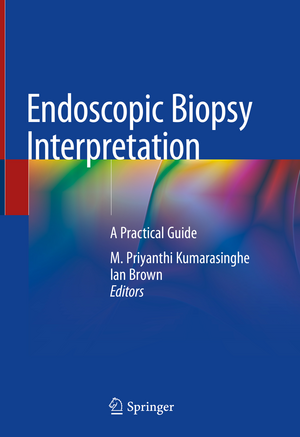
Endoscopic Biopsy Interpretation
Editat de M. Priyanthi Kumarasinghe, Ian Brownen Limba Engleză Hardback – 29 dec 2018
Observăm în practica curentă de anatomie patologică o creștere accelerată a volumului de biopsii endoscopice, acestea devenind printre cele mai frecvente specimene chirurgicale. Endoscopic Biopsy Interpretation abordează direct scenariile clinice în care aspectul microscopic poate fi diagnostic prin sine însuși sau, dimpotrivă, necesită o integrare riguroasă a datelor clinice și a testelor auxiliare. Recomandăm acest volum pentru rigoarea cu care tratează echilibrul dintre viteza de procesare și acuratețea interpretării, esențial în fluxul de lucru modern. Structura volumului urmărește o progresie logică, debutând cu un capitol fundamental despre trăsăturile mucoasei normale și anormale, urmat de o privire de ansamblu asupra pattern-urilor comune întregului tract tubular. Această abordare sistemică ne permite să identificăm reacțiile tisulare universale înainte de a trece la secțiunile specifice pentru esofag, stomac sau intestin. Fiecare segment anatomic este divizat strict între patologia non-neoplazică și cea neoplazică, facilitând o navigare rapidă prin diagnostic diferențial și „capcane” morfologice. Clinicienii care folosesc Atlas of Gastrointestinal Pathology: A Pattern Based Approach to Neoplastic Biopsies ca referință vor găsi aici o completare valoroasă prin accentul pus pe integrarea biomarkerilor și a semnăturilor moleculare direct în contextul biopsiei mici. Ediția princeps din 2019, publicată sub egida Springer, se distinge prin calitatea celor 269 de ilustrații color care susțin textul clinic. Credem că includerea tabelelor sintetice pentru interpretarea testelor auxiliare transformă această lucrare dintr-un tratat teoretic într-un instrument de lucru indispensabil la masa de microscop, oferind medicului patolog reperele necesare pentru a oferi valoare maximă fiecărei probe endoscopice.
Preț: 1055.17 lei
Preț vechi: 1110.70 lei
-5%
Carte tipărită la comandă
Livrare economică 23-28 noiembrie
Specificații
ISBN-10: 3319791168
Pagini: 426
Ilustrații: 1 schwarz-weiße und 269 farbige Abbildungen, Bibliographie
Dimensiuni: 183 x 260 x 24 mm
Greutate: 0.88 kg
Ediția:1st ed. 2019
Editura: Springer
Locul publicării:Cham, Switzerland
V-ar putea interesa
-
 Commercial LawIan Brown-33%Preț: 776.49 lei1158.61 lei
 -
 -18%Preț: 1171.58 lei1428.76 lei
 -
 -23%Preț: 552.87 lei719.02 lei
 -
 From Tartan to TartanryIan Brown-14%Preț: 210.13 lei243.27 lei
 -
 Burma's Economy in the Twentieth CenturyIan Brown-11%Preț: 565.53 lei635.43 lei
 -
 -42%Preț: 96.07 lei166.83 lei
 -
 Surgical Pathological Anatomy of Head and Neck SpecimensPieter Slootweg-25%Preț: 312.28 lei417.40 lei
 -
 -5%Preț: 383.14 lei403.31 lei
 -
 Diagnosis and Management of Pituitary TumorsKamal Thapar-5%Preț: 1129.44 lei1188.88 lei
 -
 Pathology of the Human Embryo and Previable FetusDagmar K. Kalousek-5%Preț: 364.50 lei383.68 lei
 -
 Introduction to Ion Beam BiotechnologyZengliang YuPreț: 379.61 lei
 -
 Breast Pathology: Problematic IssuesSami Shousha-5%Preț: 1566.21 lei1648.64 lei
 -
 Textbook of Head and Neck PathologyMargaret S. Brandwein-5%Preț: 449.54 lei473.20 lei
 -
 Atlas of Pediatric Brain TumorsAdekunle M. Adesina-5%Preț: 842.42 lei886.76 lei
 -
 -5%Preț: 693.44 lei729.94 lei
 -
 Pathology and Epidemiology of CancerMassimo Loda-5%Preț: 1291.27 lei1359.24 lei
 -
 Plasma Cell NeoplasmsRobert B. Lorsbach-5%Preț: 372.96 lei392.58 lei
 -
 The Infected EyeNora V. Laver-5%Preț: 795.79 lei837.67 lei
 -
 Pediatric DermatopathologyThuy L. Phung-5%Preț: 1050.02 lei1105.28 lei
 -
 Bacterial Infections and the KidneyAnjali A. Satoskar-5%Preț: 628.74 lei661.83 lei
 -
 -5%Preț: 1436.16 lei1511.75 lei
 -
 Pathologisch-Morphologische DiagnostikHans Bankl-5%Preț: 843.00 lei887.37 lei
 -
 PathologieW. Remmele-5%Preț: 584.85 lei615.63 lei
 -
 Ataxia-TelangiectasiaRichard A. Gatti-5%Preț: 355.81 lei374.54 lei
 -
 -5%Preț: 538.31 lei566.63 lei
 -
 Diagnostic Neuropathology: Volume 1Julio H. Garcia-5%Preț: 360.89 lei379.89 lei
De ce să citești această carte
Recomandăm această lucrare medicilor patologi și gastroenterologilor care doresc o metodologie sistematică de interpretare a biopsiilor digestive. Cititorul câștigă o înțelegere profundă a pattern-urilor de reacție tisulară și acces rapid la protocoalele de testare moleculară. Este un instrument esențial pentru tranziția de la simpla descriere morfologică la un diagnostic integrat, adaptat cerințelor oncologiei personalizate.
Despre autor
Volumul este coordonat de M. Priyanthi Kumarasinghe și Ian Brown, experți recunoscuți în patologia gastrointestinală. M. Priyanthi Kumarasinghe este un nume de referință în domeniul anatomiei patologice, contribuind constant la literatura de specialitate prin studii axate pe corelarea clinico-patologică. Expertiza editorilor se reflectă în abordarea pragmatică a cărții, aceștia reușind să integreze progresele recente în domeniul biomarkerilor într-un format accesibil pentru diagnosticul de rutină, asigurând o punte de legătură între patologia clasică și genetica moleculară.