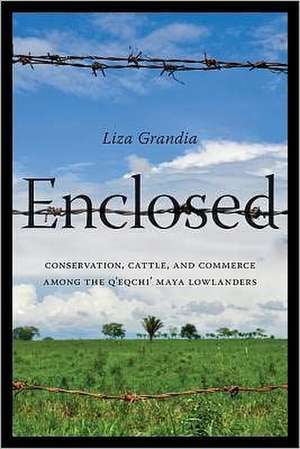
Enclosed: Culture, Place, and Nature
Autor Liza Grandiaen Limba Engleză Hardback – 15 mar 2012
Ne-a atras atenția modul în care lucrarea Enclosed reușește să abordeze o temă de o complexitate remarcabilă, situată la intersecția dintre antropologie politică, ecologie umană și economie globală. Liza Grandia investighează mecanismele prin care comunitățile indigene Q'eqchi' din Guatemala sunt sistematic îndepărtate de pe pământurile lor, transformând resursele comune în proprietăți private sub presiunea capitalului internațional. Observăm o structură narativă și analitică ce pornește de la rădăcinile „jafurilor liberale” istorice și ajunge până la analize contemporane ale politicilor de piață. Descoperim aici o critică documentată a intervențiilor instituțiilor financiare internaționale, precum Banca Mondială, și a modului în care tratatele de liber schimb (DR-CAFTA) accelerează închiderea frontierelor agricole.
Această cercetare extinde cadrul propus de Dams, Displacement and Development de Nathan Einbinder cu date noi din perioada neoliberală, oferind o perspectivă mai largă asupra modului în care proiectele de dezvoltare—fie că vorbim de baraje hidroelectrice sau de expansiunea fermelor de vite—generează marginalizare. În timp ce Einbinder se concentrează pe un incident specific de violență și strămutare, Liza Grandia oferă o sinteză a proceselor sociale și economice care stau la baza defrișărilor tropicale și a sărăciei cronice. Cartea este organizată riguros, incluzând glosare de termeni Q'eqchi' și hărți detaliate, facilitând înțelegerea tranziției de la commons (bunuri comune) la licitația neoliberală a teritoriului.
Din seria Culture, Place, and Nature
-
 Preț: 256.00 lei
 -
 Preț: 249.07 lei
 -
 Preț: 247.76 lei
 - 15%
 Preț: 618.57 lei
 -
 Preț: 268.74 lei
 - 23%
 Preț: 648.52 lei
 - 23%
 Preț: 651.49 lei
 - 23%
 Preț: 648.22 lei
 - 23%
 Preț: 647.46 lei
 - 23%
 Preț: 649.85 lei
 -
 Preț: 263.21 lei
 - 23%
 Preț: 657.00 lei
 - 23%
 Preț: 648.38 lei
 - 23%
 Preț: 620.23 lei
 - 36%
 Preț: 696.72 lei
 - 36%
 Preț: 694.35 lei
 - 23%
 Preț: 619.68 lei
Preț: 814.82 lei
Preț vechi: 1058.21 lei
-23%
Carte disponibilă
Livrare economică 04-18 noiembrie
Livrare express 20-24 octombrie pentru 33.86 lei
Specificații
ISBN-10: 0295991658
Pagini: 304
Dimensiuni: 236 x 420 x 23 mm
Greutate: 0.61 kg
Ediția:New.
Editura: University of Washington Press
Seria Culture, Place, and Nature
V-ar putea interesa
-
 The Theology of Huldrych ZwingliW. P. Stephens-19%Preț: 361.40 lei446.32 lei
 -
 -20%Preț: 324.51 lei405.37 lei
 -
 The Tragedy of Sohrab and RostamAbol-Qasem FerdowsiPreț: 229.06 lei
 -
 The Landscape of StalinismEvgeny DobrenkoPreț: 265.65 lei
 -
 The Northern Region of KoreaSun Joo KimPreț: 347.41 lei
 -
 Preț: 315.89 lei
 -
 Toxic ArchipelagoBrett L. WalkerPreț: 220.47 lei
 -
 Letters and Epistolary Culture in Early Medieval ChinaAntje RichterPreț: 248.70 lei
 -
 Idaho's PlaceAdam M SowardsPreț: 231.11 lei
 -
 The Berlin Diaries 1940-45Marie Vassiltchikov-23%Preț: 108.97 lei141.36 lei
 -
 Napoleon for DummiesJ David MarkhamPreț: 137.87 lei
 -
 Death and Burial in the Roman WorldJ M C ToynbeePreț: 276.10 lei
 -
 Outwitting HistoryAaron LanskyPreț: 123.98 lei
 -
 The Condor YearsJohn Dinges-23%Preț: 90.45 lei117.36 lei
De ce să citești această carte
Recomandăm Enclosed specialiștilor în studii de dezvoltare și celor interesați de drepturile popoarelor indigene. Cititorul câștigă o înțelegere profundă a modului în care politicile economice globale se traduc în realități locale dure. Este o resursă esențială pentru a înțelege de ce conflictele funciare rămân punctul central al rezistenței culturale în America Latină, oferind un studiu de caz exemplar despre impactul capitalismului corporatist asupra mediului și societății.
Despre autor
Liza Grandia este o cercetătoare recunoscută pentru munca sa de teren în America Centrală, fiind apreciată pentru capacitatea de a conecta macroeconomia cu viața de zi cu zi a comunităților marginalizate. Expertiza sa se concentrează pe intersecția dintre conservarea biodiversității, drepturile funciare indigene și mișcările de justiție socială. Prin scrierile sale, Grandia aduce la lumină procesele invizibile ale acumulării de capital care afectează ecosistemele tropicale și structurile sociale tradiționale din regiunea Maya, fiind o voce influentă în studiile de ecologie politică contemporană.
Descriere scurtă
Recenzii
"Liza Grandia connects global economics, local livelihoods, and concerns for cultural survival in a way few writers manage to do. Enclosed makes transparent the social processes underpinning tropical deforestation, entrenched poverty, and the vulnerabilities created by global capital." Nora Haenn, author of Fields of Power, Forests of Discontent: Culture, Conservation and the State of Mexico "A compelling read and a significant scholarly contribution to our understanding of indigenous communities dealing with the destructive but also seductive penetration of global corporate interests." Eugene Hunn, author of A Zapotec Natural History: Trees, Herbs, and Flowers, Birds, Beasts, and Bugs in the Life of San Juan Gbee
Cuprins
Preface
Acknowledgements
Q'eqchi' Language and Orthography
Notes on Measurements
Maps
Introduction: Commons Past
1. Liberal Plunder: A Recurring Q'eqchi' History
2. Maya Gringos: Q'eqchi' Lowland Migration and Territorial Expansion
3. Commons, Customs, and Carrying Capacities: The Property and Population Traps of the Peten Frontier
4. Speculating: The World Bank's Market-Assisted Land Reform
5. From Colonial to Corporate Capitalism: Expanding Cattle Frontiers
6. The Neoliberal Auction: The PPP and the DR-CAFTA
Conclusion: Common Features
Glossary
Acronyms
Notes
Bibliography
Index