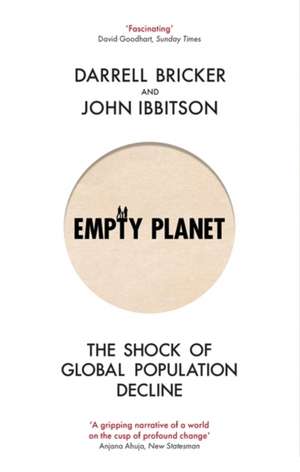
Empty Planet: The Shock of Global Population Decline
Autor Darrell Bricker, John Ibbitsonen Limba Engleză Paperback – 6 feb 2020
'Riveting and vitally important' - Steven Pinker
'A gripping narrative of a world on the cusp of profound change' - Anjana Ahuja, New Statesman
Empty Planet offers a radical, provocative argument that the global population will soon begin to decline, dramatically reshaping the social, political and economic landscape.
For half a century, statisticians, pundits and politicians have warned that a burgeoning planetary population will soon overwhelm the earth's resources. But a growing number of experts are sounding a different kind of alarm. Rather than growing exponentially, they argue, the global population is headed for a steep decline.
Throughout history, depopulation was the product of catastrophe: ice ages, plagues, the collapse of civilizations. This time, however, we're thinning ourselves deliberately, by choosing to have fewer babies than we need to replace ourselves. In much of the developed and developing world, that decline is already underway, as urbanisation, women's empowerment, and waning religiosity lead to smaller and smaller families. In Empty Planet, Ibbitson and Bricker travel from South Florida to Sao Paulo, Seoul to Nairobi, Brussels to Delhi to Beijing, drawing on a wealth of research and firsthand reporting to illustrate the dramatic consequences of this population decline - and to show us why the rest of the developing world will soon join in.
They find that a smaller global population will bring with it a number of benefits: fewer workers will command higher wages; good jobs will prompt innovation; the environment will improve; the risk of famine will wane; and falling birthrates in the developing world will bring greater affluence and autonomy for women. But enormous disruption lies ahead, too. We can already see the effects in Europe and parts of Asia, as aging populations and worker shortages weaken the economy and impose crippling demands on healthcare and vital social services. There may be earth-shaking implications on a geopolitical scale as well.
Empty Planet is a hugely important book for our times. Captivating and persuasive, it is a story about urbanisation, access to education and the empowerment of women to choose their own destinies. It is about the secularisation of societies and the vital role that immigration has to play in our futures.
Rigorously researched and deeply compelling, Empty Planet offers a vision of a future that we can no longer prevent - but that we can shape, if we choose to.
Preț: 67.60 lei
Preț vechi: 92.84 lei
-27%
Puncte Express: 101
Carte disponibilă
Livrare economică 03-17 noiembrie
Livrare express 20-24 octombrie pentru 45.36 lei
Livrare prin curier în România Termenul estimat este afișat lângă disponibilitate.
Transport gratuit de la 400.00 lei Plată online sau ramburs, în funcție de opțiunile comenzii.
Retur gratuit în 14 zile Comandă securizată și suport în română.
Specificații
ISBN-13: 9781472142979
ISBN-10: 1472142977
Pagini: 288
Dimensiuni: 126 x 196 x 24 mm
Greutate: 0.22 kg
Editura: Little Brown
Colecția Robinson
Locul publicării:London, United Kingdom
ISBN-10: 1472142977
Pagini: 288
Dimensiuni: 126 x 196 x 24 mm
Greutate: 0.22 kg
Editura: Little Brown
Colecția Robinson
Locul publicării:London, United Kingdom
Recenzii
'A fascinating study' David Goodhart, Sunday Times
'A bold thesis, but the authors are convincing . . . this briskly readable book demands urgent attention' Sarah Ditum, Mail on Sunday
For half a century, statisticians, pundits and politicians have warned that a burgeoning population will soon overwhelm the earth's resources. But a growing number of experts are sounding a different alarm. Rather than continuing to increase exponentially, they argue, the global population is headed for a steep decline - and in many countries, that decline has already begun.
In Empty Planet, international social researcher Darrell Bricker and award-winning journalist John Ibbitson find that a smaller global population will bring with it many benefits: fewer workers will command higher wages; the environment will improve; the risk of famine will wane; and falling birthrates in the developing world will bring greater affluence and autonomy for women. But enormous disruption lies ahead, too. To limit the effects of that disruption, nations must resist the growing isolationism that is leading some societies to close off just as openness becomes more critical to survival than ever.
Rigorously researched and deeply compelling, Empty Planet offers a vision of a future that we can no longer prevent - but that we can shape, if we choose.
'An ambitious reimagining of our demographic future' Doug Bock Clark, New York Times
A fascinating study
A bold thesis, but the authors are convincing . . . this briskly readable book demands urgent attention
The "everything you know is wrong" genre has become tedious, but this book is riveting and vitally important. With eye-opening data and lively writing, Bricker and Ibbitson show that the world is radically changing in a way that few people appreciate
[Bricker and Ibbitson] have written a sparkling and enlightening guide to the contemporary world of fertility as small family sizes and plunging rates of child-bearing go global.
Bricker and Ibbitson work their way around the globe in pacey, sometimes breathless journalistic prose, although their argument is refreshingly clear and well balanced . . .
The authors combine a mastery of social-science research with enough journalistic flair to convince fair-minded readers of a simple fact: fertility is falling faster than most experts can readily explain, driven by persistent forces . . . Empty Planet succeeds as a long-overdue skewering of population-explosion fearmongers
A highly readable, controversial insight into a world rarely thought about - a world of depopulation under ubiquitous urbanisation
While the global population is swelling well over 7.5 billion people today, birth rates have nonetheless already begun dropping around the world. Past population declines have historically been driven by natural disasters or disease - the Toba supervolcano, Black Death or Spanish Flu - but this coming slump will be of our own demographic making. In this fascinating and thought-provoking book, Bricker and Ibbitson compellingly argue why by the end of this century the problem won't be overpopulation but a rapidly shrinking global populace, and how we might have to adapt
To get the future right we must challenge our assumptions, and the biggest assumption so many of us make is that populations will keep growing. Bricker and Ibbitson deliver a mind-opening challenge that should be taken seriously by anyone who cares about the long-term future - which, I hope, is all of us
Thanks to the authors' painstaking fact-finding and cogent analysis, [Empty Planet] offers ample and persuasive arguments for a re-evaluation of conventional wisdom
Warnings of catastrophic world overpopulation have filled the media since the 1960s, so this expert, well-researched explanation that it's not happening will surprise many readers . . . delightfully stimulating
Arresting . . . lucid, trenchant and very readable . . . a stimulating challenge to conventional wisdom
A riveting travelogue that covers some of the most interesting places across the world
The beauty of this book is that it links hard-to-grasp global trends to the easy to-understand individual choices being made all over the world today . . . a gripping narrative of a world on the cusp of profound change
An ambitious reimagining of our demographic future
'A bold thesis, but the authors are convincing . . . this briskly readable book demands urgent attention' Sarah Ditum, Mail on Sunday
For half a century, statisticians, pundits and politicians have warned that a burgeoning population will soon overwhelm the earth's resources. But a growing number of experts are sounding a different alarm. Rather than continuing to increase exponentially, they argue, the global population is headed for a steep decline - and in many countries, that decline has already begun.
In Empty Planet, international social researcher Darrell Bricker and award-winning journalist John Ibbitson find that a smaller global population will bring with it many benefits: fewer workers will command higher wages; the environment will improve; the risk of famine will wane; and falling birthrates in the developing world will bring greater affluence and autonomy for women. But enormous disruption lies ahead, too. To limit the effects of that disruption, nations must resist the growing isolationism that is leading some societies to close off just as openness becomes more critical to survival than ever.
Rigorously researched and deeply compelling, Empty Planet offers a vision of a future that we can no longer prevent - but that we can shape, if we choose.
'An ambitious reimagining of our demographic future' Doug Bock Clark, New York Times
A fascinating study
A bold thesis, but the authors are convincing . . . this briskly readable book demands urgent attention
The "everything you know is wrong" genre has become tedious, but this book is riveting and vitally important. With eye-opening data and lively writing, Bricker and Ibbitson show that the world is radically changing in a way that few people appreciate
[Bricker and Ibbitson] have written a sparkling and enlightening guide to the contemporary world of fertility as small family sizes and plunging rates of child-bearing go global.
Bricker and Ibbitson work their way around the globe in pacey, sometimes breathless journalistic prose, although their argument is refreshingly clear and well balanced . . .
The authors combine a mastery of social-science research with enough journalistic flair to convince fair-minded readers of a simple fact: fertility is falling faster than most experts can readily explain, driven by persistent forces . . . Empty Planet succeeds as a long-overdue skewering of population-explosion fearmongers
A highly readable, controversial insight into a world rarely thought about - a world of depopulation under ubiquitous urbanisation
While the global population is swelling well over 7.5 billion people today, birth rates have nonetheless already begun dropping around the world. Past population declines have historically been driven by natural disasters or disease - the Toba supervolcano, Black Death or Spanish Flu - but this coming slump will be of our own demographic making. In this fascinating and thought-provoking book, Bricker and Ibbitson compellingly argue why by the end of this century the problem won't be overpopulation but a rapidly shrinking global populace, and how we might have to adapt
To get the future right we must challenge our assumptions, and the biggest assumption so many of us make is that populations will keep growing. Bricker and Ibbitson deliver a mind-opening challenge that should be taken seriously by anyone who cares about the long-term future - which, I hope, is all of us
Thanks to the authors' painstaking fact-finding and cogent analysis, [Empty Planet] offers ample and persuasive arguments for a re-evaluation of conventional wisdom
Warnings of catastrophic world overpopulation have filled the media since the 1960s, so this expert, well-researched explanation that it's not happening will surprise many readers . . . delightfully stimulating
Arresting . . . lucid, trenchant and very readable . . . a stimulating challenge to conventional wisdom
A riveting travelogue that covers some of the most interesting places across the world
The beauty of this book is that it links hard-to-grasp global trends to the easy to-understand individual choices being made all over the world today . . . a gripping narrative of a world on the cusp of profound change
An ambitious reimagining of our demographic future