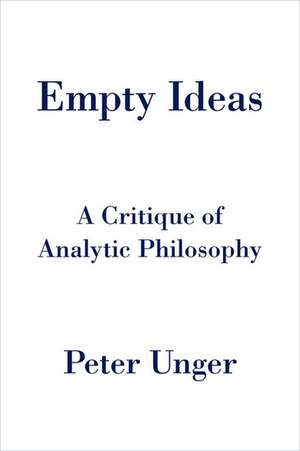
Empty Ideas: A Critique of Analytic Philosophy
Autor Peter Ungeren Limba Engleză Hardback – 7 aug 2014
Peter Unger's provocative new book poses a serious challenge to contemporary analytic philosophy, arguing that to its detriment it focuses the predominance of its energy on "empty ideas. " In the mid-twentieth century, philosophers generally agreed that, by contrast with science, philosophy should offer no substantial thoughts about the general nature of concrete reality. Leading philosophers were concerned with little more than the semantics of ordinary words. For example: Our word "perceives " differs from our word "believes " in that the first word is used more strictly than the second. While someone may be correct in saying "I believe there's a table before me "whether or not there is a table before her, she will be correct in saying "I perceive there's a table before me " only if there is a table there. Though just a parochial idea, whether or not it is correct does make a difference to how things are with concrete reality. In Unger's terms, it is a concretelysubstantial idea. Alongside each such parochial substantial idea, there is an analytic or conceptual thought, as with the thought that someone may believe there is a table before her whether or not there is one, but she will perceive there is a table before her only if there is a table there. Empty of import as to how things are with concrete reality, those thoughts are what Unger calls concretely empty ideas. It is widely assumed that, since about 1970, things had changed thanks to the advent of such thoughts as the content externalism championed by Hilary Putnam and Donald Davidson, various essentialist thoughts offered by Saul Kripke, and so on. Against that assumption, Unger argues that, with hardly any exceptions aside from David Lewis's theory of a plurality of concrete worlds, all of these recent offerings are concretely empty ideas. Except when offering parochial ideas, Peter Unger maintainsthat mainstream philosophy still offers hardly anything beyond concretely empty ideas."This incisive book lays crucial challenges at the door of mainstream analytic philosophy, for Unger argues persuasively that (contrary to its explicit self-conception), a great deal of recent philosophy has been concerned with merely conceptual issues-nothing 'concretely substantial'. The book is sure to provoke controversy and healthy debate about the role and value of philosophy." -Amie L. Thomasson, Professor of Philosophy and Cooper Fellow, University of Miami
Preț: 557.54 lei
Preț vechi: 807.76 lei
-31%
Carte tipărită la comandă
Livrare economică 27 noiembrie-08 decembrie
Specificații
ISBN-10: 0199330816
Pagini: 274
Dimensiuni: 160 x 236 x 28 mm
Greutate: 0.5 kg
Editura: Oxford University Press
Colecția OUP USA
Locul publicării:New York, United States
V-ar putea interesa
-
 -31%Preț: 1086.72 lei1584.85 lei
 -
 Identity, Consciousness, and ValuePeter Unger-24%Preț: 640.08 lei845.09 lei
 -
 Philosophical RelativityPeter Unger-22%Preț: 473.32 lei605.79 lei
 -
 All the Power in the WorldPeter Unger-18%Preț: 393.93 lei479.58 lei
 -
 Skepticism & Naturalism (Paper)P StrawsonPreț: 246.58 lei
 -
 Preț: 223.98 lei
 -
 The Critical Theory of Jürgen HabermasThomas MccarthyPreț: 409.98 lei
 -
 Preț: 238.01 lei
 -
 Lyotard ReaderBenjaminPreț: 438.77 lei
 -
 Levinas ReaderHandPreț: 438.96 lei
 -
 Methods of LogicWillard van Orman QuinePreț: 264.93 lei
 -
 Preț: 334.30 lei
 -
 Theories & Things (Paper)Willard Van Orm QuinePreț: 306.94 lei
 -
 The Zen Teaching of BodhidharmaBodhidharmaPreț: 94.91 lei
 -
 Deleuze and Futurism: A Manifesto for NonsenseHelen Palmer-14%Preț: 613.57 lei713.46 lei
 -
 Preț: 117.26 lei
 -
 Preț: 111.40 lei
Recenzii
Unger is careful and generous with most of the positions he is criticizing. He succeeds in shifting the burden of proof onto analytic philosophy's defenders ... Essential. Upper-level undergraduates and above.
Notă biografică
Peter Unger is a Professor of Philosophy at New York University. He is the author of five previous self-standing books, all currently available from the Oxford University Press: Ignorance: A Case for Scepticism; Philosophical Relativity; Identity, Consciousness and Value; Living High and Letting Die: Our Illusion of Innocence; and All the Power in the World. As well, Oxford has published hisPhilosophical Papers, a two-volume collection of shorter works previously published elsewhere.
Cuprins
- 1. How Empty is Mainstream Philosophy?
- 2. Promising Examples of Concretely Substantial Philosophy
- 3. Thinkers and What They Can Think About: Empty Issues and Individualistic Powers
- 4. The Origins of Material Individuals: Empty Issues and Sequentialistic Powers
- 5. The Persistence of Material Individuals: Empty Issues and Self-Directed Propensity
- 6. Empty Debates About Material Matters
- 7. Individuals, Properties and Time: A Few Substantial Thoughts and Many Empty Ideas
- 8. What Will Become of Us: Empty Issues and Substantial Speculations
- 9. When Will There Be Some Serious New Substantial Philosophy?