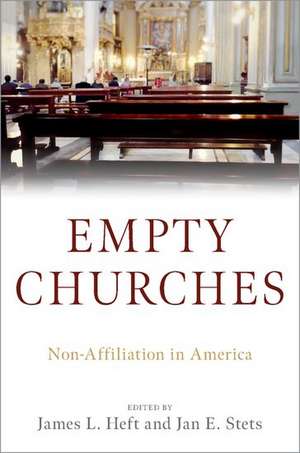
Empty Churches: Non-Affiliation in America
Editat de James L. Heft, Jan E. Stetsen Limba Engleză Paperback – 31 mar 2021
Preț: 277.07 lei
Puncte Express: 416
Carte disponibilă
Livrare economică 06-17 noiembrie
Livrare prin curier în România Termenul estimat este afișat lângă disponibilitate.
Transport gratuit de la 400.00 lei Plată online sau ramburs, în funcție de opțiunile comenzii.
Retur gratuit în 14 zile Comandă securizată și suport în română.
Specificații
ISBN-13: 9780197529324
ISBN-10: 0197529321
Pagini: 384
Dimensiuni: 155 x 231 x 28 mm
Greutate: 0.57 kg
Editura: Oxford University Press
Colecția OUP USA
Locul publicării:New York, United States
ISBN-10: 0197529321
Pagini: 384
Dimensiuni: 155 x 231 x 28 mm
Greutate: 0.57 kg
Editura: Oxford University Press
Colecția OUP USA
Locul publicării:New York, United States
Recenzii
Prefaced by the Bishop of San Diego, this important interdisciplinary study co-directed by a theologian (James L. Heft) and a sociologist (Jan E. Stets) attempts to understand the phenomenon of religious disaffiliation which, after having affected European countries, manifests itself today in the United States, more or less spared on this point until now.
I highly recommend this book, both for the extensive answers it provides to its guiding research questions, and for the avenues it charts for future research.
This volume is descriptive with a practical aim.
Empty Churches makes a significant contribution to understanding contemporary religious trends and offers valuable insights for scholars and practitioners alike. This book is particularly relevant for academics in religious studies,sociology, and political science, as well as for clergy and church leaders seeking to address declining participation. Its balanced treatment of statistical analysis and pastoral application makes it a valuable resource for anyone interested in the evolving landscape of faith and institutional religion.
I highly recommend this book, both for the extensive answers it provides to its guiding research questions, and for the avenues it charts for future research.
This volume is descriptive with a practical aim.
Empty Churches makes a significant contribution to understanding contemporary religious trends and offers valuable insights for scholars and practitioners alike. This book is particularly relevant for academics in religious studies,sociology, and political science, as well as for clergy and church leaders seeking to address declining participation. Its balanced treatment of statistical analysis and pastoral application makes it a valuable resource for anyone interested in the evolving landscape of faith and institutional religion.
Notă biografică
James L. Heft, S. M., served as professor and chair of the Theology Department at the University of Dayton for six years, Provost for eight years, and Chancellor and Professor of Faith and Culture for 10 years, before moving to the University of Southern California in 2006 as the Alton Brooks Professor of Religion and now the Founder and President Emeritus of the Institute for Advanced Catholic Studies. He is the author, editor and co-editor of fourteen books, including Catholicism and Interreligious Dialogue (OUP 2011) and Catholic High Schools: Facing the New Realities (OUP 2011).Jan E. Stets is Professor and Director of the Social Psychology Research Laboratory at the University of California, Riverside. She is the former Director of the Sociology Program at the National Science Foundation, and a former co-editor of Social Psychology Quarterly.
Cuprins
- Preface: Robert M. McElroy, Bishop of San Diego
- Chapter 1: Introduction: An Interdisciplinary Analysis of Non-Affiliation
- Jan E. Stets, University of California, Riverside
- WHO ARE THEY?
- Chapter 2: The Many Meanings of Non-Affiliation
- Nancy Ammerman, Boston University
- Chapter 3: The Many Meanings of the Secular
- Joseph O. Baker, East Tennessee State University
- Chapter 4: Lapsed Catholics and Other Religious Non-Affiliates
- Carol Ann MacGregor and Ashlyn Haycook, Loyola University New Orleans
- Chapter 5: Affiliates and Non-Affiliates in Later Life
- Vern Bengtson, University of Southern California, and Gabrielle Gonzales, Camille Endacott, and Samantha Copping Kang, University of California, Santa Barbara
- WHERE DO THEY COME FROM?
- Chapter 6: Developmental Views on Youth Religious Non-Affiliation
- Sam A. Hardy, Brigham Young University and Gregory S. Longo, Eastern University
- Chapter 7: Religious Non-Affiliation: Expelled by the Right
- William V. Trollinger, University of Dayton
- Chapter 8: The Transformation of Religion: Drawn by the Left
- Matthew S. Hedstrom, University of Virginia
- WHAT ARE SOME CONSEQUENCES?
- Chapter 9: Non-religiosity, Secularism, and Civil Society
- David E. Campbell, University of Notre Dame
- Chapter 10: Religious Non-Affiliation and Objections of Conscience
- Bernard G. Prusak, King's College
- ADDRESSING THE CHALLENGE
- Chapter 11: Reports from Faith Community Leaders in the South
- Elizabeth Kirkland Cahill
- Chapter 12: Cultivating Faith in Young Adults
- Kerry A. Robinson, Leadership Roundtable
- Chapter 13: Understanding and Responding to Non-Affiliation
- James L. Heft, University of Southern California
- Epilogue:
- Jan E. Stets, University of California, Riverside and James L. Heft, University of Southern California
- Notes
- Index