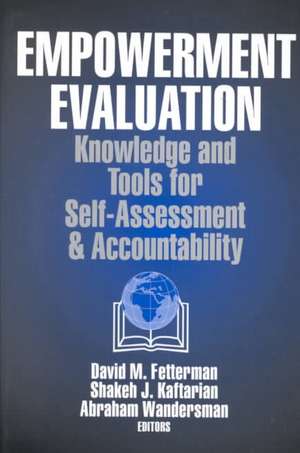
Empowerment Evaluation
Autor David M. Fetterman, Shakeh J. Kaftarian, Abraham Wandersmanen Limba Engleză Paperback – 25 oct 1995
În literatura academică dedicată metodologiilor de cercetare socială, a existat mult timp o lacună privind implicarea directă a beneficiarilor în procesul de auditare și îmbunătățire a propriilor programe. Empowerment Evaluation, aflat la a doua ediție, vine să completeze acest gol, oferind un cadru formal pentru ceea ce autorii numesc auto-evaluare sistematică și responsabilizare. Considerăm că acest volum este esențial pentru a înțelege tranziția de la evaluarea externă, adesea percepută ca intruzivă, la o abordare participativă în care evaluatorul devine un „prieten critic” al comunității. Descoperim aici o structură riguroasă, împărțită între fundamentele teoretice și aplicabilitatea lor în contexte diverse. Partea întâi clarifică cele 10 principii ale metodei, în timp ce a doua parte demonstrează versatilitatea acestora prin studii de caz ce variază de la organizații de femei artizan în Peru, până la inițiative tehnologice de amploare finanțate de Hewlett-Packard. Cititorii familiarizați cu Foundations of Empowerment Evaluation vor aprecia modul în care acest nou volum actualizează instrumentele de lucru, integrând lecțiile învățate în cele două decenii de la prima ediție. Subliniem importanța progresiei narative a textului: de la definirea misiunii și „inventarierea” resurselor, până la trasarea cursului viitor pentru sustenabilitate. Spre deosebire de Empowerment and Participatory Evaluation of Community Interventions, care se concentrează pe intervenția comunitară generală, lucrarea coordonată de David M. Fetterman, Shakeh J. Kaftarian și Abraham Wandersman oferă o metodologie de „capacity building” mult mai specifică, aplicabilă atât în fundații, cât și în mediul guvernamental. Tabelele și figurile alb-negru incluse facilitează înțelegerea fluxurilor de lucru, transformând o teorie complexă într-un ghid de implementare practic.
Preț: 478.63 lei
Carte tipărită la comandă
Livrare economică 30 noiembrie-14 decembrie
Specificații
ISBN-10: 076190025X
Pagini: 424
Ilustrații: 1
Dimensiuni: 152 x 229 x 25 mm
Greutate: 0.69 kg
Editura: SAGE Publications
Locul publicării:Thousand Oaks, United States
V-ar putea interesa
-
 Neighborhood and Community EnvironmentsAbraham Wandersman-15%Preț: 667.74 lei785.58 lei
 -
 Performance EthnographyNorman K. Denzin-18%Preț: 822.10 lei1002.56 lei
 -
 Next Steps With SPSSEric L. Einspruch-15%Preț: 454.15 lei534.29 lei
 -
 -27%Preț: 1094.00 lei1498.63 lei
 -
 The Qualitative Inquiry ReaderNorman K. Denzin-18%Preț: 821.28 lei1001.55 lei
 -
 Probability TheoryTamas RudasPreț: 325.63 lei
 -
 How To Report On SurveysArlene G. Fink-8%Preț: 509.65 lei553.96 lei
 -
 How To Design Survey StudiesArlene G. FinkPreț: 341.67 lei
 -
 Internet Data CollectionSamuel J. BestPreț: 318.88 lei
 -
 Postmodern InterviewingRobert D. Ramsey-18%Preț: 822.49 lei1003.04 lei
 -
 The Case Study AnthologyRobert K. Yin-18%Preț: 957.21 lei1167.33 lei
 -
 Practitioner Research for TeachersDiana Burton-15%Preț: 618.17 lei727.26 lei
 -
 Quality of Life ResearchMark Rapley-15%Preț: 601.10 lei707.17 lei
 -
 Internal EvaluationArnold J. Love-15%Preț: 609.38 lei716.92 lei
 -
 Professional EvaluationErnest R. House-18%Preț: 795.30 lei969.88 lei
 -
 Foundations of Empowerment EvaluationDavid M. Fetterman-15%Preț: 611.35 lei719.24 lei
 -
 Focus Group Interviews in Education and PsychologySharon Vaughn-15%Preț: 626.58 lei737.16 lei
 -
 Researching CulturePertti Alasuutari-27%Preț: 770.40 lei1055.34 lei
 -
 Preț: 220.57 lei
 -
 Action Research for EducatorsDaniel R. Tomal-24%Preț: 273.12 lei361.11 lei
 -
 Reflective InterviewingKathryn Joy Roulston-11%Preț: 430.80 lei484.05 lei
 -
 Community PsychologyBret KloosPreț: 458.52 lei
 -
 EthnographyDavid FettermanPreț: 381.64 lei
 -
 Doing Data Science in RMark Andrews-19%Preț: 431.79 lei533.08 lei
 -
 Preț: 312.43 lei
 -
 Your Undergraduate Dissertation in Health and Social CareNicholas WallimanPreț: 297.55 lei
De ce să citești această carte
Această ediție este indispensabilă pentru evaluatori, manageri de programe și studenți la sociologie care doresc să treacă dincolo de statisticile pasive. Cititorul câștigă acces la o metodologie testată global, care transformă evaluarea dintr-o sarcină administrativă într-un instrument de emancipare socială. Este resursa definitivă pentru a învăța cum să implici stakeholderii în procesul de luare a deciziilor bazate pe date factuale.
Descriere scurtă
Cuprins
Empowerment Evaluation - David M Fetterman
An Introduction to Theory and Practice
PART TWO: BREADTH AND SCOPE
Empowerment Evaluation and Accelerated Schools - Henry M Levin
Empowerment Evaluation and the W K Kellogg Foundation - Ricardo A Millett
PART THREE: CONTEXT
Empowerment Evaluation and State Government - Joyce Keller
Moving from Resistance to Adoption
The HIV Prevention Evaluation Initiative - Cynthia Gómez and Ellen Goldstein
A Model for Collaborative and Empowerment Evaluation
Empowerment Evaluation - Cheryl Grills et al
Building upon a Tradition of Activism in the African American Community
Realizing Participant Empowerment in the Evaluation of Nonprofit Women's Services Organizations - Arlene B Andrews
Notes from the Front Line
PART FOUR: THEORETICAL AND PHILOSOPHICAL FRAMEWORKS
Empowering Community Health Initiatives through Evaluation - Stephen B Fawcett et al
Empowerment Evaluation at Federal and Local Levels - Robert K Yin, Shakeh J Kaftarian, and Nancy F Jacobs
Dealing with Quality
Evaluation and Self-Direction in Community Prevention Coalitions - John F Stevenson, Roger E Mitchell, and Paul Florin
Fairness, Liberty, and Empowerment Evaluation - Dennis E Mithaug
PART FIVE: WORKSHOPS, TECHNICAL ASSISTANCE, AND PRACTICE
Empowering Community Groups with Evaluation Skills - Jean Ann Linney and Abraham Wandersman
The Prevention Plus III Model
Participatory and Empowerment Evaluation - Margret A Dugan
Lessons Learned in Training and Technical Assistance
The Plan Quality Index - Frances D Butterfoss et al
An Empowerment Evaluation Tool for Measuring and Improving the Quality of Plans
Building Community Capacity with Evaluation Activities That Empower - Steven W Mayer
PART SIX: CONCLUSION
Conclusion - David M Fetterman
Reflections on Emergent Themes and the Next Steps
Notă biografică
Descriere
Empowerment Evaluation begins with an in-depth examination of this type of evaluation as it has been adopted in academic and foundation settings. The book then focuses on the various contexts in which empowerment evaluation is conducted, ranging from resistant environments (in which significant effort is required to move from passive-compliance orientations) to responsive environments (that already have a tradition of self-determination and community organizing). Interesting highlights concerning the role empowerment evaluation has played in the U.S. Department of Health and Human Services' substance abuse prevention programs are detailed throughout the book. The contributors also provide down-to-earth tools and technical assistance needed to conduct empowerment evaluation. This volume concludes with themes that emerge from the chapters and recommendations concerning next steps. This serves to strengthen the links between empowerment evaluation and community capacity building.
empow
Recenzii
"This text brings empowerment evaluation to life, and in doing so it offers all evaluators a large body of relevant concepts and tools for designing, implementing, and assessing evaluation efforts that engage, democratize, and strengthen stakeholder’s self-determination."
"This twenty year follow-up to the original, provides even better and richer stories about the versatility and utility of empowerment work in most social contexts. It expands our understanding of how empowerment evaluation is foundational to any effort to improve and measure growth in any community/social environment."
"One of the greatest evaluation innovations of the past two decades has been the development of a professional and systematic approach to self-evaluation called empowerment evaluation. This book offers you the latest cutting edge understanding of this powerful innovation and evaluation approach. May you be inspired and empowered as you adventure through the chapters in this outstanding volume!"
"Empowerment evaluation is the name given by David Fetterman in his American Evaluation Association (AEA) 1993 Presidential Address to an evaluation theory and practice intended '... to foster improvement and self-determination'...Empowerment evaluation [is] of the people, for the people, and very much by the people. Our role as evaluators [is] to be a critical friend, a coach, and a source of technical assistance when it [is] requested by the self-evaluating communities and organizations. No wonder that in 1993 'conversations and arguments spilled out into the hallways'...Empowerment evaluation and its leaders have received AEA’s highest accolades, such as the Myrdal Evaluation Practice Award (awarded to Fetterman in 1995 and Kaftarian in 1996), the Outstanding Publication Award (Wandersman in 2008), and the Lazarsfeld Evaluation Theory Award (Fetterman in 2000) as well as other recognition...Each chapter giving a case instance explicitly connects the 10 principles of empowerment evaluation to the processes, decision-making, participation, utilization, and other aspects of the evaluations reported...the results of more than 25 years of dedicated hard work and diligent thought are being shared with us. My recommendation remains, unequivocally and appreciatively: This book belongs on our shelves. Get it, read it, and, as appropriate, use it."