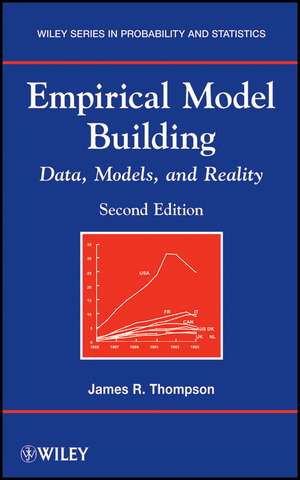
Empirical Model Building
Autor James R Thompsonen Limba Engleză Hardback – 8 noi 2011
Remarcăm în această a doua ediție a lucrării Empirical Model Building o trecere pragmatică de la teoria statistică pură către aplicabilitatea directă în sisteme complexe. Un punct central de interes este modul în care James R Thompson utilizează modelarea pe calculator pentru a descifra dinamica epidemiei de AIDS, oferind o explicație fundamentată pe date pentru distribuția cazurilor în America de Nord. Această abordare demonstrează că modelarea empirică nu este doar un exercițiu academic, ci un instrument esențial pentru înțelegerea realității. Suntem de părere că structura volumului, care îmbină armonios ecuațiile diferențiale cu metodele moderne de resampling, oferă o perspectivă rară asupra procesului de construcție a modelelor. Față de ediția anterioară, volumul extinde analiza către piețele financiare, explorând investițiile de tip momentum, o temă care face legătura cu o altă lucrare importantă a autorului, Models for Investors in Real World Markets. Dacă în Simulation autorul se concentra pe testarea ipotezelor și variabilitatea datelor, aici accentul cade pe validitatea reprezentărilor aproximative ale sistemelor reale. Apreciem rigoarea cu care sunt tratate modelele de creștere și descreștere, precum și sistemele unde competiția adaugă straturi de complexitate. Cititorii familiarizați cu Mathematical Modeling de Stefan Heinz vor aprecia în acest volum focalizarea intensă pe soluțiile empirice și pe utilizarea computerului ca laborator de testare, spre deosebire de abordările pur deterministe. Ritmul este unul tehnic, susținut de numeroase exerciții noi care permit verificarea imediată a conceptelor de analiză a datelor non-clasice.
Preț: 881.07 lei
Preț vechi: 968.21 lei
-9%
Carte tipărită la comandă
Livrare economică 29 mai-12 iunie
Specificații
ISBN-10: 0470467037
Pagini: 464
Ilustrații: Illustrations
Dimensiuni: 161 x 240 x 29 mm
Greutate: 0.85 kg
Ediția:2nd edition
Editura: Wiley
Locul publicării:Hoboken, United States
V-ar putea interesa
-
 -24%Preț: 373.19 lei494.03 lei
 -
 Just Enough Data Science and Machine LearningMark LevenePreț: 327.99 lei
 -
 Making Sense of ChaosJ. Doyne FarmerPreț: 89.41 lei
 -
 On the EdgeNate SilverPreț: 104.11 lei
 -
 Essentials of Econophysics ModellingFrantisek Slanina-11%Preț: 447.21 lei502.47 lei
 -
 Essentials of Statistics for Business & EconomicsDavid Anderson-26%Preț: 608.60 lei825.05 lei
 -
 Statistical Rethinking: A Bayesian Course with Examples in R and STANRichard McElreath-20%Preț: 628.50 lei785.64 lei
 -
 -40%Preț: 369.43 lei616.25 lei
 -
 Introduction to EconometricsGary KoopPreț: 433.74 lei
 -
 The Data Model Resource Book, Volume 1Len Silverston-20%Preț: 460.18 lei575.22 lei
 -
 Standard DeviationsGary Smith-19%Preț: 61.86 lei76.40 lei
 -
 -9%Preț: 1345.99 lei1479.11 lei
 -
 A First Course in Mathematical ModelingFrank Giordano-27%Preț: 593.17 lei808.69 lei
 -
 Business Analytics, Global EditionJames Evans-15%Preț: 635.44 lei747.57 lei
 -
 Storytelling with DataCole Nussbaumer KnaflicPreț: 238.51 lei
 -
 -44%Preț: 85.84 lei152.03 lei
 -
 Your Perfect PortfolioCullen RochePreț: 146.03 lei
 -
 Data CultureAlex VailPreț: 102.99 lei
 -
 Statistics for ScientistsUmberto Michelucci-20%Preț: 286.96 lei358.70 lei
 -
 Introductory EconometricsJeffrey Wooldridge-22%Preț: 524.75 lei673.80 lei
Public țintă
Recommended for applied statisticians and instructors (especially those who teach quantitative modeling), graduate students, and undergraduate students, as well as academic and corporate libraries.De ce să citești această carte
Recomandăm această carte statisticienilor și inginerilor care doresc să stăpânească arta modelării sistemelor complexe. Cititorul câștigă competențe practice în utilizarea tehnicilor de resampling și a modelării computerizate pentru probleme reale, de la epidemiologie la finanțe. Este un instrument indispensabil pentru cei care vor să transforme datele brute în modele predictive fiabile și utile în mediul academic sau corporativ.
Despre autor
James R Thompson este un autor și cercetător recunoscut pentru contribuțiile sale în domeniul statisticii aplicate și al modelării matematice. Expertiza sa acoperă o gamă largă de aplicații, de la simularea proceselor industriale până la analiza piețelor financiare, fapt reflectat în lucrări precum Models for Investors in Real World Markets. Prin scrierile sale, Thompson promovează o abordare practică, „hands-on”, punând accent pe utilizarea metodelor intensive pe calculator pentru a rezolva probleme care sfidează modelele teoretice clasice. Stilul său didactic este orientat către formarea unei intuiții solide asupra comportamentului datelor.
Descriere scurtă
"This...novel and highly stimulating book, which emphasizes solving real problems...should be widely read. It will have a positive and lasting effect on the teaching of modeling and statistics in general." - Short Book Reviews
This new edition features developments and real-world examples that showcase essential empirical modeling techniques
Successful empirical model building is founded on the relationship between data and approximate representations of the real systems that generated that data. As a result, it is essential for researchers who construct these models to possess the special skills and techniques for producing results that are insightful, reliable, and useful. Empirical Model Building: Data, Models, and Reality, Second Edition presents a hands-on approach to the basic principles of empirical model building through a shrewd mixture of differential equations, computer-intensive methods, and data. The book outlines both classical and new approaches and incorporates numerous real-world statistical problems that illustrate modeling approaches that are applicable to a broad range of audiences, including applied statisticians and practicing engineers and scientists.
The book continues to review models of growth and decay, systems where competition and interaction add to the complextiy of the model while discussing both classical and non-classical data analysis methods. This Second Edition now features further coverage of momentum based investing practices and resampling techniques, showcasing their importance and expediency in the real world. The author provides applications of empirical modeling, such as computer modeling of the AIDS epidemic to explain why North America has most of the AIDS cases in the First World and data-based strategies that allow individual investors to build their own investment portfolios. Throughout the book, computer-based analysis is emphasized and newly added and updated exercises allow readers to test their comprehension of the presented material.
Empirical Model Building, Second Edition is a suitable book for modeling courses at the upper-undergraduate and graduate levels. It is also an excellent reference for applied statisticians and researchers who carry out quantitative modeling in their everyday work.