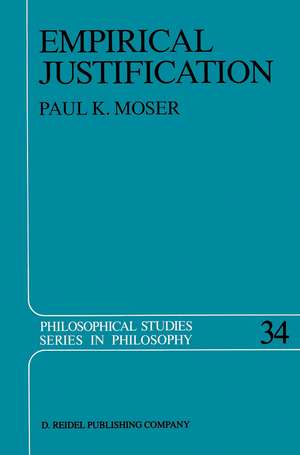
Empirical Justification
Autor P. K. Moseren Limba Engleză Paperback – 30 noi 1985
Preț: 614.41 lei
Preț vechi: 722.83 lei
-15%
Puncte Express: 922
Carte tipărită la comandă
Livrare economică 23 noiembrie-07 decembrie
Livrare prin curier în România Termenul estimat este afișat lângă disponibilitate.
Transport gratuit pentru acest produs Plată online sau ramburs, în funcție de opțiunile comenzii.
Retur gratuit în 14 zile Comandă securizată și suport în română.
Specificații
ISBN-13: 9789027720429
ISBN-10: 9027720428
Pagini: 276
Ilustrații: 258 p.
Dimensiuni: 155 x 235 x 16 mm
Greutate: 0.42 kg
Ediția:1985
Editura: Springer
Locul publicării:Dordrecht, Netherlands
ISBN-10: 9027720428
Pagini: 276
Ilustrații: 258 p.
Dimensiuni: 155 x 235 x 16 mm
Greutate: 0.42 kg
Ediția:1985
Editura: Springer
Locul publicării:Dordrecht, Netherlands
V-ar putea interesa
-
 Being, Identity, and TruthC. J. F. Williams-30%Preț: 477.74 lei683.11 lei
 -
 Representation, Meaning, and ThoughtGrant Gillett-21%Preț: 374.56 lei474.37 lei
 -
 The Metaphysics of ExperienceLeslie Stevenson-29%Preț: 343.90 lei481.12 lei
 -
 DisagreementRichard Feldman-12%Preț: 267.69 lei305.73 lei
 -
 -31%Preț: 746.12 lei1079.62 lei
 -
 Learning from Words: Testimony as a Source of KnowledgeJennifer Lackey-12%Preț: 267.97 lei305.88 lei
 -
 The Oxford Handbook of CausationHelen Beebee-18%Preț: 374.82 lei457.58 lei
 -
 The Metaphysics of KnowledgeKeith Hossack-12%Preț: 368.64 lei416.67 lei
 -
 -11%Preț: 331.92 lei373.04 lei
 -
 Knowledge AscriptionsJessica Brown-31%Preț: 680.05 lei985.26 lei
 -
 Knowledge in an Uncertain WorldJeremy Fantl-13%Preț: 302.35 lei346.74 lei
 -
 -12%Preț: 364.59 lei413.01 lei
 -
 The Oxford Handbook of SkepticismJohn Greco-29%Preț: 411.04 lei575.49 lei
 -
 The Girl with the Dragon Tattoo and PhilosophyEric BronsonPreț: 127.36 lei
 -
 TruthJohn D. CaputoPreț: 91.54 lei
 -
 SelfBarry DaintonPreț: 90.68 lei
 -
 In the Dust of This PlanetEugene ThackerPreț: 92.35 lei
Public țintă
ResearchCuprins
I: Justification and the Regress Problem.- 1. Justification and Truth.- 2. Justification and Probability.- 3. Justification and Knowledge.- 4. The Epistemic Regress Problem.- II: Epistemic Contextualism: Justification Via the Unjustified.- 1. Contextualism and Scientific Justification.- 2. Contextualism Without a Scientific Community.- 3. Contextualism and Skepticism.- 4. The Inadequacy of Contextualism.- III: Epistemic Coherentism: “Circles” of Justification.- 1. Negative Coherentism.- 2. Positive Coherentism.- 3. The Inadequacy of Coherentism.- IV. Epistemic Foundationalism (I): Infinite Regresses, Externalism, and Reliabilism.- 1. Infinite Regresses of Justification.- 2. Epistemic Foundationalism.- 3. Concluding Remarks.- V: Epistemic Foundationalism (II): Epistemic Intuitionism.- 1. Intuitionism and Immediate Justification.- 2. Justifying Nonfoundational Observation Beliefs.- 3. General Summary and Conclusion.- VI. Epilogue: The epistemic and the Rational.- 1. Rational Conflicts.- 2. Three Kinds of Rationality.- 3. All-Things-Considered Rationality.- Select Bibliography.- Index of Names.- Index of Subjects.
Recenzii
`Moser's Empirical Justification is an original and rigorously argued book. It subjects externalist epistemological theories to some of the most far-reaching criticism they have yet received, and it systematically develops an alternative theory significant in its own right.'
Robert Audi, University of Nebraska - Lincoln
`The book makes an original contribution to the contemporary interest in theories of justification - not just because it presents very interesting and quite well-grounded criticisms of many of the current views, but because in developing his own account of intuitionistic foundationalism, Moser has presented a view which will, no doubt, receive much attention.'
Prof. P. Klein, Rutgers University
Robert Audi, University of Nebraska - Lincoln
`The book makes an original contribution to the contemporary interest in theories of justification - not just because it presents very interesting and quite well-grounded criticisms of many of the current views, but because in developing his own account of intuitionistic foundationalism, Moser has presented a view which will, no doubt, receive much attention.'
Prof. P. Klein, Rutgers University