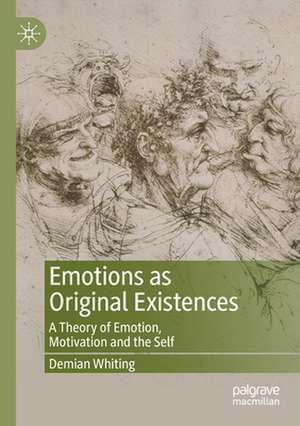
Emotions as Original Existences
Autor Demian Whitingen Limba Engleză Paperback – 27 sep 2021
The book concludes by advancing the idea that emotions make up our intrinsic nature - the characterisation of what we are like in and of ourselves, when considered apart from how we are disposed to behave. The conclusion additionally draws out the implications of the claims made throughout the book in relation to our understanding of mental illness and the treatment of emotional disorders.
Preț: 669.33 lei
Preț vechi: 787.45 lei
-15%
Puncte Express: 1004
Carte tipărită la comandă
Livrare economică 23 noiembrie-07 decembrie
Livrare prin curier în România Termenul estimat este afișat lângă disponibilitate.
Transport gratuit pentru acest produs Plată online sau ramburs, în funcție de opțiunile comenzii.
Retur gratuit în 14 zile Comandă securizată și suport în română.
Specificații
ISBN-13: 9783030546847
ISBN-10: 3030546845
Pagini: 248
Ilustrații: XI, 233 p.
Dimensiuni: 148 x 210 x 14 mm
Greutate: 0.33 kg
Ediția:1st ed. 2020
Editura: Springer
Locul publicării:Cham, Switzerland
ISBN-10: 3030546845
Pagini: 248
Ilustrații: XI, 233 p.
Dimensiuni: 148 x 210 x 14 mm
Greutate: 0.33 kg
Ediția:1st ed. 2020
Editura: Springer
Locul publicării:Cham, Switzerland
Cuprins
Chapter 1: Introduction.- Chapter 2: Emotions as Conscious Mental States.- Chapter 3: Emotions as Original Existences.- Chapter 4: Urges of the Heart.- Chapter 5: Emotion and Moral Thought.- Chapter 6: Emotion, Virtue, and Situationism.- Chapter 7: Our Emotional Cores.- Chapter 8: Emotion and The Fractured Self.
Notă biografică
Demian Whiting is a Senior Lecturer based in Hull York Medical School and the Department of Philosophy at the University of Hull, UK. His research interests include philosophy of emotion, moral psychology, phenomenal consciousness, and various issues in applied ethics.
Textul de pe ultima copertă
This book defends the much-disputed view that emotions are what Hume referred to as ‘original existences’: feeling states that have no intentional or representational properties of their own. In doing so, the book serves as a valuable counterbalance to the now mainstream view that emotions are representational mental states. Beginning with a defence of a feeling theory of emotion, Whiting opens up a whole new way of thinking about the role and centrality of emotion in our lives, showing how emotion is key to a proper understanding of human motivation and the self. Whiting establishes that emotions as types of bodily feelings serve as the categorical bases for our behavioural dispositions, including those associated with moral thought, virtue, and vice.
The book concludes by advancing the idea that emotions make up our intrinsic nature - the characterisation of what we are like in and of ourselves, when considered apart from how we are disposed to behave. The conclusion additionally draws out the implications of the claims made throughout the book in relation to our understanding of mental illness and the treatment of emotional disorders.
The book concludes by advancing the idea that emotions make up our intrinsic nature - the characterisation of what we are like in and of ourselves, when considered apart from how we are disposed to behave. The conclusion additionally draws out the implications of the claims made throughout the book in relation to our understanding of mental illness and the treatment of emotional disorders.