Cantitate/Preț
Produs

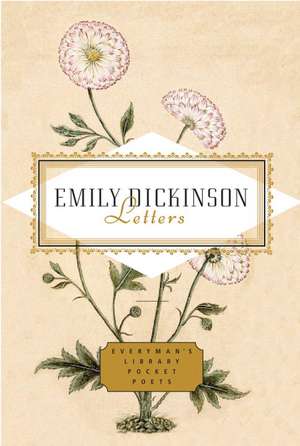
Emily Dickinson: Letters

Autor Emily Dickinson Editat de Emily Fragos
en Limba Engleză Hardback – 19 apr 2011
A selection of the remarkable letters of Emily Dickinson in an elegant Pocket Poet edition.

The same inimitable voice and dazzling insights that make Emily Dickinson’s poems immortal can be found in the whimsical, humorous, and often deeply moving letters she wrote to her family and friends throughout her life. The selection of letters presented here provides a fuller picture of the eccentric recluse of legend, showing how immersed in life she was: we see her tending her garden; baking bread; marking the marriages, births, and deaths of those she loved; reaching out for intellectual companionship; and confessing her personal joys and sorrows. These letters, invaluable for the light they shed on their author, are, as well, a pure pleasure to read.
 
Citește tot Restrânge

Toate formatele și edițiile

Toate formatele și edițiile Preț Express
Paperback (3) 3871 lei  3-5 săpt. +2100 lei  7-13 zile
  Orion Publishing Group – 6 oct 2022 3871 lei  3-5 săpt. +2100 lei  7-13 zile
  BROADVIEW PR – 21 iul 2023 14115 lei  3-5 săpt. +3063 lei  7-13 zile
  Harvard University Press – 15 mar 1986 22880 lei  6-8 săpt.
Hardback (4) 7406 lei  3-5 săpt. +3592 lei  7-13 zile
  Moondance Press – 30 sep 2016 7406 lei  3-5 săpt. +3592 lei  7-13 zile
  Gemini Books Group – 17 feb 2026 9310 lei  3-5 săpt.
  Knopf Doubleday Publishing Group – 19 apr 2011 10105 lei  3-5 săpt.
  Thelem Universitätsverlag – 19 sep 2022 22047 lei  18-23 zile +1910 lei  7-13 zile

Preț: 10105 lei

Puncte Express: 152

Preț estimativ în valută:
1788 2096$ 1555£

Carte disponibilă

Livrare economică 12-26 februarie

Preluare comenzi: 021 569.72.76

Specificații

ISBN-13: 9780307597045
ISBN-10: 0307597040
Pagini: 256
Dimensiuni: 160 x 110 x 19 mm
Greutate: 0.23 kg
Editura: Knopf Doubleday Publishing Group

Notă biografică

Emily Fragos is an award- winning poet and editor of the Pocket Poet anthologies The Great Cat, The Dance, and Music’s Spell. She teaches at New York University and Columbia University and lives in New York City.

Extras

From the Foreword by Emily Fragos

Emily Elizabeth Dickinson was born on December 10, 1830 in Amherst, Massachusetts, and she died there fifty-five years later on May 15, 1886, in her "father's house," where she had spent almost all of her adult life in seclusion. The "weary life in the second story," as she called herself with typical Dickinsonian perspicacity, never forsook human relationships, however, daily participating in a busy household and sending herself out into the world through her passionate, witty, mournful, and celebratory letters.

"My business," she told friends, "is to love" and Dickinson loved with a flame turned up to the white heat. She loved her parents and her sister and brother; her girlhood and adult friend; teachers and studies and books; the busy college town of Amherst; and the Springfield newspaper with its amusing local stories. She loved utterly Sue Gilbert, who would marry her brother Austin; and the mysterious "Master" of the famed "Master Letters" (who has never been identified but may have been Charles Wadsworth or Otis Lord or Samuel Bowles). She loved the rebirth of spring; her beautiful garden; the wild flowers of the fields; butterflies, toads, and bees; her huge brown Newfoundland, Carlo; the town's children for whom she baked cookies; the Brontës and George Eliot, the Brownings and Shakespeare; many church sermons (but certainly not all); her travels as an exuberant young girl to Washington and Philadelphia and Virginia. She was charmed by the circus that passed beneath her window and left a bright spot of red in her hyper-alert mind. She celebrated the births of babies and announcements of marriages in words of joy and kindness. Emily Dickinson found life startling and ecstatic and comical and terrible, often all at the same time. She lived in awe.

Her letters, with their feverish observations, metaphors, epigrams, allusions, paradoxes, hyperbole, and rapid leaps of imagination, must have confounded their recipients — even if they were used to "Emily being Emily." Each day she lived and expressed with an intensity and a devotion that no one she knew could emulate, much less reciprocate. She would at times become wounded when her letters, into which she poured so much of herself, went unanswered, leaving her vulnerable, almost in despair. "You are like God," she wrote to a friend who had not written back. "We pray to Him and He answers 'No.'" Absence was unbearable for this poet, as it is for many, but Dickinson's losses were multitudinous and they started early in her childhood and painfully continued throughout her life. She cherished the birds that flew away because they always came back, unlike the endless stream of loved ones whose deaths undid her.

I have devoted one chapter to Dickinson and Thomas Wentworth Higginson, the prominent man of letters who eventually helped bring her poetry to the world's attention. It is one of the greatest moments in world literature when Higginson opened that first letter from an unknown correspondent in April 1862. "Are you too deeply occupied to say if my Verse is alive?" she inquired. Her ensuing letters to him were suddenly different in tone, more breathless, deeper, if that is possible, than the letters to friends and family members. These are the words of a poet on the subject of her own genius. "Vesuvius at home" is erupting, as she announces herself with the utmost modesty, yet in earnest, and it is absolutely palpable. You can feel it happening.

Dickinson's life has always invited conjecture. She gives no reasons in the letters for her increasing isolation. We see her standing shyly at the edge of a crowd, looking on; going out only at dusk; and then not going out, with the tacit understanding of her protective family. Everyone knew she wrote poems, but no one knew the extent of her work until after her death when her sister Lavinia discovered almost 200 of the poems in Emily's sun-lit room on the second floor of the Homestead. The prolific Dickinson wrote a mind-boggling 1,775 poems of surpassing originality, numinousness, and profundity. It is estimated that she wrote 366 poems in one year alone.

In the end, Dickinson was what she was meant to be, could really only be — a poet of the highest order and rarest concentration — and her great gift subsumed the rest as she moved irrevocably deeper into her own mind and heart.

The letters are mined with phrases and entire lines that will startle readers who recognize them from the poems. There is even a real fly that may remind the reader of the immortal one "with Blue — uncertain stumbling Buzz —." The feeling is one of plunging into the teeming source from which Dickinson's art was distilled. Reading these letters is as close as we can come to being inside Emily Dickinson's alive mind as it engaged with the world around her. Almost a century and a half after she asked Higginson to "say if my Verse is alive," her words still take one's breath away.

Descriere

Descriere de la o altă ediție sau format:
This compact edition, designed for use in undergraduate courses, combines a substantial selection of Dickinson’s poems (including one complete fascicle) with a selection of letters and a range of contextual materials. In a number of cases several different versions of a poem are presented side by side.
The texts are based on the handwritten manuscripts themselves, in the facsimile form in which the Emily Dickinson Archive now makes the vast majority of Dickinson’s manuscript versions available to the general public. The three major editions that are based directly on the manuscripts—those of Thomas H. Johnson (1955), R.W. Franklin (1998) and Cristanne Miller (2016)—have also been consulted; in many cases where the transcriptions of these editors differ from one another, this edition provides information in the notes as to those differences. Extensive explanatory footnotes are also provided, as is a concise but wide-ranging introduction to Dickinson and her work.
The appendices include excerpts from numerous nineteenth-century reviews of Dickinson’s first published volume (including by William Dean Howells and Andrew Lang). Thomas Wentworth Higginson’s influential Atlantic Monthly article, “Emily Dickinson’s Letters,” is also included in its entirety.
This volume is one of a number of editions that have been drawn from the pages of the acclaimed Broadview Anthology of American Literature. The series is designed to make selections from the anthology available in a format convenient for use in a wide variety of contexts; each edition features an introduction and exaplanatory footnotes, and is designed to meet the needs of today’s students.
This edition departs from other editions in the series in one important respect—its format. The large page size of the edition facilitates the reproduction of manuscript pages in readable facsimile form, and the two-column format of the text facilitates comparison between different versions.

Recenzii

This compact edition, designed for use in undergraduate courses, combines a substantial selection of Dickinson’s poems (including one complete fascicle) with a selection of letters and a range of contextual materials. In a number of cases several different versions of a poem are presented side by side.
The texts are based on the handwritten manuscripts themselves, in the facsimile form in which the Emily Dickinson Archive now makes the vast majority of Dickinson’s manuscript versions available to the general public. The three major editions that are based directly on the manuscripts—those of Thomas H. Johnson (1955), R.W. Franklin (1998) and Cristanne Miller (2016)—have also been consulted; in many cases where the transcriptions of these editors differ from one another, this edition provides information in the notes as to those differences. Extensive explanatory footnotes are also provided, as is a concise but wide-ranging introduction to Dickinson and her work.
The appendices include excerpts from numerous nineteenth-century reviews of Dickinson’s first published volume (including by William Dean Howells and Andrew Lang). Thomas Wentworth Higginson’s influential Atlantic Monthly article, “Emily Dickinson’s Letters,” is also included in its entirety.
This volume is one of a number of editions that have been drawn from the pages of the acclaimed Broadview Anthology of American Literature. The series is designed to make selections from the anthology available in a format convenient for use in a wide variety of contexts; each edition features an introduction and exaplanatory footnotes, and is designed to meet the needs of today’s students.
This edition departs from other editions in the series in one important respect—its format. The large page size of the edition facilitates the reproduction of manuscript pages in readable facsimile form, and the two-column format of the text facilitates comparison between different versions.

Comments on The Broadview Anthology of American Literature
“The expansion, diversification, and revitalization of the texts and terms of American literary history in recent years is made marvelously accessible in the … new Broadview Anthology of American Literature.” — Hester Blum, Penn State University
The Broadview Anthology of American Literature is, quite simply, a breakthrough. … Meticulously researched and expertly assembled, this anthology should be the new gold standard for scholars and teachers alike.” — Michael D’Alessandro, Duke University
“So much thought has been put into every aspect of the Broadview Anthology of American Literature, from the selection of texts to their organization to their presentation on the page; it will be a gift to classrooms for years to come.” — Lara Langer Cohen, Swarthmore College
“The multiplicity of early American locations, languages, and genres is here on wondrous display.” — Jordan Alexander Stein, Fordham University
“Above all, this is a volume for the 21st century. … Its capaciousness and ample resource materials make for a text that is always evolving and meeting its readers in new ways.” — Russ Castronovo, University of Wisconsin-Madison
“a rich collection that reflects the diversity of American literatures…. [and] that never forgets its most important audience: students. There is a wealth of material here that will help them imagine and reimagine what American literature could be.” — Michael C. Cohen, UCLA
The Broadview Anthology of American Literature is an instructor’s dream for introducing students to the diversity and complexity of American literature.” — Venetria K. Patton, University of Illinois, Urbana-Champaign
“I am eager to teach with this anthology! It aligns with cutting-edge research through its selections, its introductions, and explanatory notes, and the texts are supplemented with primary documents that encourage teachers and students to think critically and dynamically.” — Koritha Mitchell, The Ohio State University

Cuprins

Introduction
Selected Poems
  • [It’s all I have to bring today –]
  • [I never lost as much but twice –]
  • [I robbed the woods –]
    • [alternative version]
  • [Success is counted sweetest]
    • [alternative version]
  • [These are the days when Birds come back ˎ]
    • [alternative versions]
  • [Safe in their Alabaster Chambers –]
    • [alternative versions]
  • [Besides the Autumn poets sing]
  • [All overgrown by cunning moss,]
  • [I’m “wife” – I’ve finished that –]
  • [Title divine – is mine!]
  • [Faith is a fine invention]
    • [alternative version]
  • [Some keep the Sabbath going to Church –]
  • [The Lamp burns sure – within –]
  • [I came to buy a smile – today –]
  • [I’m Nobody! Who are you?]
    • [alternative version]
  • [Wild nights – Wild nights!]
    • [alternative versions]
  • [Over the fence –]
  • [I taste a liquor never brewed –]
    • [alternative version]
  • [There’s a certain Slant of light,]
    • [alternative versions]
  • [“Hope” is the thing with feathers –]
  • [Your Riches – taught me – Poverty.]
  • [I found the words to every thought]
  • [I like a look of Agony,]
  • [I felt a Funeral, in my Brain,]
  • [It was not Death, for I stood up,]
  • [A Bird came down the Walk –]
  • [I know that He exists.]
  • [After great pain, a formal feeling comes –]
  • [This World is not conclusion.]
  • [I like to see it lap the Miles –]
    • [alternative version]
  • [The Soul selects her own Society –]
  • [One need not be a Chamber – to be Haunted –]
  • [They shut me up in Prose –]
  • [This was a Poet –]
  • [I died for Beauty – but was scarce]
  • [The Malay – took the Pearl –]
  • [Because I could not stop for Death –]
    • [alternative version]
  • [Our journey had advanced –]
  • [I dwell in Possibility –]
  • [He fumbles at your Soul]
  • [It feels a shame to be Alive –]
  • [This is my letter to the World]
  • [I’m sorry for the Dead – Today –]
  • [I heard a Fly buzz – when I died –]
  • [The Brain – is wider than the Sky –]
  • [There’s been a Death, in the Opposite House,]
  • [I measure every Grief I meet]
  • [Much Madness is divinest Sense –]
  • [I started Early – Took my Dog –]
  • [That I did always love]
  • [What Soft – Cherubic Creatures –]
  • [My Life had stood – a Loaded Gun –]
  • [“Nature” is what We see –]
  • [I could bring You Jewels – had I a mind to –]
  • [Publication – is the Auction]
  • [Truth – is as old as God –]
  • [I never saw a Moor –]
  • [Color – Caste – Denomination –]
  • [She rose to His Requirement – dropt]
  • [The Poets light but Lamps –]
  • [A Man may make a Remark –]
  • [Banish Air from Air –]
  • [As imperceptibly as Grief]
  • [The Heart has narrow Banks]
  • [Could I but ride indefinite]
  • [As the Starved Maelstrom laps the Navies]
  • [A narrow Fellow in the Grass]
    • [alternative versions]
  • [The Bustle in a House]
  • [A Spider sewed at Night]
  • [Tell all the Truth but tell it slant –]
    • [alternative version]
  • [To pile like Thunder to its close]
  • [Apparently with no surprise]
  • [A Word made Flesh is seldom]
  • [My life closed twice before its close;]
  • [To make a prairie it takes a clover and one bee,]
  • Fascicle 13
    • [I know some lonely Houses off the Road]
    • [I can wade Grief –]
    • [You see I cannot see – your lifetime –]
    • [“Hope” is the thing with feathers –]
    • [To die – takes just a little while –]
    • [If I’m lost – now –]
    • [Delight is as the flight –]
    • [She sweeps with many-colored Brooms –]
    • [Of Bronze – and Blaze –]
    • [There’s a certain Slant of light,]
    • [Blazing in Gold – and]
    • [Good Night! Which put the Candle out?]
    • [Read – Sweet – how others – strove –]
    • [Put up my lute!]
    • [There came a Day – at Summer’s full –]
    • [The lonesome for they know not What –]
    • [How the old Mountains drip with Sunset]
    • [Of Tribulation, these are They,]
    • [If your Nerve, deny you –]
Selected Letters
  • To Abiah Root (29 January 1850)
  • To Jane Humphrey (3 April 1850)
  • To Abiah Root (7 and 17 May 1850)
  • To Susan Gilbert Dickinson (April 1852)
  • To Susan Gilbert Dickinson (27 June 1852)
  • To Samuel Bowles (February 1861)
  • To Unknown Recipient (c. 1861)
  • To Susan Gilbert Dickinson (1861)
  • Susan Dickinson to Emily Dickinson (1861)
  • To Susan Gilbert Dickinson (1861)
  • To Thomas Wentworth Higginson (15 April 1862)
  • To Thomas Wentworth Higginson (25 April 1862)
  • To Thomas Wentworth Higginson (7 June 1862)
  • To Thomas Wentworth Higginson (July 1862)
  • To Otis Phillips Lord (c. 1878)
  • To Susan Gilbert Dickinson (October 1883)
In Context
  • The Reception of Emily Dickinson in the Nineteenth Century
    • from Alexander Young, “Boston Letter,” Critic (11 October 1890)
    • from anonymous, “From the Book Store,” St. Joseph Daily News (22 November 1890)
    • from anonymous, “New Books,” Boston Post (27 November 1890)
    • from Kinsley Twining and William Hayes Ward, “Poems by Emily Dickinson,” Independent (11 December 1890)
    • from William Dean Howells, “Editor’s Study,” Harper’s New Monthly Magazine (January 1891)
    • from anonymous, Springfield Republican (23 January 1891)
    • from Andrew Lang, “A Literary Causerie,” Speaker (31 January 1891)
    • Laura Coombs Hills, Retouched image of Emily Dickinson (late nineteenth century)
  • Thomas Wentworth Higginson, “Emily Dickinson’s Letters,” The Atlantic Monthly (October 1891)
Acknowledgments
Index