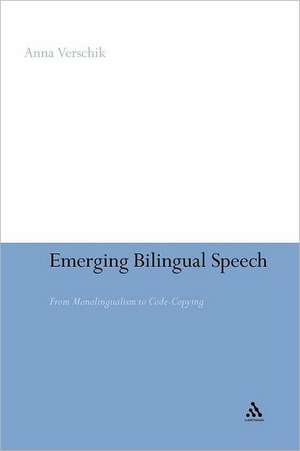
Emerging Bilingual Speech
Autor Anna Verschiken Limba Engleză Paperback – 20 oct 2011
Anna Verschik offers a new perspective on how a previously monolingual community of Russian-speakers in Estonia is rapidly becoming bilingual after the end of the Soviet occupation in 1991.
The contact-induced change in Russian under the growing impact of Estonian is analysed in the theoretical framework of code-copying.
The contact-induced change in Russian under the growing impact of Estonian is analysed in the theoretical framework of code-copying.
Changes in linguistic behaviour of the speakers are often a result of intentional cultivation of non-monolingual communication strategies and language policies, and go hand in hand with the development of a new identity, 'Estonian Russians'.
Emerging Bilingual Speech is a fascinating study that will be of interest to researchers studying language contact, language change and bilingualism.
Emerging Bilingual Speech is a fascinating study that will be of interest to researchers studying language contact, language change and bilingualism.
Preț: 266.14 lei
Nou
Puncte Express: 399
Preț estimativ în valută:
47.10€ • 55.22$ • 41.36£
47.10€ • 55.22$ • 41.36£
Carte tipărită la comandă
Livrare economică 06-20 februarie 26
Preluare comenzi: 021 569.72.76
Specificații
ISBN-13: 9781441127440
ISBN-10: 1441127445
Pagini: 270
Dimensiuni: 156 x 234 x 15 mm
Greutate: 0.42 kg
Editura: Continnuum-3pl
Locul publicării:London, United Kingdom
ISBN-10: 1441127445
Pagini: 270
Dimensiuni: 156 x 234 x 15 mm
Greutate: 0.42 kg
Editura: Continnuum-3pl
Locul publicării:London, United Kingdom
V-ar putea interesa
-
 Duelling Languages: Grammatical Structure in CodeswitchingCarol Myers-Scotton-24%Preț: 385.50 lei509.52 lei
 -
 Contact Linguistics: Bilingual Encounters and Grammatical OutcomesCarol Myers-Scotton-14%Preț: 338.29 lei392.73 lei
 -
 Language Contact in AmazoniaAlexandra Aikhenvald-19%Preț: 409.25 lei502.15 lei
 -
 Key Concepts in Second Language AcquisitionShawn LoewenPreț: 188.62 lei
 -
 Key Concepts in BilingualismFredric W. FieldPreț: 202.21 lei
 -
 Psychology for Language LearningS. MercerPreț: 402.90 lei
 -
 Bilingualism: An Advanced Resource BookNg Bee ChinPreț: 434.79 lei
 -
 The Bilingualism ReaderLi WeiPreț: 449.43 lei
 -
 Considering Trilingual EducationKathryn Henn-Reinke-33%Preț: 962.50 lei1440.60 lei
 -
 Literacy as Translingual Practice: Between Communities and ClassroomsSuresh CanagarajahPreț: 447.75 lei
 -
 Second Language Teacher Education: A Sociocultural PerspectiveKaren E. JohnsonPreț: 442.21 lei
 -
 -18%Preț: 1063.81 lei1297.33 lei
 -
 Linguistic Imperialism ContinuedRobert Phillipson-15%Preț: 440.70 lei518.47 lei
 -
 Preț: 429.09 lei
 -
 Preț: 339.75 lei
 -
 -26%Preț: 1131.87 lei1528.36 lei
 -
 Language and Cognition in Bilinguals and Multilinguals: An IntroductionAnnette M.B. de Groot-18%Preț: 1033.45 lei1260.32 lei
 -
 -18%Preț: 191.09 lei232.86 lei
Caracteristici
Uses case studies drawn from languages in contact in the former USSR to give a new perspective.
Notă biografică
Anna Verschik is Professor of Linguistics at Tallinn University, Estonia.
Cuprins
Abbreviations
Transliteration of Russian
Introduction
1. Theoretical background: combining structural and sociolinguistic factors
2. Emerging multilingual communication: Russian in Estonia, Russian and Estonian, Estonia's Russian
3. Code-copying framework and copiability
4. Case-studies in code-copying
5. Code-copying and patterns of bilingual communication
6. Conclusions
Bibliography
Index
Transliteration of Russian
Introduction
1. Theoretical background: combining structural and sociolinguistic factors
2. Emerging multilingual communication: Russian in Estonia, Russian and Estonian, Estonia's Russian
3. Code-copying framework and copiability
4. Case-studies in code-copying
5. Code-copying and patterns of bilingual communication
6. Conclusions
Bibliography
Index