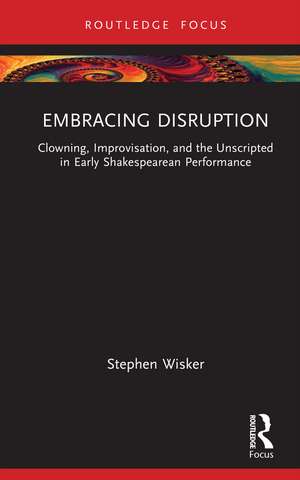
Embracing Disruption: Clowning, Improvisation, and the Unscripted in Early Shakespearean Performance: Routledge Advances in Theatre & Performance Studies
Autor Stephen Wiskeren Limba Engleză Hardback – 23 iul 2025
Clowning was a potent but divisive force in the theater of Shakespeare’s time, challenging the emerging tyranny of decorum and the developing notion of the authorial voice. As such, the figure of the clown is key to understanding the pervasive tension between existing and emergent forms of Elizabethan theater, and unlocks forgotten levels of meaning in Shakespeare’s plays, meanings that were only fully experienced in performance rather than on the page. The great clown Dick Tarleton dominated the London theater of the 1580s and deeply informed Shakespeare’s understanding of the anarchic power of performance. By the 1590s, however, the clown’s voice was increasingly silenced by emerging theater practice intent on authorial control and Elizabethan codes of decorum. Against the dominant critical tide, Shakespeare continued to embrace clowning and worked closely with Will Kemp - Tarleton’s successor as the greatest clown of his age - specifically and deliberately placing him alongside his leading man, Richard Burbage, the originator of the roles of Romeo, Hal, Hamlet and many others. Through an analysis of key scenes in Romeo and Juliet and Henry IV, Embracing Disruption illustrates the enormously generative, unstable, and compelling relationship between these two actors, Burbage and Kemp - the hero and the clown - and how their extraordinary dynamic was experienced on the stage rather than on the page. This hero-clown dynamic continues even after Kemp’s departure from Shakespeare’s company: Hamlet features the ghosts of Tarleton and Kemp, two clowns deeply informing Burbage’s performance as the hero. Then a similar dynamic emerges between Kemp’s replacement, a very different clown in Robert Armin playing the Fool opposite Burbage in King Lear. In each instance, the presence of the clown crucially informs the audience’s understanding of the hero. Moreover, Shakespeare’s increasingly sophisticated deployment of clowning comments on and resists the transformation and gentrification of the theater that defined the Elizabethan era.
This study will be of great interest to students and scholars in Performance studies and Shakespeare studies.
Din seria Routledge Advances in Theatre & Performance Studies
-
 Preț: 352.84 lei
 - 5%
 Preț: 373.60 lei
 -
 Preț: 159.97 lei
 - 11%
 Preț: 454.37 lei
 -
 Preț: 392.34 lei
 -
 Preț: 353.76 lei
 - 8%
 Preț: 420.21 lei
 -
 Preț: 346.06 lei
 -
 Preț: 156.85 lei
 -
 Preț: 335.40 lei
 -
 Preț: 164.42 lei
 -
 Preț: 313.92 lei
 -
 Preț: 336.98 lei
 -
 Preț: 335.40 lei
 -
 Preț: 416.23 lei
 -
 Preț: 342.30 lei
 -
 Preț: 304.63 lei
 -
 Preț: 336.54 lei
 -
 Preț: 294.42 lei
 -
 Preț: 336.43 lei
 -
 Preț: 431.29 lei
 -
 Preț: 362.59 lei
 -
 Preț: 309.79 lei
 -
 Preț: 321.43 lei
 -
 Preț: 334.60 lei
 -
 Preț: 320.39 lei
 -
 Preț: 353.29 lei
 -
 Preț: 335.40 lei
 -
 Preț: 334.60 lei
 -
 Preț: 319.32 lei
 -
 Preț: 355.01 lei
 - 11%
 Preț: 416.27 lei
 -
 Preț: 353.18 lei
 -
 Preț: 336.70 lei
 -
 Preț: 351.47 lei
 -
 Preț: 410.92 lei
 - 18%
 Preț: 1013.74 lei
 -
 Preț: 333.99 lei
 -
 Preț: 328.54 lei
 -
 Preț: 337.68 lei
 -
 Preț: 304.17 lei
 -
 Preț: 336.77 lei
 -
 Preț: 351.47 lei
 -
 Preț: 351.36 lei
 - 5%
 Preț: 336.93 lei
 - 8%
 Preț: 420.63 lei
 -
 Preț: 291.26 lei
 -
 Preț: 331.80 lei
 - 8%
 Preț: 424.83 lei
Preț: 468.82 lei
Puncte Express: 703
Preț estimativ în valută:
83.03€ • 96.97$ • 72.12£
83.03€ • 96.97$ • 72.12£
Carte tipărită la comandă
Livrare economică 21 februarie-07 martie
Preluare comenzi: 021 569.72.76
Specificații
ISBN-13: 9781032740799
ISBN-10: 1032740795
Pagini: 136
Ilustrații: 16
Dimensiuni: 138 x 216 x 10 mm
Greutate: 0.41 kg
Ediția:1
Editura: Taylor & Francis
Colecția Routledge
Seria Routledge Advances in Theatre & Performance Studies
Locul publicării:Oxford, United Kingdom
ISBN-10: 1032740795
Pagini: 136
Ilustrații: 16
Dimensiuni: 138 x 216 x 10 mm
Greutate: 0.41 kg
Ediția:1
Editura: Taylor & Francis
Colecția Routledge
Seria Routledge Advances in Theatre & Performance Studies
Locul publicării:Oxford, United Kingdom
Public țintă
AcademicCuprins
Acknowledgements
Introduction: Thriving Beyond Authorial Control
Chapter 1: The Man Who Could ‘Please All’ Dick Tarlton’s World and Playground
Chapter 2: ‘Enter Will Kemp’ Revivifying the Clown Peter in Romeo and Juliet
Chapter 3: ‘A Good Wit Will Make Use of Anything’ Kemp’s Playful Clowning in Serious History
Chapter 4: Clown Prince Hamlet - Exposing the Fictions of Decorum.
Chapter 5: “The Worst Returns to Laughter,” Transformation through Collaboration, Robert Armin as Lear’s Fool
Index
Introduction: Thriving Beyond Authorial Control
Chapter 1: The Man Who Could ‘Please All’ Dick Tarlton’s World and Playground
Chapter 2: ‘Enter Will Kemp’ Revivifying the Clown Peter in Romeo and Juliet
Chapter 3: ‘A Good Wit Will Make Use of Anything’ Kemp’s Playful Clowning in Serious History
Chapter 4: Clown Prince Hamlet - Exposing the Fictions of Decorum.
Chapter 5: “The Worst Returns to Laughter,” Transformation through Collaboration, Robert Armin as Lear’s Fool
Index
Recenzii
''Embracing Disruption brilliantly fuses historical reconstruction and clown practice to demonstrate how Shakespeare preserved and exploited the disruptive nature of the clown in the face of growing constraints on clowning and improvisation. An essential text for advanced undergraduate and graduate courses in Shakespeare.''
Professor Robert Knopf, Professor Emeritus, Department of Theatre nad Dance, University at Buffalo
Professor Robert Knopf, Professor Emeritus, Department of Theatre nad Dance, University at Buffalo
Notă biografică
Stephen Wisker is an Assistant Professor of Theatre in The School of Media, Arts, and Culture at Wesleyan College.
Descriere
This volume celebrates the centrality of clowning to Shakespeare’s conception of theatre and how he purposefully invites the clown’s anarchic energy into the heart of his dramaturgy.