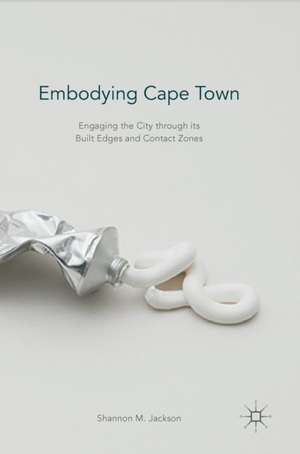
Embodying Cape Town
Autor Shannon M. Jacksonen Limba Engleză Hardback – 11 iul 2017
Preț: 671.67 lei
Preț vechi: 790.20 lei
-15%
Puncte Express: 1008
Carte tipărită la comandă
Livrare economică 06-20 iunie
Specificații
ISBN-13: 9781137587107
ISBN-10: 1137587105
Pagini: 212
Ilustrații: IX, 202 p.
Dimensiuni: 153 x 216 x 17 mm
Greutate: 0.39 kg
Ediția:1st ed. 2017
Editura: Palgrave MacMillan
Locul publicării:New York, United States
ISBN-10: 1137587105
Pagini: 212
Ilustrații: IX, 202 p.
Dimensiuni: 153 x 216 x 17 mm
Greutate: 0.39 kg
Ediția:1st ed. 2017
Editura: Palgrave MacMillan
Locul publicării:New York, United States
Cuprins
1. Introduction.-2. Making Englishness.-3. Forgetting District Six.-4. Redistributing Personhood.-5. Alternative by Design.
Notă biografică
Shannon M. Jackson is Associate Professor in the Department of Sociology/Anthropology at University of Missouri, Kansas, USA.
Textul de pe ultima copertă
This book examines the reciprocity that exists between the body and the urban built environment. It will draw on archival and ethnographic research as well as an interdisciplinary literature on cultural materialism, semiotics, and aesthetics to challenge dualist interpretations of four different points of historical-material contact in Cape Town, South Africa. Each chapter attends to different groups, social practices, and historical periods, but all share the fundamental questions: how does material culture reflect the way social agents make meaning through bodily contact with urban built form, and how does such meaning challenge the ways bodies are objectified? Further, how can we make sense of the historical processes embedded in the objectification of bodies without treating the social and the material, the mental and the physical as separate realities?
Caracteristici
Explores hidden dimensions of relationships among the human body, the built environment, material culture, and history. Challenges dualist interpretations of the history and culture of Cape Town. Draws on a wealth of diverse sources from ethnographic research to aesthetics scholarship.