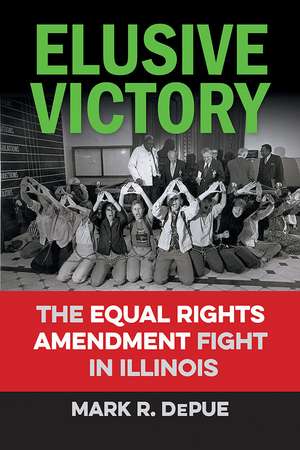
Elusive Victory: The Equal Rights Amendment Fight in Illinois
Autor Mark R. DePueen Limba Engleză Hardback – 5 noi 2026
In this gripping account of one of the most consequential political battles of the twentieth century, Mark R. DePue takes readers inside the fight that halted the Equal Rights Amendment. Drawing upon hundreds of hours of original oral history interviews, DePue reconstructs the drama, strategy, and emotion of the ERA showdown in Illinois, the state that became the amendment’s most critical battleground.
First introduced in Congress in 1923, the Equal Rights Amendment has endured for more than a century as one of the most debated yet still unratified proposals in American constitutional history. Its ratification seemed closer than ever when Congress passed the ERA in 1972 and sent it to the states with a seven-year deadline, but in Illinois, a constitutional quirk stalled its momentum. Optimism faltered, and what followed was a political war like no other the state had ever seen. Illinois’ state legislature in Springfield became the epicenter of a national struggle over gender, power, and the future of the Constitution.
At the center of the storm stood Phyllis Schlafly, the formidable conservative activist from Alton, Illinois, whose STOP ERA movement transformed a faltering amendment into a rallying cry for the New Right. Opposing her and her allies was an array of feminist organizers, legislators, celebrities, clergy, union members, and grassroots activists—often divided among themselves—who believed that equality under the law was within reach. Bringing creativity, passion, and persistence to the cause, they staged inventive demonstrations, lobbied relentlessly, and fought for every vote.
What sets this book apart are its extraordinary cast of characters and the chance DePue gives them to speak for themselves. Through vivid first-person testimony gathered at the Abraham Lincoln Presidential Library and the University of Illinois Springfield, supporters and opponents alike reflect on their motivations, fears, strategies, and regrets. Their voices bring to life the packed committee hearings, late-night strategy sessions, and personal sacrifices behind the headlines.
By 1982, the amendment fell three states short of ratification nationwide. Illinois never delivered the votes that might have changed history.
More than a political chronicle, this is a story of conviction and conflict, ambition and compromise. It is the story of how a century-old amendment came tantalizingly close to becoming law—and how, in one state capitol, the battle over women’s equality reshaped a movement and left a constitutional promise still unfinished.
Preț: 481.07 lei
Preț vechi: 593.92 lei
-19% Precomandă
Puncte Express: 722
Carte nepublicată încă
Livrare prin curier în România Precomanda se expediază când titlul devine disponibil.
Transport gratuit pentru acest produs Plată online sau ramburs, în funcție de opțiunile comenzii.
Retur gratuit în 14 zile Comandă securizată și suport în română.
Doresc să fiu notificat când acest titlu va fi disponibil:
Se trimite...
Specificații
ISBN-13: 9780809340071
ISBN-10: 0809340070
Pagini: 346
Ilustrații: 27
Dimensiuni: 152 x 229 mm
Greutate: 0.06 kg
Ediția:First Edition
Editura: Southern Illinois University Press
Colecția Southern Illinois University Press
ISBN-10: 0809340070
Pagini: 346
Ilustrații: 27
Dimensiuni: 152 x 229 mm
Greutate: 0.06 kg
Ediția:First Edition
Editura: Southern Illinois University Press
Colecția Southern Illinois University Press
Notă biografică
Mark R. DePue is the retired founding director of the Oral History Program at the Abraham Lincoln Presidential Library. He is the author of Lineage and Honors of the Illinois Militia and National Guard andPatrolling Baghdad: A Military Police Company and the War in Iraq.
Extras
From the Introduction
Oral History as a Methodology
Oral history is a relatively new methodology, steadily growing in popularity following the creation of an oral history archive at Columbia University in 1948.
Since the 1970s, oral history as an academic discipline has exploded, for it excels at giving history an intimate, human face. It democratizes history, giving voice to many of those who otherwise would be lost to the ages. Why were the ERA’s supporters so adamant about the need to amend the U.S. Constitution? Why were its opponents so strongly opposed to it? How did the ERA advocates convince their legion of supporters to turn out for rallies and demonstrations, and how did they translate that into pressure on certain legislators? Conversely, what motivated those who opposed the ERA, and what tactics did they use to sway legislators to vote against it?
Few historical tools are better suited to find answers to such questions than well executed oral history interviews. This is especially true in an age where diaries and letter collections are increasingly rare. And as Prof. Cullom Davis, the renowned creator of the Sangamon State University Oral History Program and former president of the Oral History Association stated during his own oral history interview, “older people enjoy, generally, the exercise of memory of their life experiences. It’s positive; it’s even maybe therapeutic.”
Oral history does have its downsides, however. While narrators often relate vivid memories of an event or a personality in ways that illustrate larger themes, those interviewed are often hard-pressed to remember when or where an incident occurred, or who specifically was involved. Memory is a fragile thing, and typically deteriorates over time or just as often, evolves to meet a narrator’s own biases and point of view. Who doesn’t know someone who tells a favorite story over and over again only to have the “fish” (or in the case of politicians, the crowd) get bigger with each telling? Yet, the very human tendency to share these stories helps narrators preserve their memories of important events. Donald Ritchie, the former Historian of the United States Senate, noted in his landmark book Doing Oral History that for those interviewed, “direct, dramatic, and emotional situations tend to produce more fixed and lasting memories.” It is up to the skill of the interviewer, he emphasizes, to prepare himself thoroughly before the interview to elicit the best results. For the most part, I have found that when interviewed for posterity, narrators usually strive to get their story right.
For those interviewed, remembering what year something occurred was especially problematic since ERA legislation came up year after year. That is where an interviewer’s skill and careful preparation comes into play. Going into an interview, interviewers must be as knowledgeable as possible on the subject, armed with a firm understanding of the timeline of events. So equipped, they can gently provide important context when needed (the who, what, when and where of an event), facts that the narrator probably cannot recall. For example, who was governor that year; who was Speaker of the Illinois House at the time of a vote; were Democrats or Republicans in the majority; did the incident being recalled occur during the 1978 or the 1981 debates? Once provided with that kind of information, narrators can more confidently move beyond potential stumbling blocks and give insights into the nuances of the fight. Solid preparation on the interviewer’s part also helps establish the interviewer’s credibility, which in turn encourages narrators to get things right.
In order to bolster interviewees’ memories and provide structure to the chronological narrative, I have used many other sources, including a document prepared upon request by the Illinois Commission on Government Forecasting and Accountability in August 2020. That document details the year-by-year voting record, by legislator, for the Illinois House and Senate. The General Assembly’s document, (referred to in the endnotes as “History of Illinois Votes”) will provide crucial details and help anchor the chronological flow.
To further compensate for the shortcomings of oral history interviews, articles from many of Illinois’s newspapers were also used extensively, for the state’s journalists, columnists, cartoonists and photographers were irresistibly drawn to the drama playing out in Springfield every year. These newspaper articles proved invaluable in providing a factual foundation for events, especially establishing specific dates that legislative actions occurred as well as providing information on those involved. Also valuable were the many colorful quotations and descriptions of the theatrics often encountered when the journalists fleshed out their stories. Finally, because of the extensive way that the printed press covered the entire ten-year fight, I discovered a couple of key legislative actions that General Assembly researchers missed when providing the “History of Illinois Votes” to me.
It was not just Illinois media which covered the ERA. There is an abundance of fascinating video documents that I mined as well, all available on the internet, including debates between Betty Freidan and Phyllis Schlafly on “Good Morning America,” another with Representative Pat Schroeder of Colorado, one featuring Schlafly on Phil Donahue’s show in 1974, and several others. Following FX TV’s production of “Mrs. America” which appeared on Hulu in 2020, there was a plethora of videos discussing the TV political drama, representing every side of the argument. These sources added more spice to an already fascinating story.
Finally, many secondary sources were used to bolster the narrative and provide historical context. The subject has been well mined by scholars and activists of all stripes over the years. None of the many books on the Equal Rights Amendment and women’s rights published over the last few decades, however, have trained an intimate eye on the role the Illinois legislature played in the fight. This book is meant to fill that void.
But first and foremost, whenever possible, this story will be told using the voices of those involved using excerpts from their oral history interviews.
Many oral historians avoid interviewing the influential and powerful among us. They prefer to focus their energies on the unsung people who work behind the scenes, those who give their muscle and sinew to a cause or historical event without garnering the accolades of society or the recognition of traditional historians. While this is a laudable approach, it is not entirely the model chosen for this project. In order to tell the complete story of ERA’s defeat in Illinois, it was necessary to include many of the more prominent individuals who played a central role in the fight. Thus, governors, key legislators and leaders in both the pro and anti-ERA movement were also interviewed in addition to many of those who labored for their cause in obscurity. Regardless of an individual’s prominence, for most of these individuals, their oral history interview was their first chance to discuss their involvement in the ERA fight for the record.
I approached every interview with the belief that this might be their only opportunity for an in-depth discussion on the relevant issues. For that reason, many of the interviews conducted involved multiple sessions, sometimes occurring over several months. This was especially the case for the governors and legislative leaders interviewed, where the ERA fight was only one of the many topics discussed. That was also the case for several of the key pro-ERA leaders as well as ERA’s chief opponent, Phyllis Schlafly.
One overriding goal when conducting the interviews was to strive for objectivity, the old-fashioned kind of objectivity that schools of journalism traditionally taught. This was especially important since the participants represented all sides of the issue. The Equal Rights Amendment became one of the most polarizing issues of the day, and thus was often fought at a red-hot pitch, especially as the combatants approached the 1982 deadline. “Combatants” is not too strong a word to describe members of the opposing camps. STOP ERA leader Phyllis Schlafly became one of the most polarizing and reviled women in America at the time. The disdain Mrs. Schlafly’s supporters held toward their “radical feminist” opponents was every bit as strident.
Since it was my task to interview participants on both sides of the issue and to elicit their true feelings and memories, it was therefore imperative to approach each interview free of bias, maintaining a strict impartiality throughout the interview. Every interviewee, regardless of their point of view, got tough questions. Once asked, they received a fair hearing and were allowed to answer the question without interruption or equivocation. Often, the tough questions were the ones that elicited the most revealing responses. A useful technic when asking those questions was to quote or paraphrase something said by an opponent. The responses were invariably illuminating. Nevertheless, regardless of how much an issue was pressed, in all cases the narrator was allowed to have the last word on the subject. The goal for each interview was to conduct it in a way that the narrator could not determine my own biases or point of view.
Considering that many of those interviewed were politicians or people who were otherwise familiar with the public spotlight, getting narrators to be candid was not always easy. By virtue of their profession or experiences, politicians spend their lives being elusive during interviews. Therefore, while I strove for a journalist’s objectivity, the tone I sought was conversational and not confrontational. Narrators needed to feel comfortable during an interview, believing that their words will not be twisted to fit a particular agenda, knowing that their answers will be recorded accurately and in their entirety. That approach typically encouraged a more sincere and forthright discussion. Thus, in order to honor that trust, the excerpts used in this book will often be lengthy, allowing interviewees to express their views in depth while fully developing their position.
With all of that in mind, the goal for this book is to present each side’s arguments as accurately and completely as possible. Both sides made compelling arguments, and both sides deserve to be heard. Only then can readers get a better understanding of one of the most contentious political arguments of the late 20th century. I ask only that the reader give each side a fair reading, knowing they will undoubtedly draw their own conclusions.
For my own part, I invariably enjoyed all the interviews conducted during this project. I came to admire those who were interviewed and always strove to understand their point of view. They are a remarkable collection of Americans, resolute in their convictions, and insightful in their understanding of these events. Through their voices, I hope that the reader can come to understand the intensity of the fight in Illinois, how it was that the Equal Rights Amendment was not adopted in Illinois by the 1982 deadline, and ultimately why its failure in Illinois foretold the ERA’s failure nationwide.
[end of excerpt]
Oral History as a Methodology
Oral history is a relatively new methodology, steadily growing in popularity following the creation of an oral history archive at Columbia University in 1948.
Since the 1970s, oral history as an academic discipline has exploded, for it excels at giving history an intimate, human face. It democratizes history, giving voice to many of those who otherwise would be lost to the ages. Why were the ERA’s supporters so adamant about the need to amend the U.S. Constitution? Why were its opponents so strongly opposed to it? How did the ERA advocates convince their legion of supporters to turn out for rallies and demonstrations, and how did they translate that into pressure on certain legislators? Conversely, what motivated those who opposed the ERA, and what tactics did they use to sway legislators to vote against it?
Few historical tools are better suited to find answers to such questions than well executed oral history interviews. This is especially true in an age where diaries and letter collections are increasingly rare. And as Prof. Cullom Davis, the renowned creator of the Sangamon State University Oral History Program and former president of the Oral History Association stated during his own oral history interview, “older people enjoy, generally, the exercise of memory of their life experiences. It’s positive; it’s even maybe therapeutic.”
Oral history does have its downsides, however. While narrators often relate vivid memories of an event or a personality in ways that illustrate larger themes, those interviewed are often hard-pressed to remember when or where an incident occurred, or who specifically was involved. Memory is a fragile thing, and typically deteriorates over time or just as often, evolves to meet a narrator’s own biases and point of view. Who doesn’t know someone who tells a favorite story over and over again only to have the “fish” (or in the case of politicians, the crowd) get bigger with each telling? Yet, the very human tendency to share these stories helps narrators preserve their memories of important events. Donald Ritchie, the former Historian of the United States Senate, noted in his landmark book Doing Oral History that for those interviewed, “direct, dramatic, and emotional situations tend to produce more fixed and lasting memories.” It is up to the skill of the interviewer, he emphasizes, to prepare himself thoroughly before the interview to elicit the best results. For the most part, I have found that when interviewed for posterity, narrators usually strive to get their story right.
For those interviewed, remembering what year something occurred was especially problematic since ERA legislation came up year after year. That is where an interviewer’s skill and careful preparation comes into play. Going into an interview, interviewers must be as knowledgeable as possible on the subject, armed with a firm understanding of the timeline of events. So equipped, they can gently provide important context when needed (the who, what, when and where of an event), facts that the narrator probably cannot recall. For example, who was governor that year; who was Speaker of the Illinois House at the time of a vote; were Democrats or Republicans in the majority; did the incident being recalled occur during the 1978 or the 1981 debates? Once provided with that kind of information, narrators can more confidently move beyond potential stumbling blocks and give insights into the nuances of the fight. Solid preparation on the interviewer’s part also helps establish the interviewer’s credibility, which in turn encourages narrators to get things right.
In order to bolster interviewees’ memories and provide structure to the chronological narrative, I have used many other sources, including a document prepared upon request by the Illinois Commission on Government Forecasting and Accountability in August 2020. That document details the year-by-year voting record, by legislator, for the Illinois House and Senate. The General Assembly’s document, (referred to in the endnotes as “History of Illinois Votes”) will provide crucial details and help anchor the chronological flow.
To further compensate for the shortcomings of oral history interviews, articles from many of Illinois’s newspapers were also used extensively, for the state’s journalists, columnists, cartoonists and photographers were irresistibly drawn to the drama playing out in Springfield every year. These newspaper articles proved invaluable in providing a factual foundation for events, especially establishing specific dates that legislative actions occurred as well as providing information on those involved. Also valuable were the many colorful quotations and descriptions of the theatrics often encountered when the journalists fleshed out their stories. Finally, because of the extensive way that the printed press covered the entire ten-year fight, I discovered a couple of key legislative actions that General Assembly researchers missed when providing the “History of Illinois Votes” to me.
It was not just Illinois media which covered the ERA. There is an abundance of fascinating video documents that I mined as well, all available on the internet, including debates between Betty Freidan and Phyllis Schlafly on “Good Morning America,” another with Representative Pat Schroeder of Colorado, one featuring Schlafly on Phil Donahue’s show in 1974, and several others. Following FX TV’s production of “Mrs. America” which appeared on Hulu in 2020, there was a plethora of videos discussing the TV political drama, representing every side of the argument. These sources added more spice to an already fascinating story.
Finally, many secondary sources were used to bolster the narrative and provide historical context. The subject has been well mined by scholars and activists of all stripes over the years. None of the many books on the Equal Rights Amendment and women’s rights published over the last few decades, however, have trained an intimate eye on the role the Illinois legislature played in the fight. This book is meant to fill that void.
But first and foremost, whenever possible, this story will be told using the voices of those involved using excerpts from their oral history interviews.
Many oral historians avoid interviewing the influential and powerful among us. They prefer to focus their energies on the unsung people who work behind the scenes, those who give their muscle and sinew to a cause or historical event without garnering the accolades of society or the recognition of traditional historians. While this is a laudable approach, it is not entirely the model chosen for this project. In order to tell the complete story of ERA’s defeat in Illinois, it was necessary to include many of the more prominent individuals who played a central role in the fight. Thus, governors, key legislators and leaders in both the pro and anti-ERA movement were also interviewed in addition to many of those who labored for their cause in obscurity. Regardless of an individual’s prominence, for most of these individuals, their oral history interview was their first chance to discuss their involvement in the ERA fight for the record.
I approached every interview with the belief that this might be their only opportunity for an in-depth discussion on the relevant issues. For that reason, many of the interviews conducted involved multiple sessions, sometimes occurring over several months. This was especially the case for the governors and legislative leaders interviewed, where the ERA fight was only one of the many topics discussed. That was also the case for several of the key pro-ERA leaders as well as ERA’s chief opponent, Phyllis Schlafly.
One overriding goal when conducting the interviews was to strive for objectivity, the old-fashioned kind of objectivity that schools of journalism traditionally taught. This was especially important since the participants represented all sides of the issue. The Equal Rights Amendment became one of the most polarizing issues of the day, and thus was often fought at a red-hot pitch, especially as the combatants approached the 1982 deadline. “Combatants” is not too strong a word to describe members of the opposing camps. STOP ERA leader Phyllis Schlafly became one of the most polarizing and reviled women in America at the time. The disdain Mrs. Schlafly’s supporters held toward their “radical feminist” opponents was every bit as strident.
Since it was my task to interview participants on both sides of the issue and to elicit their true feelings and memories, it was therefore imperative to approach each interview free of bias, maintaining a strict impartiality throughout the interview. Every interviewee, regardless of their point of view, got tough questions. Once asked, they received a fair hearing and were allowed to answer the question without interruption or equivocation. Often, the tough questions were the ones that elicited the most revealing responses. A useful technic when asking those questions was to quote or paraphrase something said by an opponent. The responses were invariably illuminating. Nevertheless, regardless of how much an issue was pressed, in all cases the narrator was allowed to have the last word on the subject. The goal for each interview was to conduct it in a way that the narrator could not determine my own biases or point of view.
Considering that many of those interviewed were politicians or people who were otherwise familiar with the public spotlight, getting narrators to be candid was not always easy. By virtue of their profession or experiences, politicians spend their lives being elusive during interviews. Therefore, while I strove for a journalist’s objectivity, the tone I sought was conversational and not confrontational. Narrators needed to feel comfortable during an interview, believing that their words will not be twisted to fit a particular agenda, knowing that their answers will be recorded accurately and in their entirety. That approach typically encouraged a more sincere and forthright discussion. Thus, in order to honor that trust, the excerpts used in this book will often be lengthy, allowing interviewees to express their views in depth while fully developing their position.
With all of that in mind, the goal for this book is to present each side’s arguments as accurately and completely as possible. Both sides made compelling arguments, and both sides deserve to be heard. Only then can readers get a better understanding of one of the most contentious political arguments of the late 20th century. I ask only that the reader give each side a fair reading, knowing they will undoubtedly draw their own conclusions.
For my own part, I invariably enjoyed all the interviews conducted during this project. I came to admire those who were interviewed and always strove to understand their point of view. They are a remarkable collection of Americans, resolute in their convictions, and insightful in their understanding of these events. Through their voices, I hope that the reader can come to understand the intensity of the fight in Illinois, how it was that the Equal Rights Amendment was not adopted in Illinois by the 1982 deadline, and ultimately why its failure in Illinois foretold the ERA’s failure nationwide.
[end of excerpt]
Cuprins
Acknowledgments
Introduction
1. Origins of the Equal Rights Amendment
2. 1972 and Illinois's Peculiar Political Background
3. 1973: The ERA Fight Revisited
4. Battle Lines Form: NOW vs STOP ERA
5. 1974–1976: The Fight Intensifies
6. The ERA Fight Goes Public
7. 1977–1978: The Houston Conference and Beyond
8. 1979–1980: A Second Life
9. 1981–1982: The Last Act
Epilogue
Appendix I. The Interviewees
Appendix II. Illinois Legislature's ERA Votes by Year
List of Illustrations
Endnotes
Bibliography
Index
Introduction
1. Origins of the Equal Rights Amendment
2. 1972 and Illinois's Peculiar Political Background
3. 1973: The ERA Fight Revisited
4. Battle Lines Form: NOW vs STOP ERA
5. 1974–1976: The Fight Intensifies
6. The ERA Fight Goes Public
7. 1977–1978: The Houston Conference and Beyond
8. 1979–1980: A Second Life
9. 1981–1982: The Last Act
Epilogue
Appendix I. The Interviewees
Appendix II. Illinois Legislature's ERA Votes by Year
List of Illustrations
Endnotes
Bibliography
Index
Descriere
A chronological study of the Equal Rights Amendment fight and failure in the key state of Illinois. Pulling from hundreds of hours of recorded interviews at the Abraham Lincoln Presidential Library and the University of Illinois Springfield, DePue gives readers a comprehensive, balanced view of both sides’ experiences and arguments.
Recenzii
“If you want to know what happened to the ERA in the key state of Illinois, Mark DePue takes you inside the rooms where it happened. A fine contribution to scholarship.”—Glenna Matthews, author of The Rise of Public Woman
“This powerful telling of the Equal Rights Amendment battle in Illinois and the nation records in the words of the participants an important history. It deserves to be read by every activist and student of politics.”—Dick Simpson, coauthor of Corrupt Illinois and Chicago’s Modern Mayors
“DePue’s interviews with a range of figures ground this textured account of the ERA fight in a pivotal state, which offers lessons to scholars, policymakers, and activists alike. A valuable and original contribution to the ERA literature, Elusive Victory reveals the power of oral history to challenge scholars’ neat categories and support new interpretations.”—Katherine Turk, author of The Women of NOW: How Feminists Built an Organization That Transformed America and Equality on Trial: Gender and Rights in the Modern American Workplace
“Mark R. DePue’s Elusive Victory captures the fierce battle on-ground and in the state legislature through extensive interviews with activists in this dramatic struggle. This book makes for good reading.”—Donald T. Critchlow, author of Phyllis Schlafly and Grassroots Conservatism: A Woman's Crusade
“This book is an excellent recounting of the battle over approval of the ERA in Illinois, arguably the most pivotal state in the amendment’s final rejection. The author also provides a cogent example of how oral history can be a vital method for telling the story from the perspective of the key players. Historically, this book provides one of the most significant roots of our nation’s current polarization, and the beginnings of the culture wars in Illinois, one of the most important and interesting states in the clash of national politics.”—John S. Jackson, visiting professor, Paul Simon Public Policy Institute and author of The American Political Party System
“This powerful telling of the Equal Rights Amendment battle in Illinois and the nation records in the words of the participants an important history. It deserves to be read by every activist and student of politics.”—Dick Simpson, coauthor of Corrupt Illinois and Chicago’s Modern Mayors
“DePue’s interviews with a range of figures ground this textured account of the ERA fight in a pivotal state, which offers lessons to scholars, policymakers, and activists alike. A valuable and original contribution to the ERA literature, Elusive Victory reveals the power of oral history to challenge scholars’ neat categories and support new interpretations.”—Katherine Turk, author of The Women of NOW: How Feminists Built an Organization That Transformed America and Equality on Trial: Gender and Rights in the Modern American Workplace
“Mark R. DePue’s Elusive Victory captures the fierce battle on-ground and in the state legislature through extensive interviews with activists in this dramatic struggle. This book makes for good reading.”—Donald T. Critchlow, author of Phyllis Schlafly and Grassroots Conservatism: A Woman's Crusade
“This book is an excellent recounting of the battle over approval of the ERA in Illinois, arguably the most pivotal state in the amendment’s final rejection. The author also provides a cogent example of how oral history can be a vital method for telling the story from the perspective of the key players. Historically, this book provides one of the most significant roots of our nation’s current polarization, and the beginnings of the culture wars in Illinois, one of the most important and interesting states in the clash of national politics.”—John S. Jackson, visiting professor, Paul Simon Public Policy Institute and author of The American Political Party System