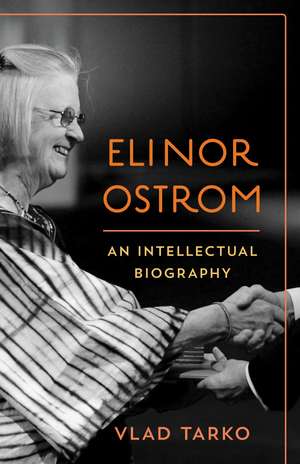
Elinor Ostrom: An Intellectual Biography
Autor Vlad Tarkoen Limba Engleză Paperback – 15 dec 2016
Preț: 261.53 lei
Preț vechi: 358.81 lei
-27%
Puncte Express: 392
Carte tipărită la comandă
Livrare economică 04-18 decembrie
Livrare prin curier în România Termenul estimat este afișat lângă disponibilitate.
Transport gratuit de la 400.00 lei Plată online sau ramburs, în funcție de opțiunile comenzii.
Retur gratuit în 14 zile Comandă securizată și suport în română.
Specificații
ISBN-13: 9781783485895
ISBN-10: 1783485892
Pagini: 160
Ilustrații: 25 b/w illustrations;10 tables;
Dimensiuni: 134 x 214 x 16 mm
Greutate: 0.25 kg
Editura: Bloomsbury Publishing
Colecția Rowman & Littlefield
Locul publicării:New York, United States
ISBN-10: 1783485892
Pagini: 160
Ilustrații: 25 b/w illustrations;10 tables;
Dimensiuni: 134 x 214 x 16 mm
Greutate: 0.25 kg
Editura: Bloomsbury Publishing
Colecția Rowman & Littlefield
Locul publicării:New York, United States
V-ar putea interesa
-
 -31%Preț: 610.96 lei879.41 lei
 -
 Capitalist Alternatives: Models, Taxonomies, ScenariosPaul Dragos Aligica-18%Preț: 1248.98 lei1523.15 lei
 -
 Happy TalesConnie BrittainPreț: 183.62 lei
 -
 Pregnancy Centers; Why I Serve: A Birth Mom'S StoryGeorgia Barnes-5%Preț: 67.70 lei71.26 lei
 -
 Was John Bunyan a Gipsy?MR James SimsonPreț: 78.21 lei
 -
 Pine Ridge Coal CampK. R. AlfordPreț: 43.37 lei
 -
 A Memoir of the REV. John Keble - Vol. IIJ. T. ColeridgePreț: 185.03 lei
 -
 Preț: 308.74 lei
 -
 Nicolo PaganiniMR Stephen S. StrattonPreț: 96.16 lei
 -
 Beyond Alterity, UsStefania FiocchiPreț: 63.90 lei
 -
 From Bari to Boston - An American ExperienceErnie GerbasiPreț: 381.78 lei
 -
 The Princess of Castro StreetMR Lee MentleyPreț: 121.84 lei
 -
 Church and HallByron BabbishPreț: 67.91 lei
 -
 Poems of Life and LightJennie HarrisonPreț: 153.55 lei
 -
 MIS HuellasOlga M. MunozPreț: 97.46 lei
 -
 Memoir of Jonathan Hutchinson, with Selections from His LettersJonathan HutchinsonPreț: 132.26 lei
 -
 Moisant de Brieux. Étude bibliographiqueGeorges MancelPreț: 78.57 lei
 -
 Preț: 72.57 lei
 -
 Preț: 115.10 lei
 -
 Preț: 87.04 lei
 -
 À M. le Comte A. de VillarsonPierre MartinPreț: 79.18 lei
 -
 Preț: 79.64 lei
 -
 Notice sur la vie et les travaux de M. Jn MazauricJ. -L. MeinadierPreț: 72.77 lei
 -
 Preț: 122.98 lei
Cuprins
Introduction: The idea of self-governance as the foundation to institutional analysis and development / 1. Against Gargantua: The study of local public economies / 2. Polycentricity: The art and science of association / 3. Escaping the tragedy of the commons: The concept of property and the varieties of self-governing arrangements / 4. Resilience: Understanding the institutional capacity to cope with shocks and other challenges / 5. Hamilton's dilemma: Can societies establish good governments by reflection and choice? / Conclusion: Elinor Ostrom as a role model for social scientists
Recenzii
[T]he book presents, in a systematic way, an excellent and easy-to-read exposition of the Ostroms' approach to social science.
Tarko's concise intellectual biography of Elinor Ostrom provides readers with an authoritative account of the Bloomington School and is a masterful work of political economy in its own right. The fields of economics, political science, and philosophy would be far better off if Ostrom's insights were more widely understood, and this book should help to make that happen.
This is a masterful account of Ostrom's work. An inspiring synthesis, of an inspiring intellectual life.
Tarko does an outstanding job capturing the breadth and depth of Lin's work to produce a course in the New Institutional Economics, as well as an intellectual history of Lin, Vincent and the many scholars associated with the Workshop in Political theory and Policy Analysis at Indiana University.
Vlad Tarko has written more than an intellectual biography of one of the most influential social scientists of her generation. His book is at the same time an insightful introduction and a nuanced interpretation of a fascinating research program with significant applied-level implications.
Vlad Tarko's book adds a valuable perspective on the ideas and work of Elinor Ostrom plus that of Vincent Ostrom and the Bloomington Workshop they established. The extent of their influence, and the reasons for it, come through clearly in these pages. It will be useful for readers looking for an introduction to Elinor's work, and enjoyable for readers who are already familiar with it.
Vald Tarko has provided a brilliant overview of what Lin Ostrom often referred to as her and Vincent's "polycentric journey". Along the way she studied local public economies, the wrestling with common-pool resources throughout the world, and the complexity of economic development. Her enduring research legacy is to be found in both her multiple methodologies approach to studying institutional diversity, and the conclusions she drew on the possibility and sustainability of self-governing democratic societies. Tarko's book is a must read not only to those who want to learn about Elinor Ostrom and her contributions, but to all students of political economy.
Tarko's concise intellectual biography of Elinor Ostrom provides readers with an authoritative account of the Bloomington School and is a masterful work of political economy in its own right. The fields of economics, political science, and philosophy would be far better off if Ostrom's insights were more widely understood, and this book should help to make that happen.
This is a masterful account of Ostrom's work. An inspiring synthesis, of an inspiring intellectual life.
Tarko does an outstanding job capturing the breadth and depth of Lin's work to produce a course in the New Institutional Economics, as well as an intellectual history of Lin, Vincent and the many scholars associated with the Workshop in Political theory and Policy Analysis at Indiana University.
Vlad Tarko has written more than an intellectual biography of one of the most influential social scientists of her generation. His book is at the same time an insightful introduction and a nuanced interpretation of a fascinating research program with significant applied-level implications.
Vlad Tarko's book adds a valuable perspective on the ideas and work of Elinor Ostrom plus that of Vincent Ostrom and the Bloomington Workshop they established. The extent of their influence, and the reasons for it, come through clearly in these pages. It will be useful for readers looking for an introduction to Elinor's work, and enjoyable for readers who are already familiar with it.
Vald Tarko has provided a brilliant overview of what Lin Ostrom often referred to as her and Vincent's "polycentric journey". Along the way she studied local public economies, the wrestling with common-pool resources throughout the world, and the complexity of economic development. Her enduring research legacy is to be found in both her multiple methodologies approach to studying institutional diversity, and the conclusions she drew on the possibility and sustainability of self-governing democratic societies. Tarko's book is a must read not only to those who want to learn about Elinor Ostrom and her contributions, but to all students of political economy.