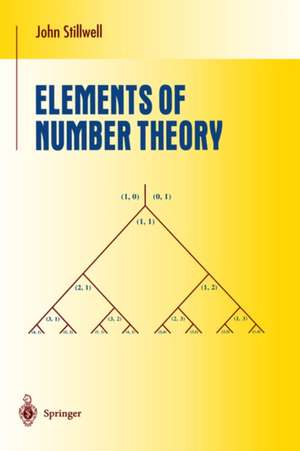
Elements of Number Theory
Autor John Stillwellen Limba Engleză Hardback – 13 dec 2002
Evoluția teoriei numerelor a fost marcată constant de trecerea de la observații empirice despre numerele naturale la structuri algebrice complexe, necesare pentru a soluționa probleme aparent simple. În Elements of Number Theory, John Stillwell surprinde această tranziție, oferind o perspectivă în care numerele sunt înțelese cel mai bine prin structura lor internă. Subliniem faptul că, deși lucrarea este independentă, ea completează viziunea autorului din Elements of Algebra, înlocuind căutarea soluțiilor prin radicali cu studiul soluțiilor întregi. Această abordare transformă concepte abstracte precum inelele și idealul în instrumente concrete, născute din nevoia istorică de a restaura factorizarea unică în arithmeticile generalizate.
Notăm cu interes modul în care Stillwell poziționează această carte în cadrul operei sale, păstrând rigoarea și claritatea istorică prezente în Mathematics and Its History sau The Story of Proof. Structura narativă a cursului este logică și progresivă: începe cu bazele aritmeticii (algoritmul lui Euclid și congruențe), trece prin aplicații practice esențiale precum The RSA cryptosystem, și culminează cu teoria idealelor. Această progresie reflectă fidel curriculumul universitar de bază, dar cu o deschidere spre algebra abstractă pe care puține manuale introductive o reușesc.
Lucrarea completează perspectiva oferită de Introduction to Number Theory de Anthony Vazzana, adăugând o fundamentare istorică și algebrică mai profundă asupra motivului pentru care au apărut structurile de inel. În timp ce alte texte se concentrează pe proprietăți computaționale, Stillwell pune accent pe „eroismul” matematic al lui Kummer și Dedekind, făcând din teoria numerelor o explorare a structurilor care guvernează universul matematic. Este o ediție esențială pentru înțelegerea modului în care teoria numerelor a devenit fundamentul algebrei moderne.
Preț: 305.37 lei
Preț vechi: 371.41 lei
-18%
Carte indisponibilă temporar
Specificații
ISBN-10: 0387955879
Pagini: 272
Ilustrații: XII, 256 p.
Dimensiuni: 160 x 241 x 20 mm
Greutate: 0.58 kg
Ediția:2003
Editura: Springer
Locul publicării:New York, NY, United States
V-ar putea interesa
-
 Elements of MathematicsJohn StillwellPreț: 162.87 lei
 -
 Reverse MathematicsJohn StillwellPreț: 148.40 lei
 -
 The Story of Proof - Logic and the History of MathematicsJohn StillwellPreț: 344.66 lei
 -
 Algebraic Number Theory for BeginnersJohn StillwellPreț: 284.88 lei
 -
 Arithmetic and GeometryLuis Dieulefait-11%Preț: 596.24 lei669.93 lei
 -
 A Concise History of Mathematics for PhilosophersJohn StillwellPreț: 147.02 lei
 -
 Hopf Algebras in Noncommutative Geometry and PhysicsStefaan Caenepeel-18%Preț: 933.12 lei1137.95 lei
 -
 Sheaves and Functions Modulo pLenny Taelman-17%Preț: 405.43 lei488.64 lei
 -
 Group Theory in Particle, Nuclear, and Hadron PhysicsSyed Afsar Abbas-18%Preț: 1483.25 lei1808.84 lei
 -
 -9%Preț: 664.56 lei730.28 lei
 -
 -18%Preț: 893.54 lei1089.69 lei
 -
 -18%Preț: 960.80 lei1171.72 lei
 -
 Methods of Solving Number Theory ProblemsEllina GrigorievaPreț: 429.77 lei
 -
 p-adic NumbersFernando Q. GouvêaPreț: 429.50 lei
 -
 Infinite Ergodic Theory of NumbersMarc Kesseböhmer-8%Preț: 445.90 lei484.67 lei
 -
 Planning Support Systems and Smart CitiesStan Geertman-18%Preț: 965.77 lei1177.77 lei
 -
 Analytic Number TheoryCarl PomerancePreț: 396.71 lei
 -
 Dedekinds Theorie der ganzen algebraischen ZahlenKatrin ScheelPreț: 330.58 lei
 -
 Bernoulli Numbers and Zeta FunctionsTsuneo Arakawa-18%Preț: 893.57 lei1089.72 lei
 -
 Land Use Simulation for EuropeJohn Stillwell-18%Preț: 951.71 lei1160.63 lei
 -
 Contemporary Research in Population GeographyJohn StillwellPreț: 388.77 lei
 -
 VALUE DISTRIBUTION IN P-ADIC ANALYSISEscassut Alain-18%Preț: 1152.62 lei1405.64 lei
Public țintă
Lower undergraduateDe ce să citești această carte
Recomandăm această carte oricărui student la matematică ce dorește să înțeleagă nu doar „cum”, ci și „de ce” au apărut conceptele de inel și ideal. John Stillwell reușește să transforme teoria numerelor dintr-o colecție de algoritmi într-o poveste coerentă despre structuri algebrice. Cititorul câștigă o bază solidă pentru cursul de algebră abstractă, beneficiind de o scriitură clară, adaptată nivelului de licență.
Descriere scurtă
Cuprins
Recenzii
"Solving equations in integers is the central problem of number theory, so this book is truly a number theory book, with most of the results found in standard number theory courses. … The book is clearly written, well organized and is a very pleasurable reading: it is an excellent and very useful undergraduate textbook. However, thanks to the many examples and exercises, it is well suitable for independent study, as well." (Lászlo Megyesi, Acta Scientiarum Mathematicarum, Vol. 71, 2005)
"In this carefully crafted undergraduate number theory text, Stillwell walks the reader through the main topics that belong in any introduction to number theory … but he does so in a way that highlights the beguiling nature of number theory problems and keeps their rich history alive. … This book has some additional features that will draw you to order it for your courses. … Stillwell … presents a compelling argument for studying the ancient and modern problems of number theory … ." (Gwynneth G. H. Coogan, Mathematical Reviews, 2004 j)
"A solid systematic introduction to (algebraic) number theory which is truly elementary in the sense that a bright young undergraduate could make rapid unaided progress through this book. … There are lots of goodies in the sidelines and the attention to clarity of writing and to pedagogic care give it a high rank amongst competing texts. … Stillwell’s book makes a very positive contribution to the coherence of the subject, which adds … to the satisfaction of studying it." (John Baylis, The Mathematical Gazette, Vol. 88 (512), 2004)
"Stillwell has taken very careful aim at his target audience and hit them squarely between the eyes. … the author has done a wonderful job of conveying his obvious love of the subject to the reader. … The author … covers basic classical number theory. … Each chapter opens with a substantial preview stating the central concepts whichare about to appear. … In short, this book is a delight to read and is ideally suited to a beginning course in number theory." (Ralph H. Buchholz, The Australian Mathematical Society Gazette, Vol. 31 (1), 2004)
"The book is a concise introduction to number theory and some related algebra, with an emphasis on solving equations in integers. … The historical development has been followed where it helps to motivate the introduction of new concepts, but modern proofs have been used where they are simpler, more natural, or more interesting. … Also, this is the only elementary number theory book that includes significant applications of ideal theory." (Zentralblatt für Didaktik der Mathematik, February, 2003)
"The text would be suitable for the standard elementary number theory course. … could serve as an introduction to algebraic number theory. … has a number of unusual and attractive features. … there is much in this book that would make it an appealing choice for a group of able mathematics majors. … the book under review provides a valuable and original alternative to the many current texts on introductory number theory." (David W. Boyd, SIAM Review, Vol. 46 (2), 2004)
Textul de pe ultima copertă
The development of these ideas, and the transition from ancient to modern, is the main theme of the book. The historical development has been followed where it helps to motivate the introduction of new concepts, but modern proofs have been used where they are simpler, more natural, or more interesting. These include some that have not yet appeared in textbooks, such as a treatment of the Pell equation using Conway's theory of quadratic forms. Also, this is the only elementary number theory book that includes significant applications of ideal theory. It is clearly written, well illustrated, and supplied with carefully designed exercises, making it a pleasure to use as an undergraduate textbook or for independent study.
John Stillwell is Professor of Mathematics at the University of San Francisco. He is the author of several highly regarded books published by Springer-Verlag, including Mathematics and Its History (Second Edition 2001), Numbers and Geometry (1997) and Elements of Algebra (1994).