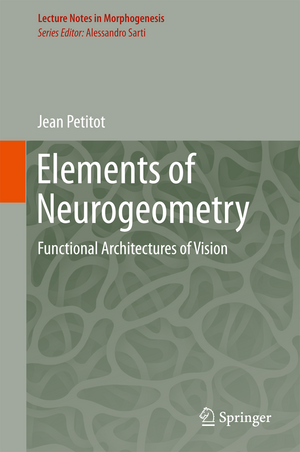
Elements of Neurogeometry: Lecture Notes in Morphogenesis
Autor Jean Petitoten Limba Engleză Hardback – 24 noi 2017
As such, it provides readers with the first systematic interpretation of a number of important neurophysiological observations in a well-defined mathematical framework. The book’s neuromathematical exploration appeals to graduate students and researchers in integrative-functional-cognitive neuroscience with a good mathematical background, as well as those in applied mathematics with an interest in neurophysiology.
Din seria Lecture Notes in Morphogenesis
- 18%
 Preț: 1080.33 lei
 - 15%
 Preț: 563.17 lei
 - 20%
 Preț: 325.33 lei
 - 15%
 Preț: 468.95 lei
 - 18%
 Preț: 706.30 lei
 - 15%
 Preț: 624.77 lei
 - 18%
 Preț: 1180.91 lei
 - 15%
 Preț: 621.78 lei
 - 20%
 Preț: 323.89 lei
 - 15%
 Preț: 621.36 lei
 -
 Preț: 367.42 lei
 - 18%
 Preț: 1014.56 lei
 - 20%
 Preț: 948.18 lei
 - 18%
 Preț: 854.76 lei
 - 15%
 Preț: 617.28 lei
 - 18%
 Preț: 701.43 lei
 - 24%
 Preț: 899.67 lei
 - 24%
 Preț: 1155.14 lei
 - 18%
 Preț: 747.88 lei
 - 18%
 Preț: 702.12 lei
 - 18%
 Preț: 1075.65 lei
 - 18%
 Preț: 697.55 lei
 - 18%
 Preț: 809.11 lei
 - 20%
 Preț: 1157.43 lei
Preț: 766.48 lei
Preț vechi: 1008.52 lei
-24%
Puncte Express: 1150
Carte tipărită la comandă
Livrare economică 03-09 iunie
Specificații
ISBN-13: 9783319655895
ISBN-10: 3319655892
Ilustrații: 239 schwarz-weiße Abbildungen, Bibliographie
Dimensiuni: 160 x 241 x 26 mm
Greutate: 0.83 kg
Ediția:1st ed. 2017
Editura: Springer
Seria Lecture Notes in Morphogenesis
Locul publicării:Cham, Switzerland
ISBN-10: 3319655892
Ilustrații: 239 schwarz-weiße Abbildungen, Bibliographie
Dimensiuni: 160 x 241 x 26 mm
Greutate: 0.83 kg
Ediția:1st ed. 2017
Editura: Springer
Seria Lecture Notes in Morphogenesis
Locul publicării:Cham, Switzerland
Cuprins
Preface.- Introdcution.- Receptive Fields and Profiles, and Wavelet Analysis.- Pinwheels of V1 Horizontal Connections and Contact Structure.-
Transition to Volume II.- References.
Notă biografică
Jean Petitot specializes in mathematical modeling in the cognitive sciences. Former student and teacher at the École Polytechnique, he is currently Professor at the Mathematics Center of the École des Hautes Études en Sciences Sociales in Paris. He is a member of the International Academy of Philosophy of Science. Having worked for several years on the theory of singularities in differential geometry, he was one of the first to become interested in René Thom's morphodynamic models of visual perception and phonetics in the 1970s.
He is the author of several books, such as Neurogeomtrie de la vision (École Polytechnique, Ellipses, 2008), ‘Physique du Sen’ (Centre Nationale de la Recherche Scientifique, 1992), ‘Morphogenèse du Sens’ (Presses Universitaires de France, 1985; English transl. Peter Lang, 2004), five other books, and more than 300 papers. He is also co-editor of ‘Constituting Objectivity’ (Springer, 2009), ‘Neurogeometry and Visual Perception’ (J. of Physiology-Paris, 2003), ‘Au Nom du Sens’, a tribute to Umberto Eco (Grasset, 2000), ‘Naturalizing Phenomenology’ (Stanford University Press, 1999), ‘Logos et Théorie des Catastrophes’, a tribute to René Thom, (Patiño, 1988).
He is the author of several books, such as Neurogeomtrie de la vision (École Polytechnique, Ellipses, 2008), ‘Physique du Sen’ (Centre Nationale de la Recherche Scientifique, 1992), ‘Morphogenèse du Sens’ (Presses Universitaires de France, 1985; English transl. Peter Lang, 2004), five other books, and more than 300 papers. He is also co-editor of ‘Constituting Objectivity’ (Springer, 2009), ‘Neurogeometry and Visual Perception’ (J. of Physiology-Paris, 2003), ‘Au Nom du Sens’, a tribute to Umberto Eco (Grasset, 2000), ‘Naturalizing Phenomenology’ (Stanford University Press, 1999), ‘Logos et Théorie des Catastrophes’, a tribute to René Thom, (Patiño, 1988).
Textul de pe ultima copertă
This book describes several mathematical models of the primary visual cortex, referring them to a vast ensemble of experimental data and putting forward an original geometrical model for its functional architecture, that is, the highly specific organization of its neural connections. The book spells out the geometrical algorithms implemented by this functional architecture, or put another way, the “neurogeometry” immanent in visual perception. Focusing on the neural origins of our spatial representations, it demonstrates three things: firstly, the way the visual neurons filter the optical signal is closely related to a wavelet analysis; secondly, the contact structure of the 1-jets of the curves in the plane (the retinal plane here) is implemented by the cortical functional architecture; and lastly, the visual algorithms for integrating contours from what may be rather incomplete sensory data can be modelled by the sub-Riemannian geometry associated with this contact structure.
As such, it provides readers with the first systematic interpretation of a number of important neurophysiological observations in a well-defined mathematical framework. The book’s neuromathematical exploration appeals to graduate students and researchers in integrative-functional-cognitive neuroscience with a good mathematical background, as well as those in applied mathematics with an interest in neurophysiology.
As such, it provides readers with the first systematic interpretation of a number of important neurophysiological observations in a well-defined mathematical framework. The book’s neuromathematical exploration appeals to graduate students and researchers in integrative-functional-cognitive neuroscience with a good mathematical background, as well as those in applied mathematics with an interest in neurophysiology.
Caracteristici
Illustrates the fascinating interactions between mathematics and neuroscience Describes geometrical models of the functional architecture of the visual cortex Presents a variety of examples Includes supplementary material: sn.pub/extras