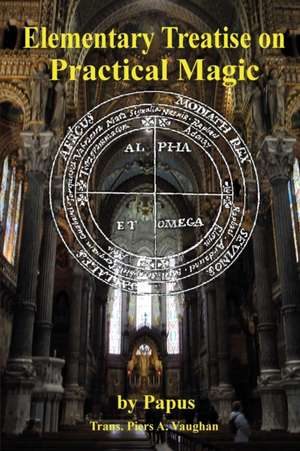
Elementary Treatise on Practical Magic
Autor (Gérard Encausse) Papusen Limba Engleză Paperback – 12 dec 2017
Notăm cu interes reeditarea unei lucrări fundamentale pentru istoria ezoterismului european, adresată în egală măsură studenților la istoria religiilor, cercetătorilor curentelor oculte și practicienilor interesați de rădăcinile magiei ceremoniale. Publicat inițial în 1893, Elementary Treatise on Practical Magic reprezintă momentul de debut public al lui Papus, pseudonimul medicului Gérard Encausse, care a încercat o reconciliere curajoasă între științele pozitive și artele oculte. Descoperim aici o abordare revoluționară pentru acea epocă: autorul susține că ritualurile vechi nu trebuie urmate orbește, ci adaptate contextului modern, folosind intelectul și resursele contemporane. Remarcăm modul în care Papus își folosește expertiza medicală pentru a explica fenomenele magice prin prisma fiziologiei și a hipnoterapiei, încercând să ofere acestui domeniu o rigoare academică. Această ediție în limba engleză este îmbogățită cu numeroase note de subsol care clarifică referințele la personalități, publicații și ordine inițiatice din Parisul de la sfârșitul secolului al XIX-lea, informații care altfel ar fi rămas obscure cititorului actual. Alternativă la Elementary Treatise of Occult Science pentru cursurile de istorie a esoterismului, volumul de față aduce în plus o dimensiune practică și o ancorare puternică în viața cotidiană a epocii, incluzând chiar și elemente de magie populară. În timp ce The History of Magic de Joseph Ennemoser se concentrează pe magnetism și hipnoză dintr-o perspectivă medicală timpurie, lucrarea lui Papus construiește o punte directă între grimoarele clasice, precum Cheile lui Solomon, și realitățile tehnologice ale primei revoluții industriale.
Preț: 175.78 lei
Carte disponibilă
Livrare economică 10-24 noiembrie
Specificații
ISBN-10: 1947907018
Pagini: 510
Dimensiuni: 152 x 229 x 28 mm
Greutate: 0.68 kg
Editura: Rose Circle Publications
De ce să citești această carte
Această carte este esențială pentru cei care doresc să înțeleagă cum a fost modernizat ocultismul la sfârșitul secolului al XIX-lea. Cititorul câștigă o perspectivă unică asupra modului în care știința medicală și magia au coexistat în viziunea lui Papus. Este un instrument de studiu valoros datorită aparatului critic adăugat, facilitând accesul la o cunoaștere care anterior era rezervată doar cercurilor închise de inițiați.
Despre autor
Gérard Encausse, cunoscut sub numele de Papus, a fost un medic, hipnotizator și figură centrală a ocultismului francez. Fondator al Ordinului Martinist modern, el a reușit să îmbine cariera medicală de succes cu cercetarea profundă a științelor oculte. Influențat de lucrările lui Eliphas Levi, Papus a devenit unul dintre cei mai prolifici autori în domeniu, încercând constant să demonstreze că fenomenele magice au o bază rațională și pot fi studiate prin metode științifice. Opera sa rămâne un punct de referință pentru studiul Tarotului, al Cabalei și al magiei ceremoniale.
Descriere scurtă
Perhaps the most important word in the long title is Adaptation, for Papus makes the very important point that it isn't necessary to follow the instructions of the Grimoires slavishly, with no understanding or engagement of the intellect. He argued that modern man had neither the time to undertake the extensive and exclusive practices of old, and that many of the materials and implements required could either be purchased ready-made, or replaced with more modern substitutes. In this, he was perhaps the first public exponent of the Art to allow the ancient rituals to be adapted to modern use.
The book was a brave attempt to 'normalize' the esoteric world by placing it firmly in the realm of science, and Papus brought his medical knowledge to the challenge, in an attempt to show that everything which magic claimed to do was either firmly within the scientific domain, or would be in the near future. By applying his scientific methods to the study of esoteric phenomena, he hoped to make the magical arts a more respectable fiend of study.
To support this, he included extensive lessons on physiology, neural pathology and hypnotherapy. These were interwoven with discussions of magic, which were primarily based on the Grimoires, and in particular the Clavicles of King Solomon, to show that in some areas of study they were moving along similar paths. Yet for the high road he tries to take, Papus is not above adding phrases like 'Country' or 'Folk Magic' and 'Love Potions' to his subtitle
That said, the book is important in the history of esoteric education for a number of reasons. It was one of the first books which brought knowledge of the Grimoires and Ceremonial Magic to the general public, rather than to a rarified group of disciples. He was also the first to try to marry esoteric studies to science, in order to make them more palatable; and indeed, his work in this field does not appear to have negatively affected his professional life.
Perhaps most importantly, it provides a fascinating insight in fin de siEcle Paris, with its aspirations, energy, fears, and pride. We see a people galvanized with excitement, anticipating the World Fair in 1889, which would see the Eiffel Tower as a monument to man's scientific advances, the appearance of mass transportation by railroad, electric lighting, photography (all of which Papus mentions in this book), together with a burgeoning knowledge of the structure and functioning of the Microcosm - Man.
The text has been supplied with extensive footnotes: Papus had a habit of writing for his times, and therefore makes many assumptions of his readers regarding current politics and history, newspapers, books and magazines, and famous characters and Orders existing in his times. Since it is unlikely any modern reader would be very familiar with these references, the footnotes are intended to provide a quick background, without forcing the reader to have to keep turning to endnotes in order to look up references.