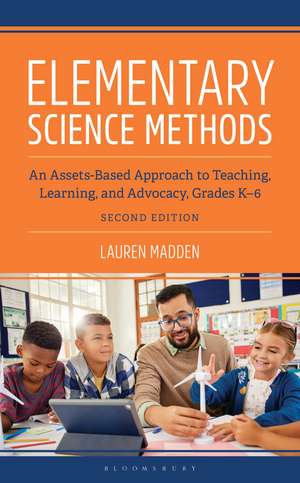
Elementary Science Methods: An Assets-Based Approach to Teaching, Learning, and Advocacy, Grades K-6
Autor Lauren Maddenen Limba Engleză Paperback – 16 apr 2026
The second edition of this textbook offers an up-to-date and practical guide to support excellent science teaching with even more ideas and tools to bring real-life authentic science into elementary classrooms.. This text meets the immediate, contextual needs of future and current elementary teachers by using an assets-based approach to science teaching, showing how to create inquiry-based lessons, differentiate instruction and lesson design based on children's developmental ages and needs, and providing easy-to-use tools to advocate for scientific teaching and learning guided by the Next Generation Science Standards (NGSS). Updates in this book include strategies for addressing complex and sometimes controversial scientific issues such as vaccine hesitancy and climate change to ensure teachers are well prepared to support a scientifically literate populace.
Preț: 210.63 lei
Preț vechi: 312.93 lei
-33%
Puncte Express: 316
Carte disponibilă
Livrare economică 31 octombrie-14 noiembrie
Livrare express 17-23 octombrie pentru 135.93 lei
Livrare prin curier în România Termenul estimat este afișat lângă disponibilitate.
Transport gratuit de la 400.00 lei Plată online sau ramburs, în funcție de opțiunile comenzii.
Retur gratuit în 14 zile Comandă securizată și suport în română.
Specificații
ISBN-13: 9798216275626
Pagini: 224
Ilustrații: 48 B/W figures
Dimensiuni: 152 x 228 x 14 mm
Greutate: 0.36 kg
Ediția:2nd edition
Editura: Bloomsbury Publishing
Colecția Bloomsbury Academic
Locul publicării:New York, United States
Pagini: 224
Ilustrații: 48 B/W figures
Dimensiuni: 152 x 228 x 14 mm
Greutate: 0.36 kg
Ediția:2nd edition
Editura: Bloomsbury Publishing
Colecția Bloomsbury Academic
Locul publicării:New York, United States
Cuprins
Foreword
Acknowledgments
Chapter 1: An Introduction to Assets-Based Elementary Science Teaching
Chapter 2: A Developmental Perspective on Science Teaching and Learning
Chapter 3: Inquiry-Based Teaching: Connecting Theory to Strategy
Chapter 4: What Is (and Isn't) Science Anyway?
Chapter 5: The Next Generation Science Standards: An Introduction
Chapter 6: Asking Good Questions and Developing Lessons
Chapter 7: Connecting Science to Language Arts and Mathematics
Chapter 8: STEM and STEAM: Creativity and Problem-Solving in Elementary Science
Chapter 9: Beginning to Use Science to Advocate
Chapter 10: Equity, Diversity, and Inclusion in Science Teaching
Chapter 11: How Do We Know What We Know in Science?
Chapter 12: Science Outside of School
Chapter 13 Advocating for Science
Glossary
References
Index
About the Author
Acknowledgments
Chapter 1: An Introduction to Assets-Based Elementary Science Teaching
Chapter 2: A Developmental Perspective on Science Teaching and Learning
Chapter 3: Inquiry-Based Teaching: Connecting Theory to Strategy
Chapter 4: What Is (and Isn't) Science Anyway?
Chapter 5: The Next Generation Science Standards: An Introduction
Chapter 6: Asking Good Questions and Developing Lessons
Chapter 7: Connecting Science to Language Arts and Mathematics
Chapter 8: STEM and STEAM: Creativity and Problem-Solving in Elementary Science
Chapter 9: Beginning to Use Science to Advocate
Chapter 10: Equity, Diversity, and Inclusion in Science Teaching
Chapter 11: How Do We Know What We Know in Science?
Chapter 12: Science Outside of School
Chapter 13 Advocating for Science
Glossary
References
Index
About the Author
Recenzii
This second edition equips preservice teachers with the tools to teach elementary science through inquiry, advocacy, and a student-centered lens. It retains its strong focus on assets-based teaching, NGSS-aligned strategies, and interdisciplinary connections, while introducing timely updates on assessing resources for science instruction and the teaching of controversial science topics, including vaccine denial. With practical guidance on asking effective questions, fostering creativity, and integrating science with literacy and math, it prepares future educators to design purposeful, inclusive, and engaging science and STEM/STEAM lessons. This newest edition deepens its commitment to preparing teachers scientific literacy, and will help teachers to become confident, reflective agents for science.
Dr. Madden's book is a must-have for elementary science teachers. What makes it so valuable is its accessible, hands-on approach that removes the intimidation factor from teaching science while igniting curiosity and joy in the classroom. Each activity is thoughtfully designed to be practical, easy to implement, and adaptable for a variety of settings. The focus isn't just on teaching content-it's on creating meaningful experiences that inspire a genuine love of science in both teachers and students.
As a teacher educator, I see the impact firsthand. My pre-service teachers are constantly energized by the activities, often asking, 'Can we try the activity from Chapter 2?' Their eagerness to dive in speaks volumes about the book's ability to connect, engage, and excite. It is more than a resource-it's an invitation to explore, wonder, and experiment. This book reminds us that science learning should be active, joyful, and shared.
Dr. Madden's book is a must-have for elementary science teachers. What makes it so valuable is its accessible, hands-on approach that removes the intimidation factor from teaching science while igniting curiosity and joy in the classroom. Each activity is thoughtfully designed to be practical, easy to implement, and adaptable for a variety of settings. The focus isn't just on teaching content-it's on creating meaningful experiences that inspire a genuine love of science in both teachers and students.
As a teacher educator, I see the impact firsthand. My pre-service teachers are constantly energized by the activities, often asking, 'Can we try the activity from Chapter 2?' Their eagerness to dive in speaks volumes about the book's ability to connect, engage, and excite. It is more than a resource-it's an invitation to explore, wonder, and experiment. This book reminds us that science learning should be active, joyful, and shared.