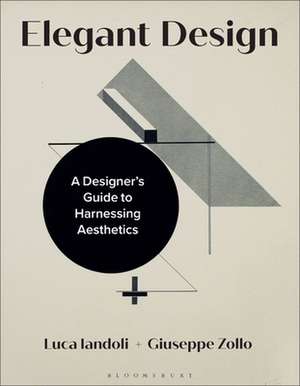
Elegant Design: A Designer’s Guide to Harnessing Aesthetics
Autor Luca Iandoli, Giuseppe Zolloen Limba Engleză Hardback – 7 apr 2022
Explorăm în acest volum designul ca intersecție între estetica vizuală și rigoarea științelor cognitive, o abordare care transformă felul în care înțelegem impactul obiectelor din jurul nostru. Elegant Design nu este doar un manual de estetică, ci o analiză a modului în care mintea umană procesează fluxul constant de date vizuale. Remarcăm prezența celor 150 de ilustrații color, care permit o experiență senzorială directă, facilitând înțelegerea conceptelor de „complexitate eficientă” și „recunoaștere a tiparelor”.
Complementar lucrării Visual Thinking for Design de Colin Ware, care pune accent pe știința percepției pure, Elegant Design propune o perspectivă mai nuanțată asupra plăcerii estetice ca instrument de procesare a informației. Dacă în Design Your Business, Luca Iandoli se concentra pe aplicarea gândirii de design în context antreprenorial, în acest volum, scris împreună cu Giuseppe Zollo, miza este descifrarea mecanismelor prin care frumusețea devine o soluție pentru suprasolicitarea informațională.
Structura volumului, publicat de Bloomsbury Visual Arts, este riguros organizată pentru a ghida cititorul de la teorie la practică. Capitolele precum „The Simplifying Machine” sau „The Art of Simplicity” sunt însoțite de secțiuni „Creativity Lab”, care oferă strategii concrete de eliminare a detaliilor redundante. Autorii demonstrează că deciziile estetice nu sunt subiective, ci reprezintă forme de inteligență colectivă și senzorială care fac produsele să fie nu doar utile, ci și memorabile. Este o resursă valoroasă pentru cei care doresc să înțeleagă de ce anumite forme ne atrag instinctiv și cum pot fi reproduse aceste calități în proiecte de design comercial sau de produs.
Preț: 545.85 lei
Preț vechi: 784.27 lei
-30%
Carte disponibilă
Livrare economică 05-19 noiembrie
Specificații
ISBN-10: 1350177458
Pagini: 200
Ilustrații: 150 colour illus
Dimensiuni: 214 x 274 x 16 mm
Greutate: 0.9 kg
Editura: Bloomsbury Publishing
Colecția Bloomsbury Visual Arts
Locul publicării:London, United Kingdom
V-ar putea interesa
-
 MotherhoodSheila Heti-19%Preț: 64.31 lei79.10 lei
 -
 A Sand BookAriana Reines-29%Preț: 77.32 lei108.32 lei
 -
 Uncreative WritingKenneth GoldsmithPreț: 128.82 lei
 -
 EssaysLydia Davis-16%Preț: 122.39 lei146.23 lei
 -
 The Collected Stories of Lydia DavisLydia Davis-27%Preț: 70.93 lei96.93 lei
 -
 Third World Women and the Politics of FeminismChandra Talpade MohantyPreț: 188.31 lei
 -
 this bridge we call home: radical visions for transformationGloria Anzaldúa-15%Preț: 470.21 lei553.18 lei
 -
 Furious Flower: Seeding the Future of African American PoetryDr. Joanne V. GabbinPreț: 234.75 lei
 -
 DeviationsGayle S RubinPreț: 212.17 lei
 -
 Essays TwoLydia DavisPreț: 137.38 lei
 -
 Vibrant Death: A Posthuman Phenomenology of MourningProfessor Nina Lykke-32%Preț: 584.81 lei864.97 lei
 -
 -15%Preț: 158.73 lei187.41 lei
 -
 -43%Preț: 141.20 lei248.17 lei
 -
 More Posthuman GlossaryProfessor Rosi Braidotti-14%Preț: 162.03 lei189.28 lei
 -
 Materialist Phenomenology: A Philosophy of PerceptionProfessor Manuel DeLanda-20%Preț: 168.45 lei210.27 lei
 -
 This Bridge Called My BackCherríe MoragaPreț: 251.67 lei
 -
 Post-Digital: Dialogues and Debates from electronic book reviewProfessor Joseph Tabbi-59%Preț: 1373.91 lei3389.35 lei
 -
 Electronic Literature as Digital Humanities: Contexts, Forms, and PracticesProfessor Dene Grigar-25%Preț: 217.50 lei290.18 lei
 -
 This Wound Is a WorldBilly-Ray BelcourtPreț: 83.79 lei
 -
 The Right to Sex: Shortlisted for the Orwell Prize 2022Amia Srinivasan-32%Preț: 53.51 lei79.10 lei
 -
 Crying in H MartMichelle Zauner-40%Preț: 47.46 lei78.75 lei
 -
 The Pain JournalBob FlanaganPreț: 109.37 lei
 -
 The Violence of Financial Capitalism, New EditionChristian MarazziPreț: 71.99 lei
 -
 Last Days at Hot SlitAndrea Dworkin-14%Preț: 102.53 lei119.25 lei
 -
 The Cybernetic HypothesisTiqqun-17%Preț: 73.74 lei88.41 lei
 -
 Bee ReavedDodie BellamyPreț: 106.04 lei
 -
 Preț: 114.29 lei
 -
 -30%Preț: 68.89 lei98.67 lei
 -
 Fetishism and Curiosity: Cinema and the Mind's EyeLaura Mulvey-25%Preț: 174.01 lei233.20 lei
De ce să citești această carte
Recomandăm această carte profesioniștilor din design și marketing care doresc să fundamenteze estetica pe date științifice. Cititorul câștigă o înțelegere profundă a modului în care creierul simplifică realitatea vizuală, primind instrumente practice pentru a crea experiențe de utilizator coerente. Este un ghid esențial pentru a transforma complexitatea în eleganță vizuală, beneficiind de expertiza unor autori cu background în arhitectură și informatică.
Descriere
The answer is to think aesthetically. Research insights at the intersection between cognitive science and art studies demonstrate that our minds can effectively process visual complexity by using aesthetic pleasure and judgement as a guide. Analysing the work of great artists and designers from the perspective of how our mind appreciates beauty, Elegant Design identifies actionable aesthetic strategies that will help you to design products and user experiences that are useful, beautiful and meaningful.
Cuprins
Introduction
The age of aesthetics
Elegant decisions
The art of simplicity
Getting started
1. The Simplifying Machine
Impressions
Simple minds
What do you see is what do you get? Understanding as pattern recognition
The joy of guessing: ambiguity and emotions in understanding
The role of aesthetic pleasure in understanding
Too good to be true
Creativity Lab: how the mind simplifies reality and compresses information
2. Beauty as Effective Complexity
There is no recipe for creativity
The hidden workflow of the creative process
How does it feel? The roles of emotions in aesthetic experience
When good is good enough? Beautify as effective complexity
Strategies for effective complexity
Conclusions: the necessity of art
Creativity Lab: handling complexity in design
Part One: Search for Unity Strategies
3. Subtract Details
The art of concision
The case for abstraction
Subtracting the obvious, adding the meaningful
Small talks
The science of brevity
Conclusions
Creativity Lab: subtracting details from your design without loosing meaningful performance
4. Symmetry
Blood, sweat, and tears: what goes up, can't go down
The invention of the point of view: symmetry in art
Managing symmetry: checks and balances
The science of symmetry
Conclusions
Creativity Lab: how to handle symmetry and asymmetry in your design
5. The Power of Grouping
A stroll down the memory lane
The power of grouping in art: seeking as creating
What is your product? The danger of cognitive inertia and the wonders of creative categorization
The science of grouping
Conclusions
Creativity Lab: Effectively grouping information in your design
6. Split
Lizards, infinite lawns, and the invention of the hypertext
The devil is in the detail
The ergonomics of simplicity: the NEST thermostat
The science of split
Conclusions
Creativity Lab: how to design effective information layers and hierarchy
Part Two: Push for Variety Strategies
7. The Power of the Center
May the force be with you
The power of the center in art: equilibrium as dynamic tension
The power of obsession: how extreme focus can make your business thrive (or die)
The science of split: the eye of the beholder
Conclusion
Creativity Lab: identifying attention-structuring centers in your design
8. Emphasize
An umbrella on four wheels
Emphasize in art
Think different: emphasize in design and management
The science of emphasizing
Creativity Lab: how to make your design stand out by harnessing the power of emphasis
9. Remix
Mission Impossible
Metamorphosis or the Nature of Change
What's your story? A chairman walks into a lab
The science of remix
Conclusions
Creativity Lab: effectively reshuffling your design to search for novelty
10. Contrast and Balance
Chess and balance
Present, tense
Lost in transition
The science of contrast
Conclusions: keep on moving
Creativity Lab: How to creative effective visual weight dynamics
11. The Swinging Mind
Black holes and supernovas: navigating the design continuum
The critical role of granularity in design
When good is good enough: the swinging mind
Design as persuasion
Creativity Lab: everyday exercises to cultivate a swinging mind
Conclusion
Index