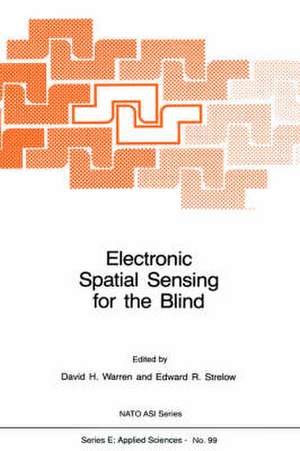
Electronic Spatial Sensing for the Blind: NATO Science Series E:, cartea 99
Editat de Edward R. Strelow, D. H. Warrenen Limba Engleză Hardback – 31 oct 1985
Din seria NATO Science Series E:
- 18%
 Preț: 983.83 lei
 - 18%
 Preț: 1905.37 lei
 -
 Preț: 374.84 lei
 -
 Preț: 386.34 lei
 - 20%
 Preț: 349.72 lei
 -
 Preț: 408.17 lei
 - 18%
 Preț: 1262.17 lei
 - 18%
 Preț: 1895.10 lei
 - 18%
 Preț: 1758.89 lei
 - 18%
 Preț: 1267.94 lei
 -
 Preț: 368.86 lei
 -
 Preț: 393.75 lei
 - 18%
 Preț: 1898.69 lei
 - 18%
 Preț: 1761.90 lei
 - 5%
 Preț: 355.87 lei
 -
 Preț: 391.71 lei
 -
 Preț: 412.56 lei
 -
 Preț: 388.01 lei
 -
 Preț: 387.28 lei
 - 18%
 Preț: 3138.09 lei
 -
 Preț: 377.01 lei
 - 5%
 Preț: 376.18 lei
 - 18%
 Preț: 1267.94 lei
 - 18%
 Preț: 1268.37 lei
 - 18%
 Preț: 1273.50 lei
 - 5%
 Preț: 3393.87 lei
 - 18%
 Preț: 1898.48 lei
 - 5%
 Preț: 367.92 lei
 - 18%
 Preț: 1266.27 lei
 -
 Preț: 382.33 lei
 -
 Preț: 384.16 lei
 - 18%
 Preț: 2569.38 lei
 - 5%
 Preț: 1474.32 lei
 -
 Preț: 384.40 lei
 - 5%
 Preț: 2211.40 lei
 - 18%
 Preț: 1903.71 lei
 -
 Preț: 388.20 lei
 -
 Preț: 398.39 lei
 -
 Preț: 402.06 lei
 - 20%
 Preț: 331.65 lei
 - 18%
 Preț: 979.10 lei
 - 18%
 Preț: 1268.99 lei
 - 20%
 Preț: 1974.01 lei
 - 20%
 Preț: 2105.96 lei
Preț: 2191.76 lei
Preț vechi: 2307.11 lei
-5%
Puncte Express: 3288
Carte tipărită la comandă
Livrare economică 26 noiembrie-10 decembrie
Livrare prin curier în România Termenul estimat este afișat lângă disponibilitate.
Transport gratuit pentru acest produs Plată online sau ramburs, în funcție de opțiunile comenzii.
Retur gratuit în 14 zile Comandă securizată și suport în română.
Specificații
ISBN-13: 9789024732388
ISBN-10: 9024732387
Pagini: 542
Ilustrații: XVI, 521 p.
Dimensiuni: 160 x 241 x 34 mm
Greutate: 0.92 kg
Ediția:1985
Editura: SPRINGER NETHERLANDS
Colecția NATO Science Series E:
Seria NATO Science Series E:
Locul publicării:Dordrecht, Netherlands
ISBN-10: 9024732387
Pagini: 542
Ilustrații: XVI, 521 p.
Dimensiuni: 160 x 241 x 34 mm
Greutate: 0.92 kg
Ediția:1985
Editura: SPRINGER NETHERLANDS
Colecția NATO Science Series E:
Seria NATO Science Series E:
Locul publicării:Dordrecht, Netherlands
V-ar putea interesa
-
 -23%Preț: 416.49 lei537.91 lei
 -
 The ScleraMaite Sainz De La Maza-5%Preț: 757.01 lei796.85 lei
 -
 -5%Preț: 355.72 lei374.45 lei
 -
 Cholestatic Liver DiseaseElizabeth J. Carey-5%Preț: 746.90 lei786.20 lei
 -
 Management of Functional Gastrointestinal Disorders in ChildrenDavid R. Fleisher-5%Preț: 627.22 lei660.23 lei
 -
 Thrombin: Function & PathophysiologyThomas Stief-23%Preț: 1278.09 lei1663.97 lei
 -
 -23%Preț: 928.00 lei1210.61 lei
 -
 Hepatic EncephalopathyKevin D. Mullen-5%Preț: 746.50 lei785.79 lei
 -
 Managing COPDRichard Russell-5%Preț: 346.54 lei364.78 lei
 -
 Critical Care for Anorexia NervosaPaul H. Robinson-5%Preț: 610.18 lei642.29 lei
 -
 Psychology of Wounds and Wound Care in Clinical PracticeDominic Upton-5%Preț: 352.71 lei371.27 lei
 -
 Differential Diagnosis for the DermatologistScott Jackson-5%Preț: 2246.23 lei2364.46 lei
 -
 Diabetologie kompaktHelmut Schatz-5%Preț: 880.94 lei927.31 lei
 -
 Injectable Fillers in Aesthetic MedicineMauricio De Maio-5%Preț: 750.07 lei789.55 lei
Public țintă
ResearchCuprins
Review Section.- Historical Overview.- A Review of Mobility Aids and Means of Assessment.- Technologies of Spatial Sensing.- On Mobility Aids for the Blind.- Computer Vision Requirements in Blind Mobility Aids.- Computer Vision for the Blind.- Sensory Aids to Spatial Perception for Blind Persons: Their Design and Evaluation.- Physical Principles Underlying Blind Guidance Prostheses with an Emphasis on the Ultrasonic Exploration of a Region of Space.- Comment: Three New Blind Guidance Prostheses and What they Teach Us.- Microprocessor Techniques Applied to Ultrasonic Pulse/Echo Travel Aids for the Blind.- Tactile Vision Substitution: Some Instrumentation and Perceptual Considerations.- Studies of the Use of Spatial Sensors.- Evaluating Mobility Aids: An Evolving Methodology.- Training the Use of Artificial Spatial Displays.- Sensory Substitution of Vision by Audition.- Sonar Sensory Aid and Blind Children’s Spatial Cognition.- Spatial Awareness Training of Blind Children Using the Trisensor.- Sensory Substitution in Blind Children and Neonates.- Use of Sonar Sensors with Human Infants.- Developmental Brain Research, Deprivation, and Sensory Aids.- Comment: Animal Models of Plasticity and Sensory Substitution.- Rehabilitation Issues.- Vision Prosthesis and Aids: Readiness or Appropriateness.- Technology and the Blind Person: Corridors of Insensitivity.- Perceptual and Cognitive Considerations.- On Replacement and Problem Solving Potentials of Spatial Aids for the Blind.- Implications of Perceptual Theory for the Development of Non-Visual Travel Aids for the Visually Impaired.- Amodal Information and Transmodal Perception.- Understanding Perceived Spatial Layout of Scenes: A Prerequisite for Prostheses for Blind Travelers.- The Cognitive Foundations of Mobility.-Comment: Issues in Travel Aid Design.- Comment: Machine Visual Guidance for the Blind.- Mobility and Orientation Processes of the Blind.- Final Commentary.