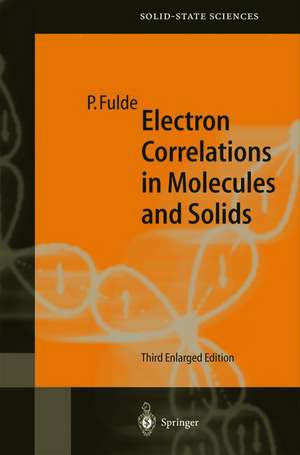
Electron Correlations in Molecules and Solids: Springer Series in Solid-State Sciences, cartea 100
Autor Peter Fuldeen Limba Engleză Paperback – 9 oct 1995
Din seria Springer Series in Solid-State Sciences
- 18%
 Preț: 978.08 lei
 - 18%
 Preț: 961.75 lei
 - 18%
 Preț: 865.62 lei
 - 18%
 Preț: 975.19 lei
 - 18%
 Preț: 974.37 lei
 - 18%
 Preț: 1208.55 lei
 - 18%
 Preț: 918.75 lei
 - 18%
 Preț: 925.97 lei
 -
 Preț: 373.90 lei
 - 15%
 Preț: 666.07 lei
 -
 Preț: 378.19 lei
 - 15%
 Preț: 642.81 lei
 - 15%
 Preț: 637.96 lei
 - 18%
 Preț: 900.69 lei
 - 15%
 Preț: 651.89 lei
 - 15%
 Preț: 655.47 lei
 - 18%
 Preț: 894.17 lei
 - 15%
 Preț: 643.87 lei
 - 15%
 Preț: 653.58 lei
 - 15%
 Preț: 649.35 lei
 - 15%
 Preț: 647.87 lei
 - 15%
 Preț: 658.03 lei
 - 18%
 Preț: 961.62 lei
 - 15%
 Preț: 640.73 lei
 - 23%
 Preț: 1140.33 lei
 - 15%
 Preț: 642.16 lei
 - 15%
 Preț: 652.10 lei
 - 15%
 Preț: 640.49 lei
 - 15%
 Preț: 643.25 lei
 -
 Preț: 379.62 lei
 -
 Preț: 385.99 lei
 -
 Preț: 376.01 lei
 - 15%
 Preț: 641.76 lei
 - 18%
 Preț: 966.98 lei
 - 18%
 Preț: 706.78 lei
 - 15%
 Preț: 643.63 lei
 - 15%
 Preț: 626.68 lei
 - 18%
 Preț: 1183.12 lei
 - 18%
 Preț: 1232.49 lei
 - 18%
 Preț: 957.20 lei
 - 15%
 Preț: 646.18 lei
Preț: 1832.67 lei
Preț vechi: 2234.95 lei
-18%
Puncte Express: 2749
Carte tipărită la comandă
Livrare economică 08-22 august
Livrare prin curier în România Termenul estimat este afișat lângă disponibilitate.
Transport gratuit pentru acest produs Plată online sau ramburs, în funcție de opțiunile comenzii.
Retur gratuit în 14 zile Comandă securizată și suport în română.
Specificații
ISBN-13: 9783540593645
ISBN-10: 3540593640
Pagini: 500
Ilustrații: XIV, 483 p. 7 illus.
Dimensiuni: 155 x 235 x 27 mm
Greutate: 0.75 kg
Ediția:Third Edition 1995
Editura: Springer
Colecția Springer Series in Solid-State Sciences
Seria Springer Series in Solid-State Sciences
Locul publicării:Berlin, Heidelberg, Germany
ISBN-10: 3540593640
Pagini: 500
Ilustrații: XIV, 483 p. 7 illus.
Dimensiuni: 155 x 235 x 27 mm
Greutate: 0.75 kg
Ediția:Third Edition 1995
Editura: Springer
Colecția Springer Series in Solid-State Sciences
Seria Springer Series in Solid-State Sciences
Locul publicării:Berlin, Heidelberg, Germany
V-ar putea interesa
-
 Schaum's Outline of Applied Physics, 4edArthur Beiser; Emeritus-23%Preț: 211.39 lei273.52 lei
 -
 Physics in Biology and MedicinePaul Davidovits-26%Preț: 358.51 lei485.21 lei
 -
 Practical Radiation Protection in HealthcareColin J Martin-11%Preț: 403.03 lei452.85 lei
 -
 Brownian Motion: Fluctuations, Dynamics, and ApplicationsRobert M. Mazo-23%Preț: 511.84 lei660.98 lei
 -
 -19%Preț: 290.72 lei359.24 lei
 -
 -5%Preț: 635.84 lei669.31 lei
 -
 Webb's Physics of Medical ImagingM Flower-5%Preț: 784.94 lei826.25 lei
 -
 The Manga Guide to PhysicsHideo Nitta-20%Preț: 135.72 lei170.19 lei
 -
 New Trends in Chemical Physics ResearchJames N. Lapherty-30%Preț: 1034.43 lei1477.98 lei
 -
 Advances in Applied Physics ResearchGabriel Waters-27%Preț: 985.69 lei1359.17 lei
 -
 Basic Health Physics – Problems and Solutions 2eJJ Bevelacqua-14%Preț: 958.53 lei1114.57 lei
Public țintă
Professional/practitionerCuprins
1. Introduction.- 2. The Independent-Electron Approximation.- 2.1 Starting Hamiltonian.- 2.2 Basis Functions and Basis Sets.- 2.3 Self-Consistent Field Approximation.- 2.4 Simplified SCF Calculational Schemes.- 2.5 Koopmans’ Theorem.- 2.6 Homogeneous Electron Gas.- 2.7 Local Exchange Potential — The Xa Method.- 2.8 Shortcomings of the Independent-Electron Approximation.- 2.9 Unrestricted SCF Approximation.- 3. Density Functional Theory.- 3.1 Thomas-Fermi Method.- 3.2 Hohenberg-Kohn-Sham Theory.- 3.3 Local-Density Approximation.- 3.4 Results for Atoms, Molecules, and Solids.- 3.5 Extensions and Limitations.- 4. Quantum-Chemical Approach to Electron Correlations.- 4.1 Configuration Interactions.- 4.2 Many-Body Perturbation Theory.- 5. Cumulants, Partitioning, and Projections.- 5.1 Cumulant Representation.- 5.2 Projection and Partitioning Techniques.- 5.3 Coupled-Cluster Method.- 5.4 Comparison with Various Trial Wavefunctions.- 5.5 Simplified Correlation Calculations.- 6. Excited States.- 6.1 CI Calculations and Basis Set Requirements.- 6.2 Excitation Energies in Terms of Cumulants.- 6.3 Green’s Function Method.- 6.4 Local Operators.- 7. Finite-Temperature Techniques.- 7.1 Approximations for Thermodynamic Quantities.- 7.2 Functional-Integral Method.- 7.3 Monte Carlo Methods.- 8. Correlations in Atoms and Molecules.- 8.1 Atoms.- 8.2 Hydrocarbon Molecules.- 8.3 Molecules Consisting of First-Row Atoms.- 8.4 Strength of Correlations in Different Bonds.- 8.5 Polymers.- 8.6 Photoionization Spectra.- 9. Semiconductors and Insulators.- 9.1 Ground-State Correlations.- 9.2 Excited States.- 10. Homogeneous Metallic Systems.- 10.1 Fermi-Liquid Approach.- 10.2 Charge Screening and the Random-Phase Approximation.- 10.3 Spin Fluctuations.- 11. Transition Metals.- 11.1 CorrelatedGround State.- 11.2 Excited States.- 11.3 Finite Temperatures.- 12. Strongly Correlated Electrons.- 12.1 Molecules.- 12.2 Anderson Hamiltonian.- 12.3 Effective Exchange Hamiltonian.- 12.4 Magnetic Impurity in a Lattice of Strongly Correlated Electrons.- 12.5 Hubbard Hamiltonian.- 12.6 The t — J Model.- 12.7 Slave Bosons in the Mean-Field Approximation.- 12.8 Kanamori’s t-Matrix Approach.- 13. Heavy-Fermion Systems.- 13.1 The Fermi Surface and Quasiparticle Excitations.- 13.2 Model Hamiltonian and Slave Bosons.- 13.3 Application of the Noncrossing Approximation.- 13.4 Variational Wavefunctions.- 13.5 Quasiparticle Interactions.- 13.6 Quasiparticle-Phonon Interactions Based on Strong Correlations.- 14. Superconductivity and the High-Tc Materials.- 14.1 The Superconducting State.- 14.2 Electronic Properties of the High-Tc Materials.- 14.3 Other Properties of the Cuprates.- 14.4 Heavy Fermions in Nd2_xCexCuO4.- B. Derivation of Several Relations Involving Cumulants.- C. Projection Method of Mori and Zwanzig.- D. Cross-Over from Weak to Strong Correlations.- E. Derivation of a General Form for ??).- F. Hund’s Rule Correlations.- G. Cumulant Representation of Expectation Values and Correlation Functions.- H. Diagrammatic Representation of Certain Expectation Values.- I. Derivation of the Quasiparticle Equation.- J. Coherent-Potential Approximation.- K. Derivation of the NCA Equations.- L. Ground-State Energy of a Heisenberg Antiferromagnet on a Square Lattice.- M. The Lanczos Method.- References.
Textul de pe ultima copertă
Electron Correlations in Molecules and Solids bridges the gap between quantum chemistry and solid-state theory. In the first half of the text new concepts are developed for treating many-body and correlation effects, combining standard quantum chemical methods with projection techniques, Greens-function methods and Monto-Carlo techniques. The second half deals with applications of the theory to molecules, semiconductors, transition metals, heavy fermion systems, and the new high-Tc superconducting materials.