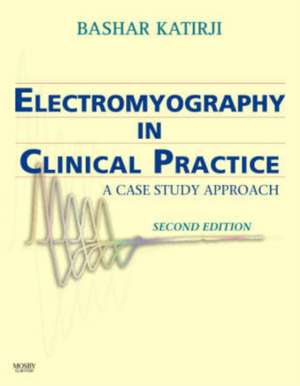
Electromyography in Clinical Practice: A Case Study Approach
Autor Bashar Katirjien Limba Engleză Hardback – 12 sep 2007
Veți descoperi în această lucrare un instrument pedagogic rafinat, conceput special pentru a reduce distanța dintre teoria aridă și realitatea complexă a laboratorului de electromiografie. Electromyography in Clinical Practice nu este doar un manual de referință, ci un ghid de rezolvare a problemelor clinice, structurat pentru a mima procesul decizional de la patul bolnavului. Observăm o organizare riguroasă în două părți: o introducere tehnică solidă în studiile de conducere nervoasă (NCS) și EMG-ul cu ac, urmată de o secțiune vastă de 36 de cazuri clinice. Acestea din urmă sunt clasificate meticulos, de la neuropatii ischemice și radiculopatii lombo-sacrate, până la afecțiuni complexe precum Myasthenia Gravis.
Pe același raft cu Electromyography and Neuromuscular Disorders de David C. Preston, lucrarea lui Bashar Katirji se distinge prin accentul pus pe analiza valorilor exacte obținute în timpul testării și prin modul în care ghidează cititorul spre un diagnostic diferențial logic. În timp ce alte tratate pot fi excesiv de teoretice, volumul de față prioritizează pragmatismul clinic. Reținem, de asemenea, continuitatea tematică în opera autorului; dacă în Neuromuscular and Electrodiagnostic Medicine Board Review acesta oferea o resursă esențială pentru examenele de specialitate, aici se concentrează pe rafinarea abilităților practice necesare în activitatea cotidiană.
Fiecare caz este prezentat printr-un format standardizat care include datele clinice, constatările electrodiagnostice detaliate și o discuție amplă asupra patologiei. Această a patra ediție, publicată sub egida Oxford University Press, rămâne o resursă indispensabilă pentru medicii neurologi și specialiștii în recuperare medicală care doresc să stăpânească nuanțele interpretării corecte a semnalelor neuromusculare.
Preț: 1000.31 lei
Preț vechi: 1052.96 lei
-5%
Carte tipărită la comandă
Livrare economică 03-17 decembrie
Specificații
ISBN-10: 0323028993
Pagini: 432
Ilustrații: Approx. 260 illustrations
Dimensiuni: 216 x 276 x 21 mm
Greutate: 1.19 kg
Ediția:First and 2006.
Editura: Elsevier
V-ar putea interesa
-
 A Video Atlas of Neuromuscular DisordersAziz Shaibani-21%Preț: 1200.09 lei1522.02 lei
 -
 -24%Preț: 1183.66 lei1559.44 lei
 -
 Oxford Handbook of CardiologyPunit RamrakhaPreț: 294.68 leiRecomandat
 -
 Oxford Handbook of NeurologyHadi ManjiPreț: 278.94 lei
 -
 Neurology SecretsEli M. Mizrahi-5%Preț: 334.13 lei351.71 lei
 -
 -30%Preț: 2683.59 lei3855.90 lei
 -
 -27%Preț: 1100.59 lei1508.23 lei
 -
 Neuromuscular and Electrodiagnostic Medicine Board ReviewThananan Thammongkolchai-28%Preț: 526.35 lei735.43 lei
 -
 -28%Preț: 403.22 lei559.76 lei
 -
 Aminoff's Diagnosis of Neuromuscular DisordersMichael J. Aminoff-28%Preț: 1024.23 lei1413.92 lei
 -
 Neuromuscular Case StudiesTulio E. Bertorini-28%Preț: 992.38 lei1385.82 lei
 -
 Essentials of Clinical NeurophysiologyKarl E. Misulis-28%Preț: 488.39 lei680.90 lei
 -
 Kumar and Clark's Clinical MedicineDavid Randall-26%Preț: 487.97 lei658.70 leiRecomandat
 -
 Evidence-Based NeurologyBart Demaerschalk-5%Preț: 902.63 lei950.14 lei
 -
 -21%Preț: 629.35 lei800.83 lei
 -
 100 Cases in Clinical MedicineEamon Shamil-5%Preț: 259.20 lei272.84 leiRecomandat
 -
 -38%Preț: 1050.86 lei1689.72 lei
 -
 Neuromuscular Ultrasound: Expert Consult - Online and PrintFrancis Walker-31%Preț: 707.86 lei1031.57 lei
 -
 -23%Preț: 1143.39 lei1482.64 lei
 -
 Motor DisordersDavid S. Younger-24%Preț: 938.92 lei1232.90 lei
 -
 Clinical Handbook of Neuromuscular MedicineDavid Walk-5%Preț: 934.85 lei984.06 lei
Public țintă
Neurologists, Physiatrists, Clinical Neurophysiologists, Physical Medicine and RehabilitationDe ce să citești această carte
Această carte este esențială pentru rezidenții și specialiștii în neurologie sau medicină fizică și recuperare care doresc să își perfecționeze tehnica de diagnostic. Prin cele 36 de studii de caz, cititorul câștigă experiență practică în interpretarea datelor NCS și EMG, învățând să formuleze diagnostice diferențiale precise. Este un ghid aplicat care transformă rezultatele de laborator în decizii clinice sigure.
Despre autor
Bashar Katirji este un expert de renume internațional în domeniul bolilor neuromusculare și al electrodiagnosticului. Activitatea sa academică și clinică este marcată de o contribuție vastă la literatura de specialitate, fiind autorul unor lucrări fundamentale precum Neuromuscular Disorders in Clinical Practice și Stiff-Person Syndrome and Related Disorders. Experiența sa în pregătirea medicilor pentru examenele de certificare, reflectată în ghidurile sale de „Board Review”, se traduce în acest volum printr-o claritate didactică excepțională, facilitând înțelegerea mecanismelor fiziopatologice complexe ale sistemului nervos periferic.
Descriere scurtă
Cuprins
Nerve Conduction Studies
Needle EMG Examination
Specialized Procedures
Overview of Electromyography Laboratory Procedures and Reporting
Case Studies
Focal Disorders
Case 1: Nerve Injury
Case 2: Ischemic Monomelic Neuropathy
Case 3: Tourniquet Paralysis
Focal Disorders of the Lower Extremity
Case 4: Lumbosacral Radiculopathy
Case 5: Sciatic Neuropathy
Case 6: Femoral Neuropathy
Case 7: Lumbosacral Plexopathy
Case 8: Tarsal Tunnel Syndrome
Case 9: Diabetic Amyotrophy
Case 10: Peroneal Neuropathy
Focal Disorders of the Upper Extremity
Case 11: Ulnar Neuropathy at the Wrist
Case 12: Axillary Neuropathy
Case 13: Cervical Radiculopathy
Case 14: Radial Neuropathy
Case 15: Thoracic Outlet Syndrome
Case 16: Carpal Tunnel Syndrome
Case 17: Ulnar Neuropathy at the Elbow
Case 18: Neuralgia Amyotrophy (Acute Brachial Plexitis)
Generalized Disorders
Case 19: Myasthenia Gravis
Case 20: Chronic Inflammatory Demyelinating Polyneuropathy
Case 21: Amyotrophic Lateral Sclerosis
Case 22: Diabetic Peripheral Polyneuropathy
Case 23: Polymyositis
Case 24: Mononeuropathy Multiplex
Case 25: Lambert-Eaton Syndrome
Case 26: Charcot-Marie-Tooth Disease
Case 27: Myotonic Dystrophy
Case 28: Dorsal Ganglionopathy (Sensory Neuronopathy)
Case 29: Guillian-Barre Syndrome
Case 30: Botulism
Case 31: Hereditary Neuropathy with Liability to Pressure Palsy
Case 32: Multifocal Motor Neuropathy
Descriere
Electromyography in Clinical Practice, now in its fourth edition, provides case-based learning of clinical Electromyography (EMG) with a main mission of reducing the gap between theory and practice in the fields of electrodiagnostic (EDX) and neuromuscular medicine. The book format includes four detailed introductory chapters that acquaint the discipline and scope of the EDX Examination. This includes chapters on nerve conduction studies (NCS), needle EMG, specialized EDX testing, and EDX findings in neuromuscular disorders. The second part of the book includes comprehensive presentations of 36 cases that encompass the most common disorders encountered in the EMG laboratory and are presented in a similar layout. These are classified into focal disorders of the lower and upper extremities, cranial nerve disorders and generalized neuromuscular disorders. The book focuses on problem solving through analysis of the data obtained on NCS and needle EMG. This is meant to mimic a bedside analysis of data, like what occurs regularly in the EMG laboratory. The exact values obtained on NCS and specialized tests, and findings on needle EMG are analysed in detail. A differential and final diagnoses are then made. This is followed by a comprehensive discussion of the clinical and EDX findings of the disorder.This text is an ideal book for physicians interested in learning and mastering the clinical practice of clinical EMG. This includes mostly specialists in the fields of neuromuscular medicine, neurology, and physical medicine and rehabilitation, but also include orthopedists, hand surgeons, neurosurgeons, spine surgeons, rheumatologist and pain management specialists.
Notă biografică
Recenzii
This third edition is unique, inclusive, and more representative of real cases that are encountered in daily practice, appealing to both budding and experienced electromyographer physicians. Most impressive is each case is approached and discusses in a motivating step by step format, that exactly resemble real life examples, in both academic and private practice. This is essential to the practice of electromyography.
Prof. Katirji has combined his unique combination of neuromuscular practice and electrophysiology in preparing a book with a case based approach. This is a treatise, would benefit both beginners and clinical neurologists. This comprehensive textbook could be an excellent teaching manual.
Electromyography in Clinical Practice is an easy and enjoyable read to the new or more experienced in the field. It can be used as a teaching or self-assessment tool and provides a quick reference and review to topics commonly seen in the neuromuscular and EMG practice. The book is a work of love, reflecting Dr. Katirjis passion in caring for his patients and teaching his students.
This book is a treasure trove of pearls and practical points. The emphasis of clinical correlation to EDX findings is invaluable. The case study format drives home the importance of the history and physical, and how it guides the EDX study to arrive at a logical conclusion. Electromyography in Clinical Practice is an outstanding text for the physician in training as well as the practicing physician.