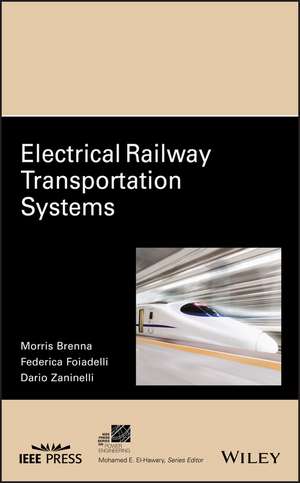
Electrical Railway Transportation Systems: IEEE Press Series on Power Engineering
Autor Morris Brenna, Federica Foiadelli, Dario Zaninellien Limba Engleză Hardback – 7 mar 2018
Diferența majoră dintre volumul Electrical Railway Transportation Systems și documentația tehnică standard rezidă în capacitatea autorilor Morris Brenna, Federica Foiadelli și Dario Zaninelli de a unifica perspectiva teoretică cu soluțiile realizabile în teren. Considerăm că această lucrare depășește simpla descriere a componentelor, oferind o analiză riguroasă a modului în care infrastructura fixă interacționează cu materialul rulant sub constrângeri diverse de alimentare și frecvență. Dacă Rail Transport—Systems Approach v-a oferit cadrul teoretic al managementului feroviar global, această carte oferă instrumentele practice necesare pentru proiectarea și operarea sistemelor de tracțiune. Găsim în paginile acestui tratat o documentare detaliată a sistemelor de curent continuu utilizate în transportul urban și suburban, dar și o explorare a sistemelor de curent alternativ pentru liniile de mare viteză. Un aspect distinctiv este atenția acordată interoperabilității; autorii explică soluțiile tehnice care permit vehiculelor să traverseze rețele cu standarde de electrificare diferite fără sincope operaționale. Structura narativă este una tehnică, progresivă, începând cu fundamentul istoric și evoluând spre probleme critice precum compatibilitatea electromagnetică și interferențele parazite. Publicată sub egida IEEE Press Series on Power Engineering, lucrarea analizează nu doar motoarele de tracțiune, ci și dispozitivele auxiliare și convertoarele de putere. Prin comparație cu Introduction to High-Speed Railway, care oferă o privire de ansamblu asupra infrastructurii, volumul de față plonjează în specificul ingineriei electrice, fiind un punct de referință pentru cei care gestionează complexitatea tehnică a transportului feroviar modern.


Preț: 859.66 lei
Preț vechi: 944.69 lei
-9%
Carte tipărită la comandă
Livrare economică 07-21 decembrie
Specificații
ISBN-10: 1119386802
Pagini: 624
Dimensiuni: 157 x 235 x 37 mm
Greutate: 1.04 kg
Editura: Wiley
Seriile IEEE Press Series on Power Engineering, Electrical Railway
Locul publicării:Hoboken, United States
V-ar putea interesa
-
 -9%Preț: 971.05 lei1067.09 lei
 -
 DCC for Railway ModellersFiona FortyPreț: 168.81 lei
 -
 Preț: 228.96 lei
 -
 Railway Safety Management: Systems, Practices, and Emerging TrendsKatarzyna Chruzik-15%Preț: 438.72 lei516.14 lei
 -
 -19%Preț: 501.18 lei618.74 lei
 -
 Electrical Machines, Drives and Power SystemsTheodore Wildi-11%Preț: 701.01 lei787.64 lei
 -
 Hughes Electrical and Electronic TechnologyEdward Hughes-9%Preț: 638.19 lei701.31 lei
 -
 -9%Preț: 563.36 lei619.07 lei
 -
 Electrical Power System EssentialsPieter Schavemaker-19%Preț: 601.23 lei742.26 lei
 -
 -19%Preț: 514.71 lei635.44 lei
 -
 Analysis of Electric Machinery and Drive SystemsPaul C Krause-23%Preț: 769.47 lei999.32 lei
 -
 -23%Preț: 1294.93 lei1681.72 lei
 -
 -26%Preț: 2304.02 lei3134.06 lei
 -
 Electronics and Wiring for Model RailwaysAndrew DuckworthPreț: 154.88 lei
 -
 abc Rail Guide 2023Pip DunnPreț: 196.49 lei
 -
 British Railways Diesel and Electric LocomotivesHugh LongworthPreț: 289.81 lei
 -
 Lines of PowerJohn BuxtonPreț: 232.09 lei
 -
 Fundamentals of Railway DesignMarco GuerrieriPreț: 489.63 lei
 -
 -18%Preț: 925.07 lei1128.14 lei
 -
 -18%Preț: 1158.65 lei1412.99 lei
Public țintă
Primary audience: graduate studentsSecondary audience: professionals and industry enthusiasts
De ce să citești această carte
Această carte este esențială pentru inginerii și studenții la master care doresc să stăpânească arhitectura sistemelor de tracțiune electrică. Veți câștiga o înțelegere profundă a modului în care sunt alimentate trenurile de mare viteză și metrourile, învățând totodată cum să rezolvați problemele de interoperabilitate și compatibilitate electromagnetică într-un sector tot mai orientat către sustenabilitate și eficiență energetică.
Descriere
Allows the reader to deepen their understanding of various technologies for both fixed power supply installations of railway systems and for railway rolling stock
This book explores the electric railway systems that play a crucial role in the mitigation of congestion and pollution caused by road traffic. It is divided into two parts: the first covering fixed power supply systems, and the second concerning the systems for railway rolling stock. In particular, after a historical introduction to the framework of technological solutions in current use, the authors investigate electrification systems for the power supply of rail vehicles, trams, and subways.
Electrical Railway Transportation Systems explores the direct current systems used throughout the world for urban and suburban transport, which are also used in various countries for regional transport. It provides a study of alternating current systems, whether for power supply frequency or for special railway frequency, that are used around the world for the electrification of railway lines, long-distance lines, and high-speed lines. In addition, this resource:
- Analyzes multiple railway systems from a theoretical and realizable vantage point, with particular regard to functionality, electromagnetic compatibility, and interferences with other electrical systems
- Studies electric traction railway vehicles, presenting various types of drives and auxiliary devices currently in circulation
- Discusses solutions employed to ensure interoperability of vehicles that run along lines powered by different systems (e.g., DC and AC, at different frequencies)
Electrical Railway Transportation Systems is an ideal text for graduate students studying the subject as well as for industry professionals working in the field.