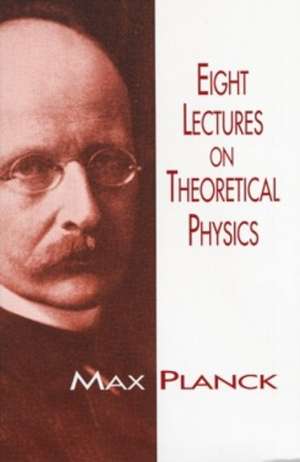
Eight Lectures on Theoretical Physics
Autor Max Plancken Limba Engleză Paperback – 18 iul 1997
The first, third, fifth, and sixth lectures present his account of the revolutionary developments occasioned when he first applied the quantum hypothesis to blackbody radiation. The reader is given a valuable opportunity to witness Planck's thought processes both on the level of philosophical principles as well as their application to physical processes on the microscopic and macroscopic scales.
In the second and fourth lectures Planck shows how the new ideas of statistical mechanics transformed the understanding of chemical physics. The seventh lecture discusses the principle of least action, while the final one gives an account of the theory of special relativity, of which Planck had been an early champion.
These lectures are especially important since they reflect Planck's reconsiderations and rethinking of his original discovery of quantum theory. A new Introduction by Peter Pesic places this book in historical perspective among Planck's works and those of his contemporaries. Now available in this inexpensive edition, it will be of particular interest to students of modern physics and of the philosophy and history of science."
Preț: 63.53 lei
Puncte Express: 95
Carte disponibilă
Livrare economică 29 octombrie-12 noiembrie
Livrare prin curier în România Termenul estimat este afișat lângă disponibilitate.
Transport gratuit de la 400.00 lei Plată online sau ramburs, în funcție de opțiunile comenzii.
Retur gratuit în 14 zile Comandă securizată și suport în română.
Specificații
ISBN-13: 9780486697307
ISBN-10: 0486697304
Pagini: 176
Dimensiuni: 136 x 215 x 9 mm
Greutate: 0.19 kg
Editura: Dover Publications
ISBN-10: 0486697304
Pagini: 176
Dimensiuni: 136 x 215 x 9 mm
Greutate: 0.19 kg
Editura: Dover Publications
V-ar putea interesa
-
 Quantum Theory at the CrossroadsGuido Bacciagaluppi-11%Preț: 615.03 lei691.04 lei
 -
 Simon Learns about EnergyAndrew KaczmarskiPreț: 115.73 lei
 -
 Physics with ExamplesMrs Serife SaricaPreț: 371.13 lei
 -
 Hidden in Plain Sight 4Dr Andrew H. ThomasPreț: 64.04 lei
 -
 Elementary Particle Physics for EnthusiastsYoshiki TeramotoPreț: 55.21 lei
 -
 Physics in a Nutshell - Companion for Success in Competitive TestsDr S. DevanarayananPreț: 161.35 lei
 -
 Hidden in Plain Sight 6Dr Andrew H. ThomasPreț: 64.41 lei
 -
 Even Mathematicians and Physicists Make MistakesDennis MorrisPreț: 123.57 lei
 -
 Ideas Relating to the SciencesVince FlyntPreț: 88.59 lei
 -
 Die strahlende EnergieCurt Heinke-23%Preț: 1167.28 lei1515.94 lei
 -
 -23%Preț: 1089.99 lei1415.57 lei
 -
 Preț: 400.69 lei
 -
 Neue Bahnen in der Lehre vom Verhalten der Niederen OrganismenFriedrich AlverdesPreț: 392.17 lei
 -
 Vorträge Reden ErinnerungenMax PlanckPreț: 276.92 lei
 -
 Preț: 414.75 lei
 -
 Preț: 404.41 lei
 -
 Preț: 407.91 lei
 -
 Mechanische SchwingungenJacob P. DenHartog-15%Preț: 458.96 lei539.96 lei
 -
 Lehrbuch der Physik: In Elementarer DarstellungArnold Berliner-15%Preț: 501.32 lei589.79 lei
 -
 Kurzes Lehrbuch der PhysikHerbert Arthur StuartPreț: 413.45 lei
 -
 Preț: 404.41 lei
 -
 Identification of MaterialsAnton A. Benedetti-PichlerPreț: 408.94 lei
 -
 Die letzten Räuberbanden in OberschwabenMax PlanckPreț: 215.23 lei
 -
 Preț: 380.08 lei
Descriere
Landmark lectures (1909) by Nobel Prize winner deal with application of quantum hypothesis to blackbody radiation, principle of least action, relativity theory, more. 1915 edition.
Notă biografică
"Max Karl Ernst Ludwig Planck ForMemRS (23 April 1858 - 4 October 1947) was a German theoretical physicist whose discovery of energy quanta won him the Nobel Prize in Physics in 1918.Planck made many substantial contributions to theoretical physics, but his fame as a physicist rests primarily on his role as the originator of quantum theory, which revolutionized human understanding of atomic and subatomic processes. In 1948, the German scientific institution Kaiser Wilhelm Society (of which Planck was twice president) was renamed Max Planck Society (MPG). The MPG now includes 83 institutions representing a wide range of scientific directions."