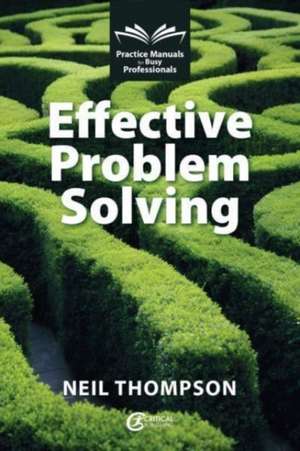
Effective Problem Solving: Practice Manuals for Busy Professionals
Autor Neil Thompsonen Limba Engleză Paperback – 3 oct 2024
Practitioners across the range of human services and managers in all sectors are constantly faced with problems of various kinds. Each of these is unique, however there will be general patterns that we can learn from. This book draws upon the author's extensive experience in teaching and training on problem-solving, providing students, practitioners and managers with a powerful repertoire of tools that can make a real difference in a wide range of situations.
This easy-to-read text incorporates new challenges in the modern workplace such as;
- Artificial Intelligence,
- increased job insecurity,
- neurodivergence in relation to problem-solving, and
- safeguarding our habitat.






Preț: 247.57 lei
Puncte Express: 371
Carte disponibilă
Livrare economică 30 octombrie-13 noiembrie
Livrare express 16-22 octombrie pentru 21.17 lei
Livrare prin curier în România Termenul estimat este afișat lângă disponibilitate.
Transport gratuit de la 400.00 lei Plată online sau ramburs, în funcție de opțiunile comenzii.
Retur gratuit în 14 zile Comandă securizată și suport în română.
Specificații
ISBN-13: 9781916925373
ISBN-10: 1916925375
Pagini: 244
Dimensiuni: 156 x 234 x 14 mm
Greutate: 0.26 kg
Ediția:2. Auflage
Editura: Taylor & Francis
Colecția Routledge
Seria Practice Manuals for Busy Professionals
Locul publicării:Oxford, United Kingdom
ISBN-10: 1916925375
Pagini: 244
Dimensiuni: 156 x 234 x 14 mm
Greutate: 0.26 kg
Ediția:2. Auflage
Editura: Taylor & Francis
Colecția Routledge
Seria Practice Manuals for Busy Professionals
Locul publicării:Oxford, United Kingdom
Public țintă
Professional Practice & DevelopmentCuprins
About the author Acknowledgements Preface Foreword Introduction: who, why, what and how Why a manual? How do I use it? PART 1: Understanding people and their problems 1. Introduction 2. What is a problem? 3. What is a ‘people’ problem? 4. Why is the context important? 5. How do we start? 6. How do we get people motivated? 7. How do we find the right way forward? 8. How do we promote change? 9. Why do we need PRECISE practice? 10. What are the challenges involved? 11. Is there a problem-solving process? 12. Is a problem always an opportunity? 13. What is the role of reflective practice? 14. How do we make things happen? 15. Conclusion PART 2: Problem-solving methods Introduction Important notes A Active listening
- 16. Show that you are paying attention 17. Avoiding attribution errors 18. Avoiding oversimplifying the reasons for people’s behaviour 19. Avoiding avoidance 20. Facing up to our responsibilities
- 21. Maximising our range of options 22. Brokerage 23. Redirecting people to sources of help
- 24. Realizing the potential of critical moments in a person’s life 25. The CBC approach - Putting people at their ease 26. Challenging cognitive distortions - Trying to get a balanced view of the situation 27. Chunk up or chunk down - Finding the right level of analysis 28. The CIA framework - Managing pressure and stress 29. Circular questioning - Establishing the importance of interrelationships 30. Confronting without being confrontational - Using assertiveness skills 31. Congruence -Getting on the same wavelength 32. Consequences - Exploring options and their likely outcomes 33. Cost-benefit analysis - Balancing the pros and cons 34. Creative tension - Making sure expectations are realistic 35. Critical incident technique - Learning from significant experiences 36. Culture audit -Making sense of organizational cultures
- 37. Persuading people to move forward 38. Developing a checklist Save time and efforts with checklists 39. Doing the right things versus doing things right Balancing efficiency and effectiveness 40. The drama triangle Avoiding being drawn into being a ‘rescuer’
- 41. Being realistic about what we can achieve 42. Eco maps - Mapping out relationships across groups of people 43. Educating - Problem solving through helping people learn 44. Elegant challenging - Being constructive in challenging unacceptable behaviour or language 45. Embedded whys - Establishing reasons for our actions 46. The empty chair - Exploring the influence of an absent person 47. Encouraging creativity - Avoiding getting stuck in ruts 48. Exchange is no robbery - The importance of reciprocity
- 49. Anticipating failure and learning from it 50. Finding the growth zone Finding the balance between comfort and fear 51. Fishbone analysis A visual aid to problem solving 52. Fishing for red herrings Not allowing ourselves to get distracted 53. Force-field analysis Managing change 54. FORM good habits Use habits to gain greater control
- 55. GIVE UP How to let go of negativity 56. Giving feedback Letting people know where they stand 57. Grief audit Getting an overview of people’s experiences of grief
- 58. Obtaining an overview 59. Holding Helping to provide emotional security
- 60. Getting a perspective from outside the situation you are dealing with
- 61. Coping with anxiety
- 62. Finding new ways to think about problems and solutions
- 63. Getting as close to the ideal as possible 64. Making the most of meetings - Avoiding time and energy being wasted 65. Mind mapping - Developing a picture of the situation you are dealing with 66. Mitigate the effects - Minimize the effects 67. Modelling and use of self - Using yourself as a tool to help others 68. Motivational interviewing - Using ambivalence to bring about change 69. Motivation audit - Getting an overview of key motivational factors
- 70. Bringing hidden agendas out into the open 71. Negotiating expectations Being clear about what we can expect from each other 72. Not tolerating vagueness Avoiding the dangers of being too vague
- 73. A framework for helping to develop plans
- 74. Making a fresh start 75. The paradoxical approach - Reducing behaviours by encouraging them 76. PCS analysis - Understanding different levels of discrimination 77. Peacemaking circles -Drawing on Native American wisdom 78. PEARLS - Building relationships 79. Positive strokes Building confidence 80. Principled negotiation - Constructive ways of reaching agreement 81. Promoting realism - Getting a balance between optimism and pessimism 82. Providing an anchor - Providing security in times of instability 83. Pushing the buttons - Acting as an advocate
- 84. Allowing situations to resolve themselves 85. RAID - Reducing problematic behaviours 86. REBT - Understanding anger 87. Recognising grief - Appreciating the significance of loss and grief 88. The RED approach - Managing conflict 89. Reframing - Redefining problem situations to allow people to move forward 90. Releasing the scapegoat - Avoiding the destructiveness of blame 91. Responding to feelings - Taking account of the emotional dimension 92. Revisiting assumptions - Questioning the premises 93. The right person for the job - Matching skills and aptitudes to tasks 94. Risk assessment - Analysing the risks involved in a given situation 95. Role reversal - Seeing the situation from someone else’s point of view
- 96. Coping with emotional intensity 97. Serendipity - Making the most of chance occurrences 98. The six thinking hats - Looking at the different angles 99. SMART objectives - The importance of having clear goals 100. SOLER - Managing interpersonal relations 101. Start – Stop – Continue - Optimising a situation 102. Stop trying! Taking a break from our efforts can sometimes be helpful 103. Storytelling - Using stories to gain fresh insight 104. Stress audit Getting an overview of pressures, coping methods and support 105. SWOT analysis - Balancing positives and negatives as an aid to decision making
- 106. Taking account of the three dimensions of human experience 107. The three Hs - Understanding what motivates people’s behaviour 108. The three Rs - Drawing on strengths 109. TOTE - Testing out the changes we make 110. Transactional analysis - Understanding interpersonal dynamics 111. Tuning in - Making connections with the people we are trying to help 112. Typology of objectives - Prioritising what you are trying to achieve
- 113. The importance of supportive reminders 114. Using dissonance - Challenging ingrained views 115. Using personal constructs - Developing our own theories
- 116. Developing a vision of the place we want to get to
- 117. Keeping a clear focus on outcomes 118. Worst case, best case
Notă biografică
Neil Thompson is an independent writer, producer of online learning resources and a visiting professor at the Open University. His approach is based on the three Ps: where there are People, there will be Problems, but there will also be Potential. He has decades of experience helping individuals and organisations to address the problems and fulfil the potential.
He is renowned for his ability to express complex ideas clearly and accessibly without oversimplifying them and to successfully blend theory and practice. In a long career, he has provided training or consultancy services to over 100 organisations, spoken at conferences and seminars in 13 different countries and has won awards for the quality and impact of his work. He has held full or honorary professorships at five UK universities, but for many years now he has focused on reaching a much wider audience to help make a positive difference. He has earned the trust to be a helpful guide and mentor through his writings and online learning and you will no doubt soon see why when you start reading this book. His Academy website, with his Manifesto for Making a Difference, is at www.NeilThompson.info.
He is renowned for his ability to express complex ideas clearly and accessibly without oversimplifying them and to successfully blend theory and practice. In a long career, he has provided training or consultancy services to over 100 organisations, spoken at conferences and seminars in 13 different countries and has won awards for the quality and impact of his work. He has held full or honorary professorships at five UK universities, but for many years now he has focused on reaching a much wider audience to help make a positive difference. He has earned the trust to be a helpful guide and mentor through his writings and online learning and you will no doubt soon see why when you start reading this book. His Academy website, with his Manifesto for Making a Difference, is at www.NeilThompson.info.
Descriere
A bumper book of powerful problem-solving tools and techniques presented clearly and concisely by a highly respected author.