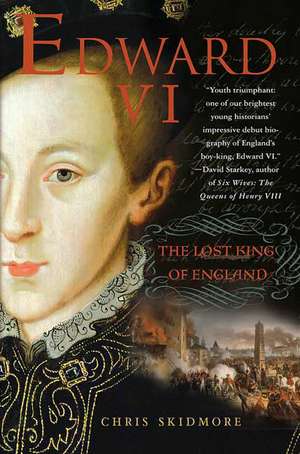
Edward VI
Autor Chris Skidmoreen Limba Engleză Paperback – 14 apr 2009
Chris Skidmore describes how, in the six years of Edward's reign, court intrigue, deceit, and treason very nearly plunged the country into civil war while the stability that the Tudors had sought to achieve came close to being torn apart. Even today, Henry VIII and Elizabeth I are considered the two dominant figures of the Tudor period. But Edward's reign is equally important. It was one of dramatic change and tumult whose impact is still felt today certainly in terms of his religious reformation, which not only exceeded Henry's ambitions but has endured for over four centuries since Edward's death in 1553."
Preț: 142.37 lei
Puncte Express: 214
Carte disponibilă
Livrare economică 17 noiembrie-01 decembrie
Livrare prin curier în România Termenul estimat este afișat lângă disponibilitate.
Transport gratuit de la 400.00 lei Plată online sau ramburs, în funcție de opțiunile comenzii.
Retur gratuit în 14 zile Comandă securizată și suport în română.
Specificații
ISBN-13: 9780312538934
ISBN-10: 0312538936
Pagini: 386
Dimensiuni: 152 x 229 x 23 mm
Greutate: 0.63 kg
Editura: St. Martins Press-3pl
ISBN-10: 0312538936
Pagini: 386
Dimensiuni: 152 x 229 x 23 mm
Greutate: 0.63 kg
Editura: St. Martins Press-3pl
V-ar putea interesa
-
 Britain After RomeRobin Fleming-29%Preț: 77.10 lei108.19 lei
 -
 The Kings & Queens of EnglandNicholas Best-27%Preț: 46.81 lei64.14 lei
 -
 Catherine of AragonGiles TremlettPreț: 109.06 lei
 -
 The Great FilthStephen Halliday-6%Preț: 136.39 lei144.42 lei
 -
 The Tribes of BritainDavid Miles-24%Preț: 84.02 lei109.99 lei
 -
 The Age of ShakespeareSir Frank Kermode-28%Preț: 65.85 lei91.12 lei
 -
 -25%Preț: 71.11 lei94.33 lei
 -
 Bosworth: The Birth of the TudorsChris Skidmore-24%Preț: 82.38 lei109.04 lei
 -
 -28%Preț: 65.93 lei91.01 lei
 -
 The Six Wives Of Henry VIIILady Antonia Fraser-26%Preț: 90.27 lei121.45 lei
 -
 Dr Johnson's LondonLiza Picard-25%Preț: 70.40 lei93.91 lei
 -
 Restoration London: Everyday Life in the 1660sLiza Picard-25%Preț: 69.97 lei93.66 lei
 -
 When I Was a NipperAlan Titchmarsh-39%Preț: 84.90 lei139.65 lei
Descriere
Descriere de la o altă ediție sau format:
The struggle for the soul of England after the death of Henry VIII
In the death of Henry VIII, the crown passed to his nine-year-old son, Edward. However, real power went to the Protector, Edward's uncle, the Duke of Somerset. The court had been a hotbed of intrigue since the last days of Henry VIII. Without an adult monarch, the stakes were even higher. The first challenger was the duke's own brother: he seduced Henry VIII's former queen, Katherine Parr; having married her, he pursued Princess Elizabeth and later was accused of trying to kidnap the boy king at gunpoint. He was beheaded. Somerset ultimately met the same fate, after a coup d'etat organized by the Duke of Warwick. Chris Skidmore reveals how the countrywide rebellions of 1549 were orchestrated by the plotters at court and were all connected to the (literally) burning issue of religion: Henry VIII had left England in religious limbo. Court intrigue, deceit and treason very nearly plunged the country into civil war.
Edward was a precocious child, as his letters in French and Latin demonstrate. He kept a secret diary, written partly in Greek, which few of his courtiers could read. In 1551, at the age of 14, he took part in his first jousting tournament, an essential demonstration of physical prowess in a very physical age. Within a year it is his signature we find at the bottom of the Council minutes, yet in early 1553 he contracted a chest infection and later died, rumours circulating that he might have been poisoned. Mary, Edward's eldest sister, and devoted Catholic, was proclaimed Queen.
This is more than just a story of bloodthirsty power struggles, but how the Church moved so far along Protestant lines that Mary would be unable to turn the clock back. It is also the story of a boy born to absolute power, whose own writings and letters offer a compelling picture of a life full of promise, but tragically cut short.
The struggle for the soul of England after the death of Henry VIII
In the death of Henry VIII, the crown passed to his nine-year-old son, Edward. However, real power went to the Protector, Edward's uncle, the Duke of Somerset. The court had been a hotbed of intrigue since the last days of Henry VIII. Without an adult monarch, the stakes were even higher. The first challenger was the duke's own brother: he seduced Henry VIII's former queen, Katherine Parr; having married her, he pursued Princess Elizabeth and later was accused of trying to kidnap the boy king at gunpoint. He was beheaded. Somerset ultimately met the same fate, after a coup d'etat organized by the Duke of Warwick. Chris Skidmore reveals how the countrywide rebellions of 1549 were orchestrated by the plotters at court and were all connected to the (literally) burning issue of religion: Henry VIII had left England in religious limbo. Court intrigue, deceit and treason very nearly plunged the country into civil war.
Edward was a precocious child, as his letters in French and Latin demonstrate. He kept a secret diary, written partly in Greek, which few of his courtiers could read. In 1551, at the age of 14, he took part in his first jousting tournament, an essential demonstration of physical prowess in a very physical age. Within a year it is his signature we find at the bottom of the Council minutes, yet in early 1553 he contracted a chest infection and later died, rumours circulating that he might have been poisoned. Mary, Edward's eldest sister, and devoted Catholic, was proclaimed Queen.
This is more than just a story of bloodthirsty power struggles, but how the Church moved so far along Protestant lines that Mary would be unable to turn the clock back. It is also the story of a boy born to absolute power, whose own writings and letters offer a compelling picture of a life full of promise, but tragically cut short.