
Edward the Second
Autor Christopher Marloween Limba Engleză Paperback
Preț: 65.41 lei
Puncte Express: 98
Carte disponibilă
Livrare economică 09-23 noiembrie
Livrare prin curier în România Termenul estimat este afișat lângă disponibilitate.
Transport gratuit de la 400.00 lei Plată online sau ramburs, în funcție de opțiunile comenzii.
Retur gratuit în 14 zile Comandă securizată și suport în română.
Specificații
ISBN-13: 9781494761790
ISBN-10: 1494761793
Pagini: 100
Dimensiuni: 189 x 246 x 5 mm
Greutate: 0.2 kg
Editura: CREATESPACE
ISBN-10: 1494761793
Pagini: 100
Dimensiuni: 189 x 246 x 5 mm
Greutate: 0.2 kg
Editura: CREATESPACE
V-ar putea interesa
-
 The Greatest TraitorIan Mortimer-18%Preț: 76.75 lei93.94 lei
 -
 The Complete PlaysChristopher Marlowe-26%Preț: 81.46 lei110.60 lei
 -
 King Henry VIII; or All is True: The New Oxford ShakespeareWilliam Shakespeare-19%Preț: 46.70 lei57.46 lei
 -
 William Shakespeare: The Complete WorksWilliam Shakespeare-9%Preț: 163.69 lei178.94 lei
 -
 -16%Preț: 68.98 lei81.85 lei
 -
 Doctor FaustusChristopher MarlowePreț: 45.52 lei
 -
 NCSWilliam ShakespearePreț: 77.73 lei
 -
 Preț: 60.98 lei
 -
 -14%Preț: 81.70 lei94.96 lei
 -
 Edward IIKathryn WarnerPreț: 94.23 lei
 -
 Edward II RevisedMartin Wiggins-18%Preț: 73.64 lei90.19 lei
 -
 The Changeling: Revised EditionThomas Middleton-18%Preț: 72.72 lei89.10 lei
 -
 King Henry VIIIWilliam ShakespearePreț: 42.04 lei
 -
 King Richard IIWilliam ShakespearePreț: 38.30 lei
 -
 Sir Thomas MoreWilliam ShakespearePreț: 91.61 lei
 -
 King JohnWilliam ShakespearePreț: 37.70 lei
 -
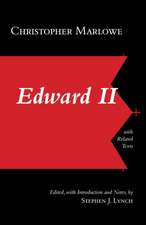 Edward II: With Related TextsChristopher Marlowe-18%Preț: 100.07 lei121.63 lei
 -
 Preț: 72.83 lei
 -
 The Country WifeWilliam Wycherley-35%Preț: 62.69 lei96.40 lei
Recenzii
Depicting with shocking openness the sexual and political violence of its central characters’ fates, Edward the Second broke new dramatic ground in English theatre. The play charts the tragic rise and fall of the medieval English monarch Edward the Second, his favourite Piers Gaveston, and their ambitious opponents Queen Isabella and Mortimer Jr., and is an important cultural, as well as dramatic, document of the early modern period.
This modernized and fully annotated Broadview Edition is prefaced by a critical but student-oriented introduction and followed by ample appendix material, including extended selections from Marlowe’s historical sources, texts bearing on the play’s complex sexual and political dynamics, and excerpts from contemporary poet Michael Drayton’s epic rendition of Edward the Second’s reign.
“This is a first-rate edition of an increasingly important play. Mathew Martin’s editing of the quarto text of Edward the Second is detailed and thoughtful, with copious, insightful annotations, and his critical introduction lucidly explores the play’s theatrical contexts, historiographical concerns, and thematic imperatives. The extensive appendices that conclude the volume are invaluable for understanding the larger historical, political, and sexual contexts of the work. All in all, this is an edition that will greatly benefit both the student reader and the experienced scholar.” — Ian Munro, University of California, Irvine
“Mathew Martin’s new edition of Edward the Second will serve well the needs of students. The introduction contains a succinct and helpful summary of the pertinent aspects of Marlowe’s life and of the practical concerns of the Elizabethan stage, details the reign of the historical Edward II, and considers early modern and postmodern evaluations of “sodomitical” relationships. Appendices offer important cultural contexts, including passages from Marlowe’s historical sources in Holinshed and Stow, Michael Drayton’s very different poetic account of Edward’s reign, a selection of early modern versions of the tradition of amity (or friendship between men), and Renaissance legal and moral descriptions of sodomy.” — Ian McAdam, University of Lethbridge
This modernized and fully annotated Broadview Edition is prefaced by a critical but student-oriented introduction and followed by ample appendix material, including extended selections from Marlowe’s historical sources, texts bearing on the play’s complex sexual and political dynamics, and excerpts from contemporary poet Michael Drayton’s epic rendition of Edward the Second’s reign.
“This is a first-rate edition of an increasingly important play. Mathew Martin’s editing of the quarto text of Edward the Second is detailed and thoughtful, with copious, insightful annotations, and his critical introduction lucidly explores the play’s theatrical contexts, historiographical concerns, and thematic imperatives. The extensive appendices that conclude the volume are invaluable for understanding the larger historical, political, and sexual contexts of the work. All in all, this is an edition that will greatly benefit both the student reader and the experienced scholar.” — Ian Munro, University of California, Irvine
“Mathew Martin’s new edition of Edward the Second will serve well the needs of students. The introduction contains a succinct and helpful summary of the pertinent aspects of Marlowe’s life and of the practical concerns of the Elizabethan stage, details the reign of the historical Edward II, and considers early modern and postmodern evaluations of “sodomitical” relationships. Appendices offer important cultural contexts, including passages from Marlowe’s historical sources in Holinshed and Stow, Michael Drayton’s very different poetic account of Edward’s reign, a selection of early modern versions of the tradition of amity (or friendship between men), and Renaissance legal and moral descriptions of sodomy.” — Ian McAdam, University of Lethbridge
Descriere
Descriere de la o altă ediție sau format:
Depicting with shocking openness the sexual and political violence of its central characters’ fates, Edward the Second broke new dramatic ground in English theatre. The play charts the tragic rise and fall of the medieval English monarch Edward the Second, his favourite Piers Gaveston, and their ambitious opponents Queen Isabella and Mortimer Jr., and is an important cultural, as well as dramatic, document of the early modern period.
This modernized and fully annotated Broadview Edition is prefaced by a critical but student-oriented introduction and followed by ample appendix material, including extended selections from Marlowe’s historical sources, texts bearing on the play’s complex sexual and political dynamics, and excerpts from contemporary poet Michael Drayton’s epic rendition of Edward the Second’s reign.
Depicting with shocking openness the sexual and political violence of its central characters’ fates, Edward the Second broke new dramatic ground in English theatre. The play charts the tragic rise and fall of the medieval English monarch Edward the Second, his favourite Piers Gaveston, and their ambitious opponents Queen Isabella and Mortimer Jr., and is an important cultural, as well as dramatic, document of the early modern period.
This modernized and fully annotated Broadview Edition is prefaced by a critical but student-oriented introduction and followed by ample appendix material, including extended selections from Marlowe’s historical sources, texts bearing on the play’s complex sexual and political dynamics, and excerpts from contemporary poet Michael Drayton’s epic rendition of Edward the Second’s reign.
Cuprins
Acknowledgements
Introduction
Christopher Marlowe: A Brief Chronology of His Life and Times
A Note on the Text
Edward the Second
Appendix A: Marlowe’s Historical Sources
Appendix C: The Diana-Actæon Myth
Introduction
Christopher Marlowe: A Brief Chronology of His Life and Times
A Note on the Text
Edward the Second
Appendix A: Marlowe’s Historical Sources
- From Raphael Holinshed, The Third Volume of Chronicles of England, Scotland, and Ireland (1587)
- From John Stow, The Annals of England (1592)
Appendix C: The Diana-Actæon Myth
- From Arthur Golding, The XV Books of P. Ovidius Naso (1567)
- Sonnet V of Samuel Daniel’s Sonnet Sequence Delia (1592)
- Thomas Elyot, “The True Description of Amity or Friendship” (1580)
- From Francis Bacon, “Of Friendship” (1625)
- From Richard Barnfield, “The Tears of an Affectionate Shepherd Sick for Love or The Complaint of Daphnis for the Love of Ganymede” (1594)
- “An Act for the Punishment of the Vice of Buggerie” (1587)
- Edward Coke, “Of Buggery, or Sodomy” (1644)
- From Philip Stubbes, The Anatomy of Abuses (1583)
- From Thomas Beard, The Theatre of God’s Judgements (1597)
- From An Homily against Disobedience and Wilful Rebellion (1570)
- From Hugh Languet, Vindiciae contra Tyrannos: A Defence of Liberty against Tyrants (1648)
- From James I of England and VI of Scotland, The True Law of Free Monarchies (1603)
Notă biografică
English playwright, poet, and translator Christopher Marlowe (1564-1593) lived during the Elizabethan period. He was educated at the King's School and afterwards Cambridge University after being born in Canterbury, England. His plays, such as "Tamburlaine the Great," "Doctor Faustus," "The Jew of Malta," and "Edward II," were well-known and ground-breaking at the time they were written. Marlowe's writings often dealt with themes of power, politics, and religion. His literary style was distinguished by his use of blank verse. Marlowe mysteriously passed away at the age of 29 during a scuffle at a London pub in Deptford. Despite having a brief life and career, he made a big contribution to the growth of drama and English literature.